
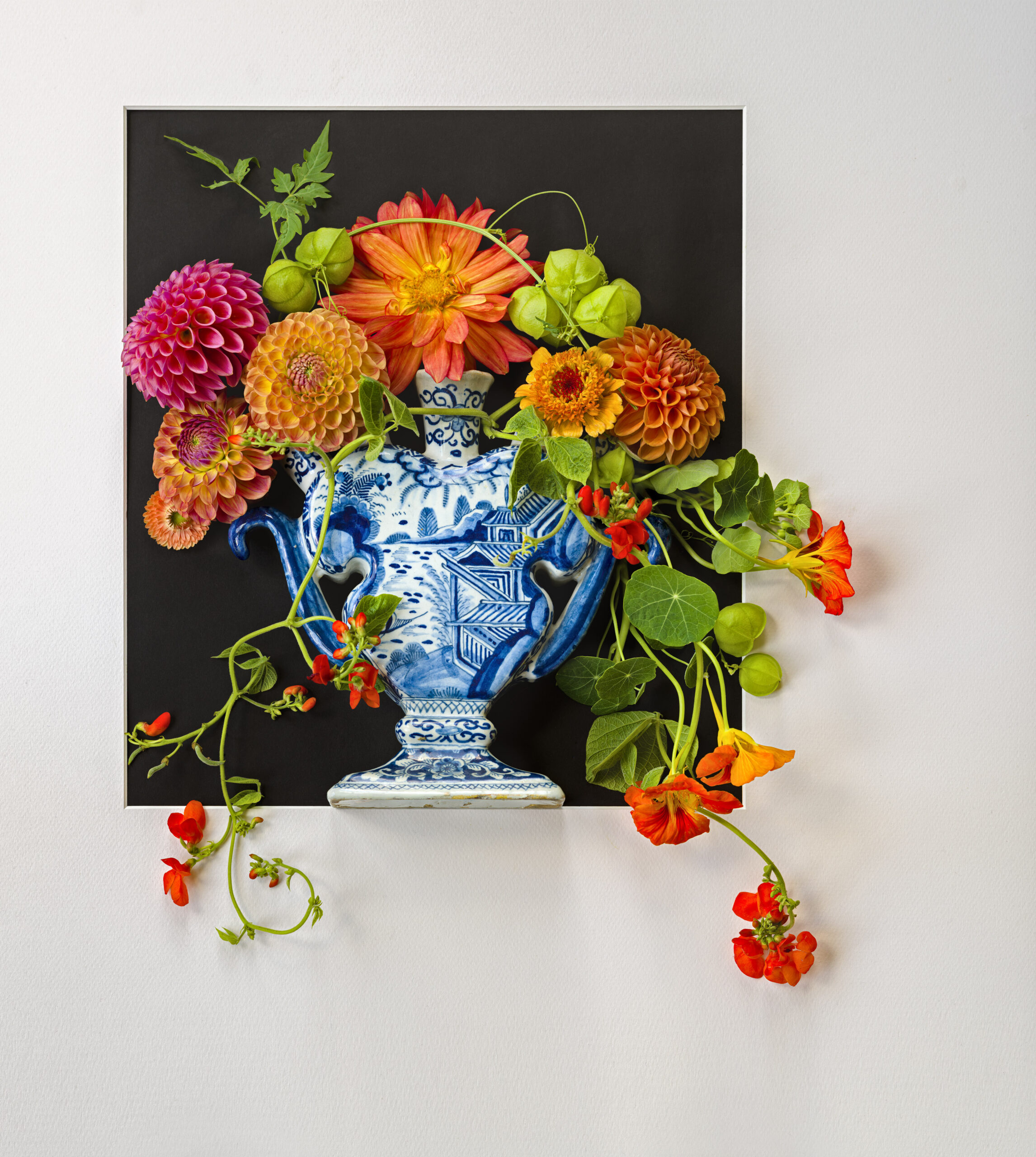
The fan-shaped flower holder: form, function and international origins
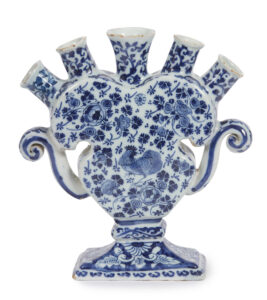
Main image by Marie Louise Photography. Blue and White Flower Vase, marked CK for Cornelis Koppens, owner of De Metaale Pot (The Metal Pot) factory from 1724 to 1757, Delft, circa 1730, Aronson Collection (inv. no. D2211)
Delft flower vases with multiple spouts have been admired since their earliest production in the last quarter of the seventeenth century. Among the many forms developed in Delft potteries, the fan-shaped flower holder stands out as one of the most distinctive and enduring types. Although it belongs to the broader Delft tradition of vessels designed to separate and support individual flower stems, its flat back, radiating top, and relatively modest scale define it as a clearly recognizable and distinctive group. This article explores the origins and context of this elegant flower holder.
From Egytptian and Middle Eastern prototypes to European adaptations
Delft flower holders with spouts should be understood as the result of a gradual evolution rather than a sudden invention. The basic principle of arranging flowers individually in tubular openings likely originates in ancient Egypt. Wall paintings from the tombs at the Egyptian archaeological site of Beni Hasan, dating to around 2500 BC, depict vases with spouts specifically designed to support the heavy-headed lotus flower. The lotus held profound symbolic significance in Egyptian culture, associated with rebirth and eternal life.
In the ancient world more broadly, flowers primarily served religious, symbolic, and ceremonial purposes. In Greek and Roman cultures, they were present in and around the home, but mainly in ritual contexts, such as domestic altars, banquets, and festive occasions, rather than as permanent elements of interior decoration. This long-standing association between flowers, symbolism, and controlled display forms an important conceptual backdrop for the later development of specialized flower-holding vessels.
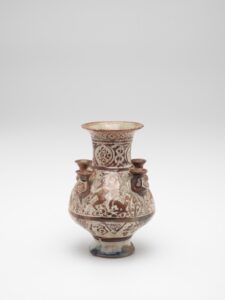
Much later in history, further examples of spouted vases appear in the Middle East. As early as the Seljuk and early Ilkhanid periods in Iran (eleventh to fourteenth centuries), potters produced small stonepaste vessels with a central neck surrounded by short tubular spouts (fig. 1). These compact objects already embodied the essential idea later refined in Delft: a shared water reservoir combined with separate supports for individual stems.
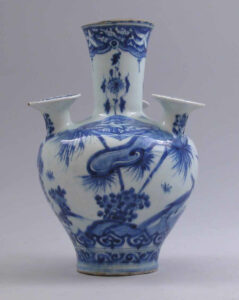
During the Safavid period and within the wider Ottoman floral culture of the sixteenth and seventeenth centuries, this principle was developed into larger and more luxurious flower holders (fig. 2). These objects formed part of a broader courtly culture in which flowers, including tulips, played a highly symbolic role. Through trade routes, and earlier through crusader contact, Middle Eastern arts exerted a sustained influence on European material culture.
By the early seventeenth century, these long-standing traditions of symbolic flower display increasingly intersected with new European ideas about gardening, order, and visual control, expanding the role of flowers from primarily symbolic markers to carefully staged objects of aesthetic display.
Gardening manuals and botanical treatises began to conceptualize flowers not only as living plants rooted in the soil, but also as carefully arranged objects of display. In this intellectual climate, Giovanni Battista Ferrari’s De Florum Cultura (1633) famously described vases as “portable gardens,” emphasizing their role as instruments through which nature could be shaped, ordered, and admired indoors. The publication illustrates several vase designs in which individual flower stems are supported by separate, clearly defined openings, reinforcing Ferrari’s notion of the vase as a “portable garden” and anticipating the development of multi-spouted flower holders (fig 3). This notion provides an important conceptual bridge between earlier symbolic flower vessels and the emerging European interest in complex, multi-spouted flower holders.
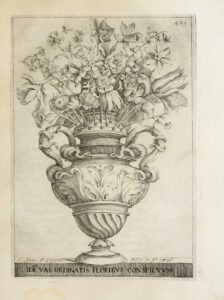
1638, p. 421 (first edition dates from 1633)
Across Europe, related ceramic “portable garden” solutions emerged both before and alongside the Delft examples. The earliest European multi-spouted vases appeared in late sixteenth-century Italy (fig. 4). In their overall profile and controlled distribution of stems, this Italian model comes close to the later Delft fan-shaped type. By the late seventeenth century, additional forms were produced in Savona, Italy and earlier in the seventeenth century in France, faience workshops in Nevers developed gondola- or navette-shaped flower holders fitted with multiple nozzles (fig. 5). Although often regarded as autonomous inventions, these Nevers vessels show clear conceptual affinities with Middle Eastern models, reinforced by their frequent decoration with floral motifs derived from Iznik pottery.
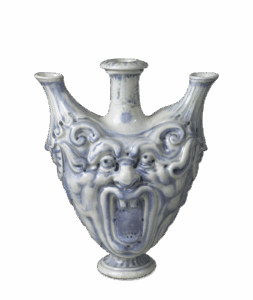
Delft potters operated within a dense network of international contacts. Their connections to Nevers and Italian ceramic centers probably formed one channel of influence, but direct exposure to Middle Eastern objects through the Levant trade must also be considered. This seventeenth-century commercial system linked the Dutch Republic with Ottoman ports such as Smyrna, Aleppo, and Constantinople, facilitating not only the exchange of goods but also the circulation of visual ideas and aesthetic preferences.
One of the most visible outcomes of this exchange was the introduction of the tulip to the Netherlands. By the early seventeenth century, tulips had become high-status luxury plants, culminating in the well-known tulip mania of 1636–1637. Although this predates the emergence of Delft flower holders by several decades, it established a cultural climate in which elaborate flower display had strong appeal. From around 1900 onward, multi-spouted Delft vases even came to be called “tulip vases,” a term that is evocative but historically inaccurate. These vessels were intended for a variety of flowers, including tulips, often combined into carefully orchestrated bouquets.
The emergence of the fan-shaped flower holder in Delft
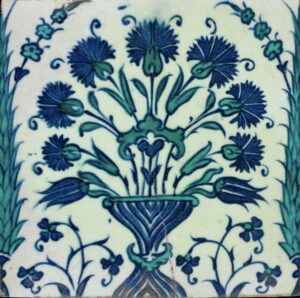
In sixteenth- and seventeenth-century Ottoman decorative arts, floral motifs were embedded within a symbolic framework reflecting cosmic harmony and cultural meanings. Ottoman art routinely incorporated highly stylized plant forms, tulips, carnations, hyacinths, and roses, arranged in rhythmic, symmetrical compositions that emphasize balance and order, a principle linked in Islamic aesthetic theory to the notion of cosmic equilibrium (mizan). Symmetrical floral arrays on Iznik ceramics, for example, have been interpreted as visual expressions of these ideals, with rotational symmetry and radiating forms evoking spiritual and cosmic balance (fig. 5). Stylized motifs such as carnations often appear in fan-like configurations, particularly in textiles and ceramics of the classical period, associated with elegance and refinement in courtly contexts. While the fan-shape should not be understood as a literal symbol, these forms reflect a visual language of ordered, controlled display, which resonates with the later development of Delft’s fan-shaped flower holders, translating two-dimensional compositional logic into three-dimensional ceramic design.
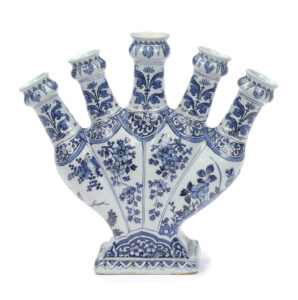
The fan-shaped flower holder belongs to the earliest group of spouted vases produced in Delft. The first examples, dating from the 1680s, were so-called quintel vases, featuring a single fan-like row of five spouts designed to support individual flower stems. (fig. 6). Constructed from multiple small tubes joined together, it allowed individual stems to be arranged into a structured, frontal bouquet. Archaeological evidence connects this form to royal contexts: Fragments of two fan-shaped flower holders bearing the mark of Samuel van Eenhoorn, owner of the Grieksche A factory between 1678 and 1687, were found in the gardens of Paleis Het Loo, the residence of King William III (1650–1702) and Queen Mary II (1662–1694). These pieces likely correspond to the “flat flower bottles” recorded in a 1713 inventory of the royal collection, indicating both their prestige and their functional differentiation.
What distinguishes the Delft fan-shaped type from its international predecessors is not the basic idea of spouts, but its geometry. The flat reverse indicates that these vases were intended to be placed against a vertical surface, such as a wall, chimney breast, or within a niche or overmantel, rather than viewed in the round. The radiating top transforms the bouquet into a frontal, carefully staged display, emphasizing symmetry and visual control. Rather than imitating a single foreign prototype, Delft potters appear to have assembled several narrow vase units into a unified silhouette, thereby creating a new visual logic for floral presentation suited to specific interior contexts.
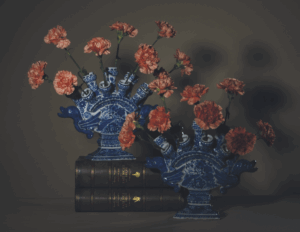
Alongside a wide range of spouted vase types produced in Delf, including bowl-shaped vessels with covers, round and polygonal vases, and obelisk-shaped pyramidal forms, fan-shaped flower holders themselves evolved into a variety of nuanced designs. Delft potters developed increasingly elaborate fan-shaped models with multiple tiers of spouts, as seen in the blue-and-white pair dating to around 1710, which combine an oval water reservoir with a second row of four spouts along the front edge (fig. 7).
. In addition to these developments, Delft potters also produced heart-shaped flower vases derived from the quintel form, characterized by a flattened silhouette and five spouts (fig. 8 2539). Common in the early eighteenth century, these models illustrate how potters adapted the basic multi-spouted concept into distinct silhouettes that responded to changing decorative tastes and specific spatial contexts.
Conclusion
The Delft fan-shaped flower holder is best understood as the product of a layered and international genealogy. While its fundamental concept derives from Middle Eastern models and related European developments in Italy and Nevers, Delft potters did not simply copy these sources. Instead, they reconfigured them, introducing a distinctive fan-shape that transformed the bouquet into an ordered, almost theatrical display. This form may reflect Middle Eastern visual traditions, transmitted through trade and filtered through Dutch taste. In doing so, Delft potters transformed international influences into an object that is unmistakably Dutch, exemplifying Delftware at its most imaginative.
Notes
- Julia Berrall, “Floral Decoration: Historical and Stylistic Developments,” Encyclopaedia Britannica (online), https://www.britannica.com/art/floral-decoration/Historical-and-stylistic-developments
- Ronald Brouwer, “Turkish Tulips and Delft Flowerpots,” in The Tulip: A Symbol of Two Nations (Utrecht/Istanbul, 1993), p. 26
- M.S. van Aken-Fehmers, Delfts aardewerk. Geschiedenis van een nationaal product, vol. IV: Vazen met tuiten. 300 jaar pronkstukken / Dutch Delftware: History of a National Product. Vases with Spouts. Three Centuries of Splendour (Zwolle / Den Haag: Gemeentemuseum, 2007), pp. 112-113
- Brouwer, “Turkish Tulips and Delft Flowerpots, p. 26
- Van Aken-Fehmers, Delfts aardewerk, vol. IV p. 34.
- Van Aken-Fehmers, Delfts aardewerk, vol. IV ,pp. 116-117
- Iznik, in present day Turkey, counts a an important ceramic centre.
- Brouwer, “Turkish Tulips and Delft Flowerpots,” p. 26
- “The Whirling Flowers,” Illuminating Objects (The Courtauld Institute of Art),https://sites.courtauld.ac.uk/illuminating-objects/illuminating-objects-home/iznik-dish/the-whirling-flowers/
- Collection of Paleis het Loo, Apeldoorn (inv. no. RL 6048)
- A.M.L.E. Erkelens, ‘Delffs porceleijn’ van koningin Mary II / Queen Mary’s ‘Delft porcelain’: Ceramiek op Het Loo uit de tijd van Willem III en Mary II / Ceramics at Het Loo from the time of William and Mary (Zwolle/Apeldoorn: Waanders Uitgevers / Paleis Het Loo, 1996)p. 63
 CHINESE 阿伦森 WEBSITE