
Delftware Coffee Utensils: The Rise of Coffee Drinking in the Dutch Republic
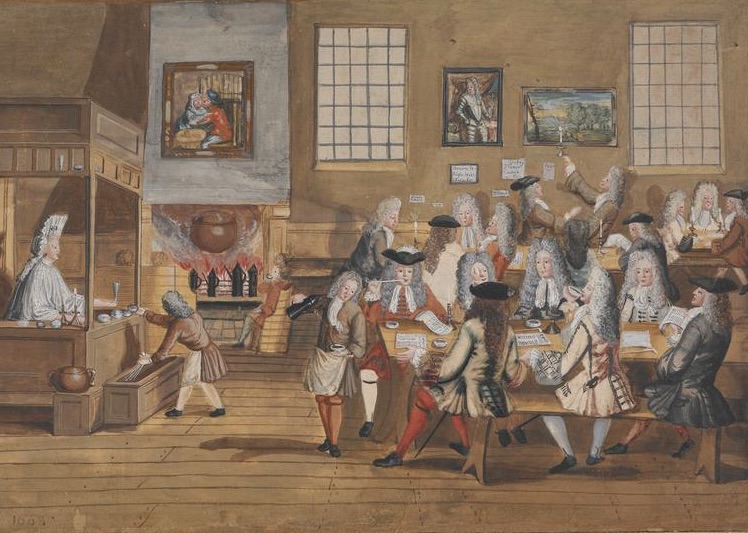
Main Image: Drawing, Anonymous, Interior of a Coffee House in London, Britain, circa 1690, Collection of the British Museum (inv. no 162021001)
Coffee: few commodities are as widespread or as deeply woven into daily life. For many people, the day begins with a cup of coffee, accompanied by the vessels and utensils designed for its preparation and enjoyment. The remarkable relationship between coffee and ceramics continues to attract scholarly and public interest. This is reflected in the forthcoming exhibition Coffee? A Dutch History in Ceramics, at the Princessehof National Museum of Ceramics in Leeuwarden, which explores the role of coffee in Dutch history through the lens of ceramic production and consumption. This article examines the arrival of coffee in the Dutch Republic and the ways in which the growing coffee culture influenced the development of Delftware during the seventeenth and eighteenth centuries.
Coffee had a long history before it entered Dutch society in the seventeenth century. According to one of the many legends surrounding the discovery of coffee, its stimulating effects were first observed by goats. Although the story lacks historical evidence, it remains too compelling to omit. The goats of an Ethiopian goatherd named Kaldi supposedly became unusually energetic, jumping around, after eating the berries of the coffee shrub. An abbot from a nearby monastery discovered that the berries of the coffee plant provided this energy. He gave them to his monks, enabling them to stay awake longer for prayer and work. This discovery is said to have laid the foundation for coffee culture in the Middle East.
From Ethiopia, coffee plants were brought to Yemen by Arab traders during the fourteenth or fifteenth century. The principal export harbor was Mocha, located on the Red Sea, whose name would later become synonymous with coffee itself. It was here that Coffea arabica was traded, the aromatic coffee variety prized for its refined flavor and relatively limited production. The term “mocha” derives directly from this harbor city, while “arabica” still refers today to the same species of coffee bean that once circulated through the Arab trade networks.
Although Dutch merchants had secured trading rights in Mocha by 1617, the coffee trade to the Dutch Republic developed only gradually. In 1628, the VOC purchased its first known cargo of raw coffee beans in Yemen for trade in Persia, marking the beginning of a long-standing coffee trade within Asia.
During the same period, coffee was steadily making its way westward through the Ottoman Empire into Europe. The Ottomans played an important role in promoting its consumption, and in 1638 coffee was publicly auctioned in Venice for the first time, one of the earliest documented moments at which the beverage entered European commercial life.
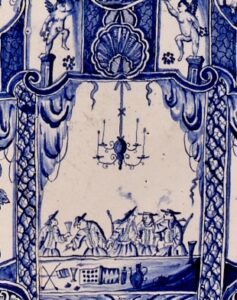
The Dutch Republic followed somewhat later. Coffee was first auctioned in Amsterdam in 1661 and quickly gained popularity among urban consumers. Known at the time as cauwe, a word likely derived from the Arabic qahwa, the beverage soon became a familiar feature of city life. Amsterdam records mention a coffeehouse as early as 1663, and by around 1700 no fewer than thirty-two officially registered coffeehouses were operating within a small district of the city center alone (Fig. 1).
For the Dutch East India Company (VOC), importing coffee exclusively from Mocha ultimately proved insufficiently profitable. In 1699, coffee cultivation was introduced by the Dutch on Java, and in 1712 more successful plantations were established in Suriname, both colonies of the Dutch Republic at the time. These developments marked the beginning of an extensive Dutch coffee trade, transforming the Dutch Republic into an important distribution center for Scandinavia and the German territories.
Although coffeehouses played a significant role in introducing the beverage to Dutch consumers, the most significant development occurred during the first half of the eighteenth century when coffee drinking increasingly shifted into the domestic sphere. Falling prices and expanding imports enabled a growing number of households to prepare and serve coffee at home, stimulating the production of specialized coffee wares that transformed coffee consumption into a distinctly domestic ritual.
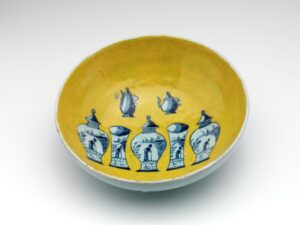
Coffee pots and mills for grinding coffee beans were initially unknown in the Dutch Republic. The earliest European coffee pots, used primarily in coffeehouses, were tall, slender vessels. Usually made of tin or copper, they were designed to withstand the prolonged heating required for traditional coffee preparation. Their high spouts reflected the practical need to pour coffee while leaving the grounds settled at the bottom of the vessel. Teapots, which contained loose tea leaves that moved freely within the liquid during brewing, generally had lower spouts. This distinction is clearly illustrated by a yellow-ground Delft bowl depicting a coffee pot (right) beside a teapot (left) (Fig. 2).
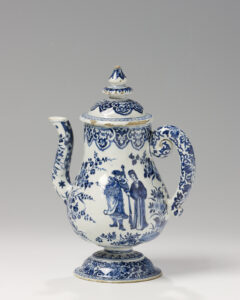
From around 1680 onward, porcelain coffee pots were imported from Japan and later from China, many of them produced specifically for the Dutch domestic market. Around 1700, the original conical form gradually evolved into the pear-shaped coffee pot inspired by Persian examples, a silhouette that would become the standard European coffee pot throughout the eighteenth century. An early Delft coffee pot in the collection of the Groninger Museum (Fig. 3) demonstrates how quickly Delft potters responded to evolving tastes and new patterns of consumption.
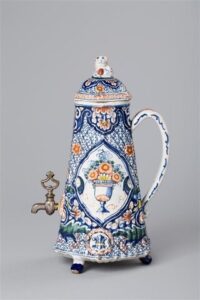
Alongside these forms, the kraantjeskan developed, a vessel fitted with one or more taps from which coffee could be dispensed directly into cups. Similar forms were already known in Europe by the late fifteenth century, when large tap-equipped guild vessels were used for serving beer and wine.
Coffee cups followed a somewhat different course of development. Delft potters had already been producing small cups for tea consumption since the seventeenth century, and these forms could readily be adapted for the serving of coffee. As the consumption of coffee and chocolate increased, taller and more cylindrical forms appeared that were better suited to these beverages.
VOC records indicate that at least three different types of coffee cups were in use: double ware, large Dutch coffee ware, and single Dutch coffee ware. The latter measured approximately 6.5 cm (2.6 in.) in height and 7.5 cm (2.9 in.) in diameter. These dimensions correspond closely to surviving late seventeenth and early eighteenth century coffee cups, which were generally smaller than the vessels commonly used for coffee today. An interesting example is found in a set of four cups fitted with a handle, produced by Pieter Adriaensz. Kocx around 1700, although it remains unclear whether they were intended for the consumption of coffee or chocolate (Fig. 4). Probate inventories nevertheless suggest that cups were frequently used interchangeably for tea, coffee, and chocolate, indicating that distinctions between these beverages were not always reflected in everyday household practice.
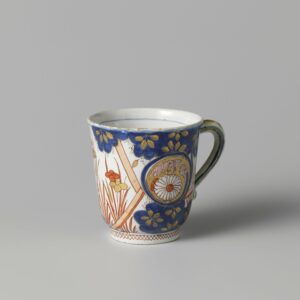
As coffee drinking spread beyond the coffeehouse and into the domestic sphere, Dutch potters responded to the growing demand for specialized coffee wares. An archival source from 1695 records the shipment of Hollants Porceleyn coffee pots from Delft to The Hague. Since Hollants Porceleyn was the contemporary term for Delft faience, this shipment provides one of the earliest documentary indications that Delft potters were producing coffee pots by the 1690s. Given the time required for the introduction and commercial distribution of new forms, production likely began somewhat earlier.
Delft potters adapted models that had originally been developed in metal and porcelain. A Delftware coffee pot with tap, preserved in the collection of the Kunstmuseum Den Haag demonstrates how functional metal prototypes were transformed into fashionable ceramic table wares (Fig. 5). Another model, preserved in the collection of the Rijksmuseum, Amsterdam, is clearly derived from contemporary metal coffee pots and features a cylindrical body with a straight spout (Fig. 6). This type also occurs with a reinforcing bridge connecting the upper part of the spout to the body of the pot, providing additional stability.
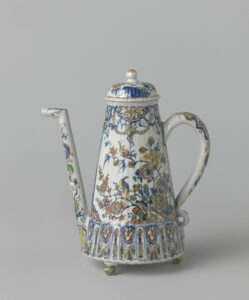
Yet Delftware coffee pots were produced in smaller numbers than metal examples. Metal vessels remained more practical for daily use because they could withstand direct heat and frequent handling, whereas Delftware coffee pots were fragile and likely intended primarily for serving coffee at the table rather than brewing it. This may also help explain why comparatively few Delftware coffee pots survive today.
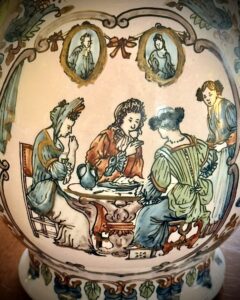
The growing popularity of coffee also found expression in Delftware decoration, as is reflected in Fig. 1. Next to this example, is a pair of polychrome vases made at Het Morieanshooft (the Moors Head) factory during the directorship of Rochus Hoppesteyn depicts elegantly dressed figures gathered around a table furnished with cups and a clearly recognizable coffee pot (Fig. 7). Similar imagery appears on a Hoppesteyn vase in the collection of the Moritzburg Art Museum in Halle, where two distinct coffee pots are represented within an elaborate interior scene. Such depictions are particularly valuable because they preserve visual evidence of contemporary coffee wares that may no longer survive and demonstrate that coffee drinking had become sufficiently familiar to serve as a recognizable decorative motif.
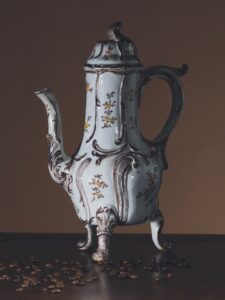
During the eighteenth century, the rococo style came to exert a strong influence on Delftware production. Coffee pots, like many other ceramic forms, became less rigid in appearance and adopted more fluid silhouettes and organic contours. Among the few surviving Delftware coffee pots, one of the finest examples is a large polychrome coffee pot and cover in our collection (Fig. 8). Its elegant pear-shaped form, enriched with rococo scrollwork, reflects the mature European coffee pot type that developed during the eighteenth century. A closely related example, decorated in a slightly different palette, is preserved in the collection of the Princessehof Museum.
Very few Delftware coffee wares survive when compared to the relatively large numbers of tea wares produced during the same period. This disparity may reflect differences in the preparation of the two beverages. Tea was typically infused in a teapot and served directly from it, making ceramic vessels ideally suited to the process. Coffee, by contrast, was often prepared over a fire and required more durable equipment. Metal coffee pots therefore remained more practical and widely used throughout the eighteenth century, while Delftware examples were likely intended primarily for serving coffee at the table and displaying refinement and taste. Produced in smaller numbers than tea wares, they remain comparatively rare today. Yet precisely because of their scarcity, surviving Delftware coffee pots provide valuable insight into the growing popularity of coffee in the Dutch Republic and the ways in which Delft potters adapted their products to accommodate changing patterns of consumption.
Notes
- On view from October 10, 2026, until August 29, 2027.
- Pim Reijnders and Thera Wijsenbeek, Koffie in Nederland. Vier eeuwen cultuurgeschiedenis (Delft/Zutphen, 1994), p. 12.
- Reijnders and Wijsenbeek, 1994, p. 19.
- Reijnders and Wijsenbeek, 1994, p. 11.
- Rudi Matthee, “Coffee in Safavid Iran: Commerce and Consumption,” Journal of the Economic and Social History of the Orient 37, no. 1 (1994), p. 2.
- Anne E. C. McCants, “Poor Consumers as Global Consumers: The Diffusion of Tea and Coffee Drinking in the Eighteenth Century,” Economic History Review 61 (Special Issue, 2008), pp. 175–176.
- Reijnders and Wijsenbeek, 1994, p. 43.
- Reijnders and Wijsenbeek, 1994, p. 24.
- Marijke de Koning, Henk Snelders, and Els Stronks, “Niet zo beschaafd als we dachten: Koffiehuizen, sociabilisering en literaire socialisatie in Amsterdam, c. 1685–c. 1785,” Tijdschrift voor Nederlandse Taal- en Letterkunde 139, no. 1 (2023), p. 40.
- Judith te Kronnie, “From Elite Brew to Everyday Fuel: The Evolution of Dutch Coffee Culture in the 18th Century,” Public History Amsterdam, University of Amsterdam, September 27, 2024.
- Reijnders and Wijsenbeek, 1994, p. 55.
- Anna Preußinger, Material Culture in Early Modern Amsterdam Coffeehouses: The Sociability and Aesthetics of Porcelain Coffee Ware (Leiden University, 2022), p. 31.
- Ibid.
- Reijnders and Wijsenbeek, 1994, p. 75.
- Reijnders and Wijsenbeek, 1994, p. 58.
- J. de Kleyn, “De kraantjeskan met conische vorm, een oud type koffiekan,” Antiek, no. 6 (1972/1973), pp. 435–436.
- Reijnders and Wijsenbeek, 1994, p. 91.
- Preußinger, 2022, p. 37.
- Reijnders and Wijsenbeek, 1994, p. 75.
- Ibid.
 CHINESE 阿伦森 WEBSITE