
Sinterklaas and the Shoe: Delft Miniatures in a Dutch Tradition of Giving
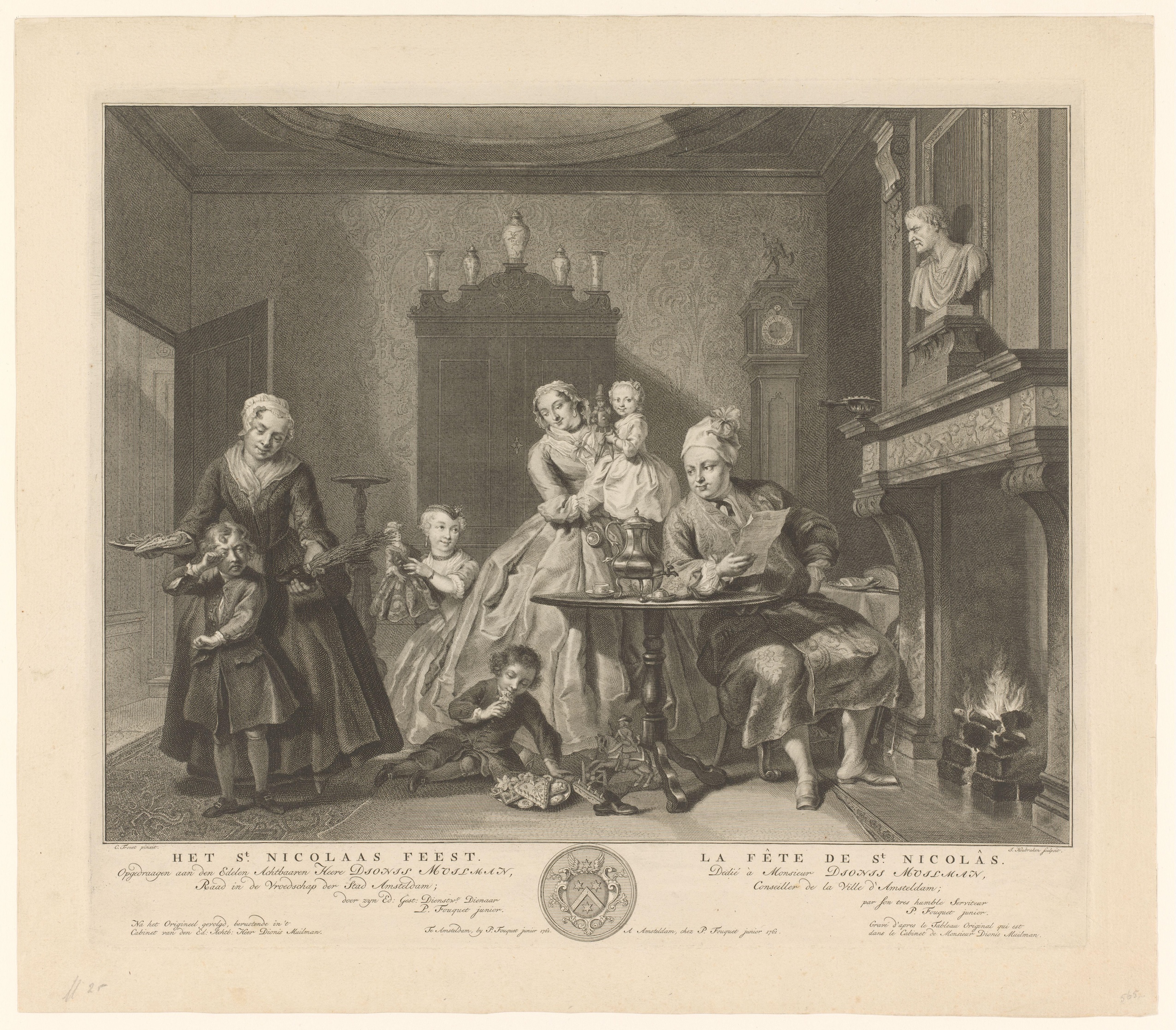
Main image: Jacob Houbraken, Het Sint Nicolaasfeest, Engraving, 1761, Collection Rijksmuseum, Amsterdam (inv. no. RP-P-1938-1443) The footwear worn by the figures in the engraving correspond perfectly with the Delft miniature shoe models.
On 5 December, many people in the Netherlands celebrate Sinterklaas (Saint Nicholas), a time-honored occasion rich in history, ritual, and joy. It is a fitting moment to reflect on the origins and customs of this celebration, its connection to Santa Claus, and to draw a thoughtful bridge to the role of the shoe during Sinterklaas and to one of Delft’s most charming creations: faience miniature shoe models.
While no official sources confirm details from the life of Saint Nicholas, it is generally assumed that his roots trace back to around 270 AD. He was a Christian bishop of Greek origin, born in Patara (in modern-day Turkey). He died in Myra, today Demre, also in Turkey, on 6 December 343.
Although officially canonized in 1446, Nicholas was regarded as a saint long before that date. His reputation as a benefactor of the poor was widely recognized, and as early as 520, a church devoted to him was built on his original burial site in Myra.
The earliest biography of Saint Nicholas, composed around the year 800, laid the foundation for later accounts, including the widely influential Legenda Aurea (Golden Legends) by Jacobus de Voragine, written around 1300.(1) This work circulated broadly across Europe and underpinned many traditions of the Dutch Sinterklaasfeest. One story in particular stands out, as it appears to have provided an early basis for the custom of putting out a shoe and receiving chocolate coins.
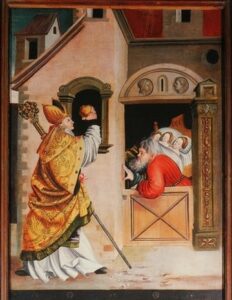
To explain this custom more fully, we turn to a well-known legend. During the time Nicholas served as bishop of Myra, he learned of a poor man with three daughters. The man could not provide dowries for them, which meant they were unable to marry and were destined to live very difficult lives. Nicholas decided to visit the house by night and threw a small bag of gold through an open window (Fig. 1). When the father discovered the gold, he was overwhelmed with gratitude toward the anonymous donor, as his eldest daughter could now marry. Saint Nicholas repeated this generous act twice more, and in the end all three daughters were able to marry.
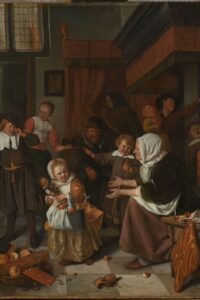
Some versions of the legend recount that the gold fell into a shoe, which helps to explain how the shoe became part of the Sinterklaas tradition. The custom of setting out a shoe to be filled with treats, known in Dutch as schoen zetten, has been documented from the second quarter of the fifteenth century onward. It was originally linked to charity: children placed their shoes in church to receive alms. By the sixteenth century the practice had entered the domestic sphere. Children would place a shoe by the hearth at home, slip in a note or drawing, and often leave a little fodder for Sinterklaas’s faithful white horse. If they had behaved well, they would discover the shoe filled with treats by morning. Children who had misbehaved might receive a bag of salt or the roe, a small bundle of twigs carried by Sinterklaas’s helper as a traditional symbol of discipline, and in earlier times used for a light spanking. A wonderful example of how the celebration looked in the seventeenth century can be found in a painting by Jan Steen (Fig. 2).
In the Dutch context today, children still eagerly anticipate the arrival of Sinterklaas. They sing songs, place their shoes by the hearth or door, and leave small offerings for his horse, hoping to discover sweets or small gifts the next morning. Other familiar customs include the consumption or gifting of marzipan, gingerbread, speculaas cookies, almond pastry and chocolate letters.
While these customs remain distinctly Dutch, the figure of Sinterklaas also became part of a wider transatlantic tradition. Beyond the Sinterklaas celebrations preserved in former Dutch colonies, in Belgium, in parts of the German-speaking world, and in several Eastern European countries, there is also a clear line of cultural connection linking Sinterklaas to the Anglo-American figure of Santa Claus. When Dutch settlers established New Amsterdam in the seventeenth century, they brought with them the annual commemoration of St. Nicholas on 5 and 6 December, along with customs of gift-giving, children’s songs, and the idea of a benevolent saint arriving from afar. Even after the English took control of the city and renamed it New York, traces of this Dutch celebration continued within local communities.
Over the eighteenth and early nineteenth centuries, these remnants mingled with other European winter traditions brought by new immigrant groups.(2) Writers and illustrators in New York played a crucial role in reshaping St. Nicholas into a more broadly recognizable, non-sectarian holiday visitor.(3) In this process, the Dutch name and imagery proved especially durable: “Sinterklaas” gradually became “Santa Claus,” and the figure itself shifted from a bishop-saint into a jolly, gift-bearing character associated with Christmas rather than a separate feast day. As the celebration adapted to its new setting, the Dutch custom of putting out a shoe for gifts slowly evolved into the now-familiar practice of hanging a stocking by the fireplace. Seen in this light, the Sinterklaas celebration in New Amsterdam was not the sole origin of modern Santa, but it was an important and formative strand in the larger cultural weaving that produced the Santa Claus myth as we know it today.

Delft miniature shoes
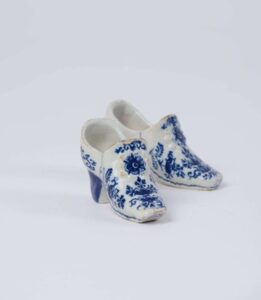
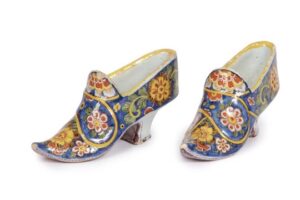
Back in the Netherlands, the enduring image of a shoe waiting quietly by the hearth offers a gentle stepping-stone to miniature Delft faience shoes (Fig. 3). These objects were not made for the custom of schoen zetten, nor were they intended to be filled with treats. Their connection to Sinterklaas is therefore not one of origin, but of association: in both cases, the shoe participates in a culture of gifting and domestic ritual, though in the miniatures the shoe is the gift itself.
Ceramic and ornamental shoe models have captivated collectors for centuries. In the seventeenth century, shoemaking developed into a highly decorative and skilled craft, inspiring the creation of Delft faience miniature shoes as intricate artistic objects. Often made with the same attention to detail as full-sized footwear, these miniatures could symbolize prosperity and affection.
Shoes in general were also linked to customs such as attaching shoes to newlyweds’ carriages (and later cars), a gesture wishing the couple good fortune, fertility and shared wealth. Another practice, recorded from the Middle Ages through the nineteenth century, involved concealing shoes within the walls of homes, thought to protect the household from misfortune and to ward off witches.
By the eighteenth century, exchanging ceramic model shoes had become fashionable among the aristocracy. Celebrated for their refined designs and association with luxury, they were prized collectibles in elite circles.
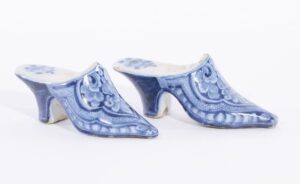
Various models were produced in both Delftware and Frisian ceramics, ranging from blue-and-white to polychrome and petit feu examples. Always designed in step with contemporary fashion, they came in a range of types and sizes, attesting to their popularity. The pair of blue-and-white slippers (Fig. 4) illustrates footwear commonly worn at home by both men and women in the seventeenth and eighteenth centuries. Slippers like these were typically fashioned from costly materials intended for indoor use, keeping them clean and pristine. Delft painters often evoked these luxurious surfaces, such as silk, leather, metal thread, and stitched decoration; an effect that is clearly visible in this pair.
The examples illustrated in Figs. 5 and 6 show shoes that were typically worn outdoors by both sexes. They had stacked heels, a fashion promoted by the French court of Louis XIV. Heeled shoes were a status symbol, as they were mostly worn by the nobility.
It is highly possible that shoes and slippers were made in little kilns by so-called thuiswerkers (home workers), who were not part of a factory, as was the case with so many other miniature objects. Miniature ceramic shoes like these were sold at annual fairs and markets. Although most examples are undated, some bear dates and initials, suggesting they were given as gifts on special occasions. Since brides traditionally offered a pair of shoes to the groom, it is likely that these faience shoes had the same function. They were a sign of respect for the marriage and domestic stability, and they also signified an erotic connotation in the seventeenth century. Thus, the pair of Delftware shoes was possibly exchanged as a symbol of good luck in marriage.
These finely modelled and carefully painted miniature Delft faience shoes reflect the same culture of gifting and domestic ritual that underlies the Sinterklaas tradition. Both the child’s shoe set out in expectation and the finely crafted faience shoe exchanged or displayed as an object of value belong to a shared history of material customs centered on generosity, family life, and good fortune. They remind us that the shoe, whether set out in hope or cherished as a collectible, holds a lasting place in the material language of giving in the Netherlands, a tradition to which Delft potters also contributed with their creations.
For those who celebrate Sinterklaas, we wish you a wonderful evening, and we can only imagine the delight of anyone who finds a pair of miniature Delft faience shoes in the shoe they set out.
Notes
1. Paul Faber, De Geschiedenis van Sinterklaas, published on NEMO Kennislink on December 4, 2008
2. Rachel Walman, The New York City Origins of Santa Claus, in: History Detectives, December 21, 2018 (https://www.nyhistory.org/blogs/the-new-york-city-origins-of-santa-claus?)
3. Ibidem
 CHINESE 阿伦森 WEBSITE