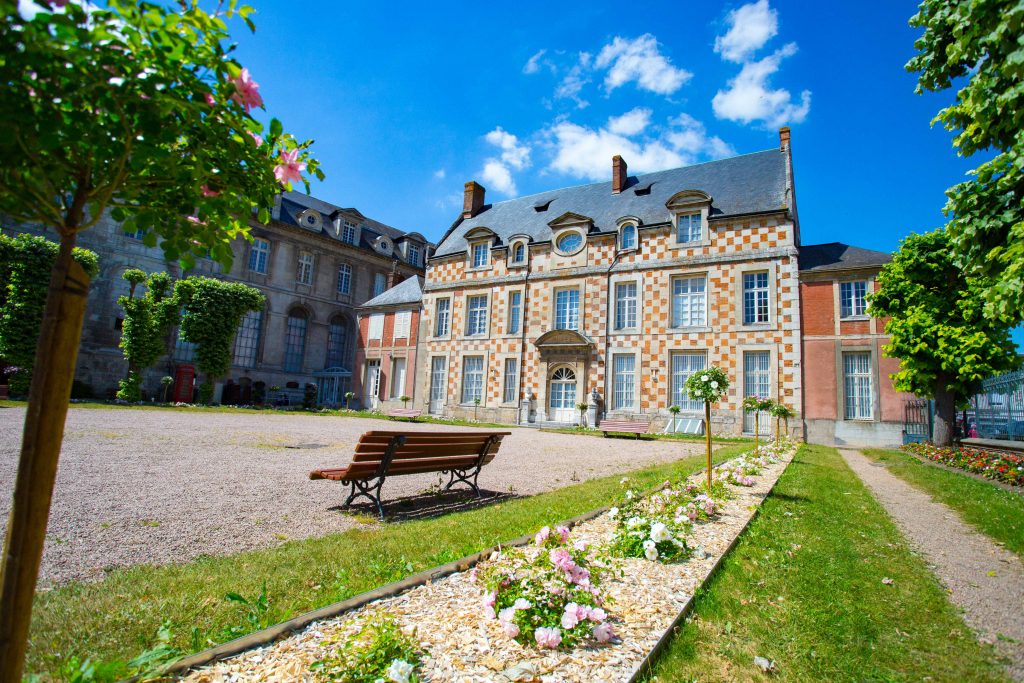
The Musée des Beaux-Arts de Bernay is a characteristic example of the provincial museums established in France during the nineteenth century, institutions shaped by a strong educational mission and a desire to preserve regional heritage. Its foundation is closely linked to the collector Alphonse Assegond, who in 1866 offered his collection of ceramics and works of art to the city on the condition that a museum be created. The museum opened shortly thereafter and gradually developed through a combination of donations and acquisitions, eventually finding a permanent home in the former abbatial residence, where its collections continue to be displayed today.
Within this broader context, the ceramic collection occupies a place of particular distinction. Comprising more than a thousand objects, it offers varied survey of European tin-glazed earthenware, with examples from centers such as Rouen, Delft, Nevers, and Strasbourg. The presence of Delftware within the collection reflects the wide dissemination and enduring appeal of Dutch ceramics in France from the seventeenth century onward.
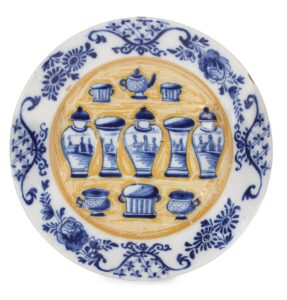
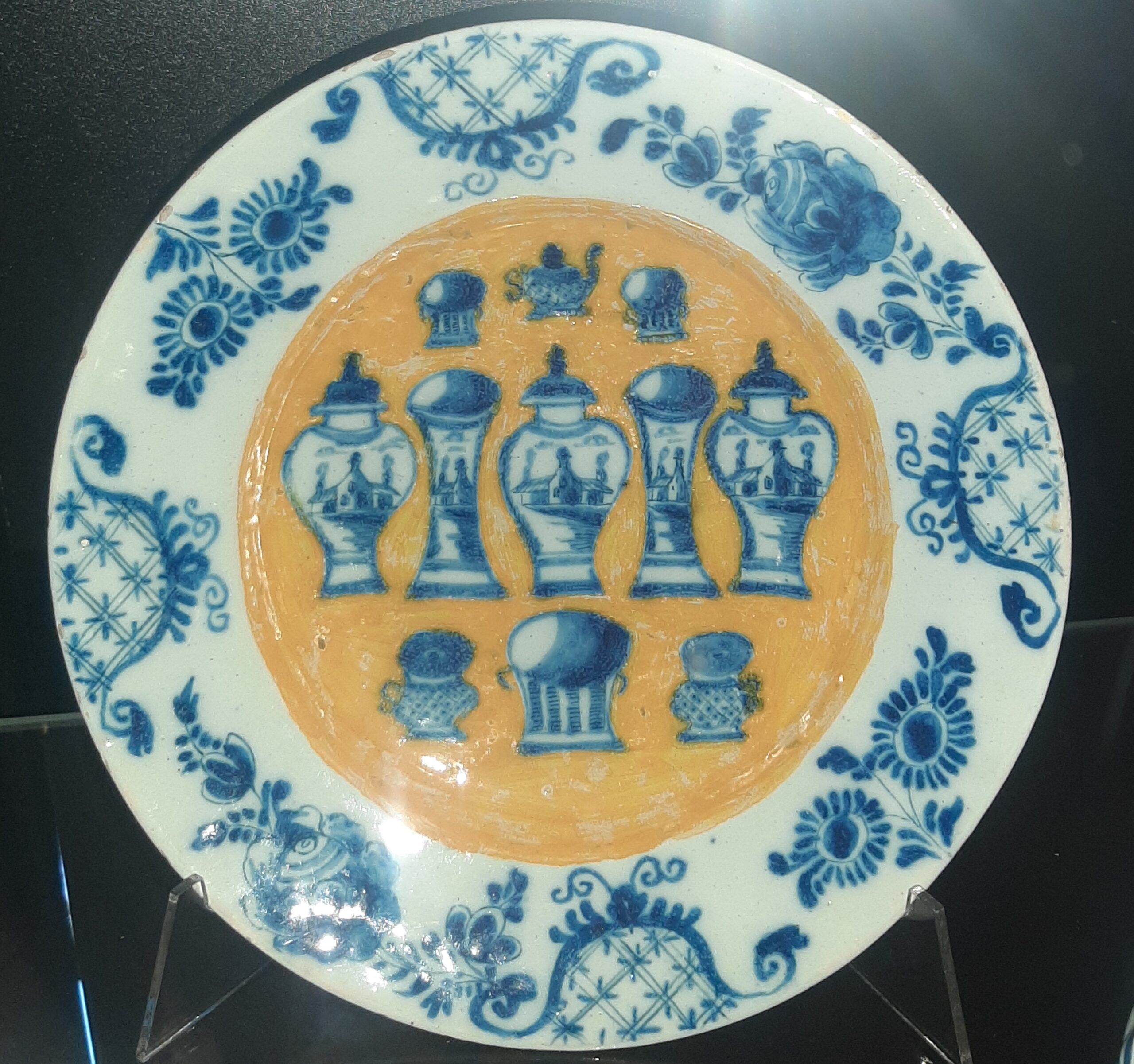
Among the Delft pieces, a single sample plate stands out as an especially rare and significant object (Fig. 1). Although documentary evidence is lacking, such plates have long been interpreted as a form of advertisement, possibly used by Delftware factories to present their repertoire and to demonstrate the technical and artistic skill of their painters. Their concept may have been inspired by Chinese Kangxi-period porcelain decorated with assemblages of loose objects, such as the so-called Hundred Antiquities or Eight Precious Objects. Unlike the freely scattered compositions found on Chinese porcelain, however, Delft painters arranged these elements in orderly rows and rendered them with a markedly higher degree of realism. This structured approach supports the idea that Delft examples functioned as visual catalogues of production rather than purely decorative compositions.
Its rarity enhances its importance, as only a limited number of such objects have survived. A closely comparable example, preserved in our own collection, further underscores both the consistency and the refinement of this type, particularly in the use of a distinctive yellow ground (Fig. 2).
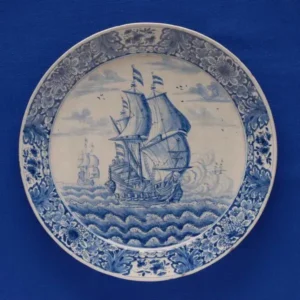
The museum also preserves a striking Delft dish depicting a naval battle, a subject that enjoyed considerable popularity in the Dutch Republic (Fig. 3). The composition is notable for the precision of its painting, with carefully rendered ships and well-balanced detailing that demonstrate a high level of technical control. Rather than relying solely on dramatic effect, the decoration reflects a disciplined approach to brushwork and composition, indicative of a skilled hand
Although Delftware is only modestly represented, the museum nonetheless holds an interesting and rewarding ceramic collection.
 CHINESE 阿伦森 WEBSITE