Delft Cruet Stands: Form, Function, and Context
Oil and vinegar sets, commonly referred to as cruet sets, are among the more telling additions to the early modern dining table. Their emergence marks a shift toward more structured dining, in which individual elements assumed a defined role in both presentation and use.
In the seventeenth and early eighteenth centuries, dining in Europe became increasingly formalized. Meals were arranged with growing attention to order, symmetry, and display, a development closely linked to the adoption of dining à la française, a style associated with the court of Louis XIV. Dinners were organized in successive courses, beginning with cold dishes, followed by hot preparations, and concluding with preserved fruits and sweetmeats, a precursor to the modern dessert. Dishes were set out in balanced compositions across the table, from which guests served themselves. In this setting, tableware played an active role, as each course introduced a new combination of functional and decorative objects.
Within this context, cruet sets provided a practical means of serving liquid condiments, most notably oil and vinegar, directly at the table. Their presence also signals a broader shift in taste. Flavors became lighter and less dependent on heavy seasoning in the kitchen, while diners were given greater control to adjust their food according to individual preference. Initially produced in metal and glass, these sets soon offered Delft potters an opportunity to explore both form and decoration within a clearly defined functional type.
Strictly speaking, the term cruet refers to the individual vessel, a small bottle with a narrow neck and stopper, rather than to the ensemble as a whole. The supporting structure is more accurately described as a stand or frame. The direct origins of such vessels most likely lie outside the domestic sphere. In medieval liturgical practice, small containers known as ampullae were used to hold wine and water for the Eucharist, typically presented as a pair. These were sometimes marked with the letters “V” for vinum and “A” for aqua to distinguish their contents. They were most often made of metal, while glass examples became more common from the Renaissance onward.
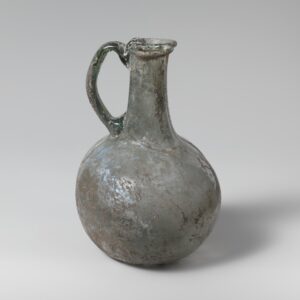
Although their appearance in the seventeenth century may seem novel, the combined use of oil and vinegar has a much longer history. An early example of a joined cruet is found in a Roman or Syrian glass vessel with a double body (Fig. 1). This type is often described as an oil and vinegar bottle, although its precise function remains uncertain.
By the early medieval period, however, the pairing of oil and vinegar is securely attested in elite contexts. At the court of Charlemagne (742-814), meals could include vegetables or salads prepared with oil, vinegar, and generous quantities of pepper. This use primarily took place in the kitchen, as part of the preparation of dishes, rather than at the table, as would become customary in later periods.
Seen in this light, the growing presence of oil and vinegar in Northern European dining during the seventeenth century does not represent an entirely new development, but rather a transformation in the way they were presented and used. No longer confined to the kitchen, they became part of the table setting itself, presented in dedicated vessels and ultimately giving rise to the cruet set as a distinct and recognizable object.
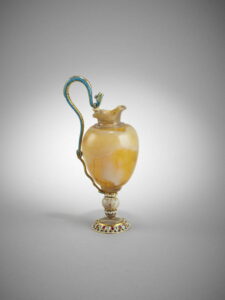
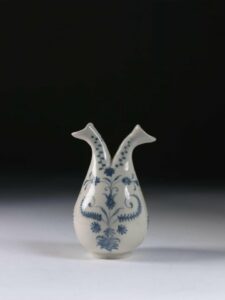
A late sixteenth-century oil and vinegar vessel in Medici porcelain may represent one of the earliest European examples intended for use at the table (Fig. 2). Marked with the letters “O” and “A,” referring to oleum and acetum, it invites comparison with the earlier liturgical practice of marking paired vessels. While a direct connection cannot be firmly established, the parallel suggests a continuity in the visual language used to distinguish liquids. At the same time, the object points to the emergence of a comparable use in a secular and more refined dining context. By this date, such vessels were no longer confined to liturgical settings, but were also incorporated into the material culture of the table. Its execution in costly Medici porcelain underscores both the novelty of the form and its association with elite settings.
Over the course of the seventeenth century, cruet sets became part of increasingly elaborate table arrangements. Their emergence in a courtly context is often linked to Cardinal Mazarin (1602-1661), whose role at the court of Louis XIV (1638-1715) has given rise to the suggestion that he played a decisive part in their dissemination. Such claims, however, remain difficult to substantiate. While it is clear that Mazarin acted as an important intermediary for Italian taste within France, direct evidence for his role in introducing or popularizing cruet sets is lacking.
A small pouring vessel listed in his inventory nevertheless offers a more tangible point of reference. The so-called burette, recorded in 1644 and now preserved in the Louvre, demonstrates that refined vessels for controlled pouring were already present within elite circles at an early date (Fig. 3).
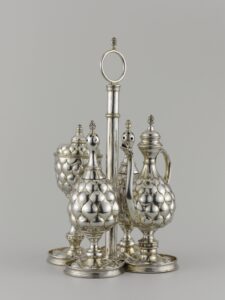
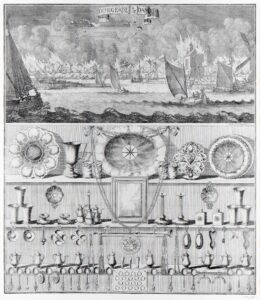
The development of cruet sets should be understood within a broader European context, in which forms and ideas circulated between different regions. The earliest Dutch example for secular use is a silver set dating from 1642, reflecting this wider exchange (Fig. 4). Made by the silversmith Anthony Grill, who originated from Augsburg but was active in Amsterdam, it consists of a tray with a detachable frame, an oil vessel, two casters, and a salt. A closely comparable set appears in a later print made for a lottery held in Durgerdam, near Amsterdam, organized to raise funds after a devastating fire in 1689 (Fig. 5).
Delft cruet stands appear to derive from contemporary metal prototypes, such as those attributed to the silversmith Anthony Grill. The vessels are raised on a foot, fitted with a handle, and conceived as bridge-spouted ewers, the spout set low on the body and connected to the neck by a supporting strut.
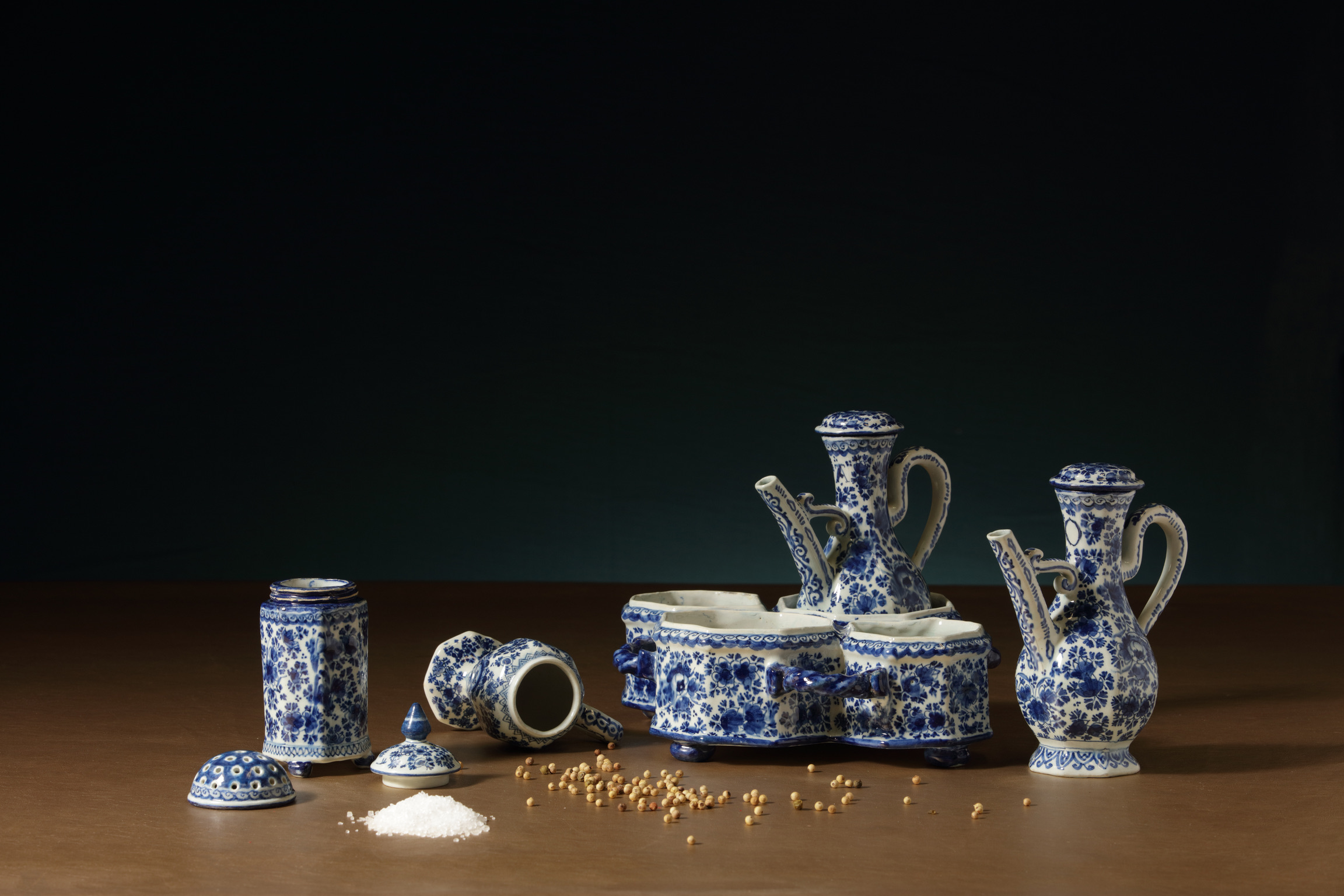
Delft potters translated these elements into faience, adapting both form and function to suit ceramic production. This development is exemplified by one of the earliest known Delft faience cruet stands, produced in the late seventeenth century at De Metaale Pot (The Metal Pot) factory under the directorship of Lambertus Cleffius, owner from 1679 to 1691. This blue and white set forms part of an extensive dinner service commissioned for Prince Wenzel Ferdinand Lobkowicz of Bílina (1656-1697), now known as the Lobkowicz service. The cruet stand was conceived to hold three vessels: two bottles intended for oil and vinegar, and a third container, most likely for mustard. The ensemble offers an exceptional insight into the level of sophistication achieved by De Metaale Pot as early as the 1680s.
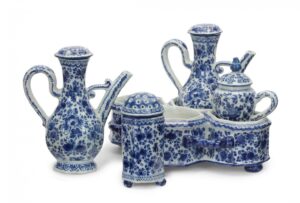
In addition to the Lobkowicz service, another important early blue and white set, attributed to Frederik van Frytom (1632-1702) on account of its finely painted landscapes, and possibly also produced at De Metaale Pot, follows a similar model, with accommodation for three vessels. A further early example, now in the collection of Museum Boijmans Van Beuningen, is attributed to De Witte Ster (The White Star) factory and bears a coat of arms, suggesting a noble provenance.
Production at De Metaale Pot continued under Lambertus van Eenhoorn, successor to Lambertus Cleffius, who owned the company from 1691 to 1721. From this period, blue and white cruet stands are known that were designed to accommodate four or five vessels. A late seventeenth-century example of such production is a cruet set marked IVB for Johannes Verburg, comprising a stand for four elements, including two bottles for oil and vinegar, a mustard pot, and a caster, now part of a private collection collection (Fig. 6).
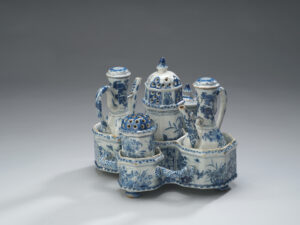
The factory De Grieksche A (The Greek A) was likewise engaged in the production of cruet stands during this period, under the directorship of Adrianus Kocx from 1687 to 1701. A notable blue and white set of six elements, comprising a stand, two bottles, a large caster, a smaller example, and a mustard pot, is preserved in the Amsterdam Museum (Fig. 7). A comparable blue and white set, marked APK and bearing the coat of arms and monogram of the Danish baron Iver Juel Høg and his wife, indicates that production of this model continued under Adrianus’ son, Pieter, who owned the company from 1701 until his death in 1703. As Iver Juel Høg had already died in 1683, the commission was likely made by his widow, Helle Nielsdatter Trolle (1657-1722).
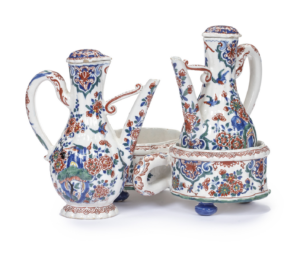
In the eighteenth century, the use of cruet sets became more widespread, extending beyond elite circles to a broader public. This development allowed for the introduction of new models and color schemes. In addition to blue and white, Imari and so-called cashmere palettes were employed (Fig. 8). While the spouted form remained in use, a model with a rounded body and a wider neck fitted with a pouring lip appears to have gained particular popularity (Fig. 9).
On the basis of extant examples, it may be cautiously suggested that the earliest Delft cruet sets comprised between three and five vessels arranged within a stand. As is often the case with new dining practices, such sets were likely conceived as part of larger services and intended for use within aristocratic, and possibly royal, contexts. Over the course of the seventeenth and eighteenth centuries, however, these more elaborate configurations were gradually simplified, and cruet sets were increasingly reduced to two bottles intended solely for oil and vinegar.
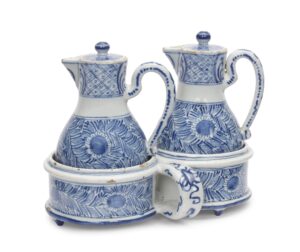
The use of oil and vinegar sets increased over the course of the eighteenth century. Extant examples indicate that such wares were produced at several Delft factories, including De Witte Ster, De Metaale Pot, De Grieksche A, De Drie Posteleyne Astonne, De Twee Scheepjes, De Romeyn, and In ’t Fortuyn, demonstrating the extent to which this form had become firmly established within Delft faience production.
Notes
- Acqui Newling and Scott Hill, Pass the Cruet, Sydney Living Museums, February 12, 2015, published online: https://blogs.sydneylivingmuseums.com.au/cook/cruet-sets/index.html
- John McClintock and James Strong, Cyclopedia of Biblical, Theological, and Ecclesiastical Literature, vol. 1 (A–B), New York, Harper & Brothers, 1896, p. 206.
- Wina Born, Eten door de eeuwen. De geschiedenis van de culinaire cultuur, Baarn, Bosch & Keuning, 1989, p. 93.
- Besides the example illustrated here, a comparable model is preserved in the Museum of Fine Arts, Boston (inv. no. 12.717).
- Rijksmuseum Bulletin, “Keuze uit de aanwinsten,” 1997, p. 157.
- Marion S. van Aken-Fehmers and Loet A. Schledorn, Delfts aardewerk. Geschiedenis van een nationaal product, Zwolle, 2001, pp. 53–54.
- Illustrated in A. Vecht, Frederik van Frytom (1632–1702). Life and Work of a Dutch Pottery Decorator, Amsterdam, 1968, pp. 74–75.
- A stand with five compartments, lacking its vessels and marked LVE for Lambertus van Eenhoorn, owner of De Metaale Pot (The Metal Pot) from 1691 to 1721, was sold at Christie’s Amsterdam on November 2, 2005, as lot 415. Another holder for four vessels, marked LVE G 24, is in the collection of the Kulturen Museum in Lund (inv. no. KM 9342).
- Cruet set, Attributed to De Witte Ster (the White Star) factory, Delft, circa 1700, Collection of the Boijmans van Beuningen Museum (inv. no. A 2249 a-f (KN&V))
- Ulla Houkjær, Tin-Glazed Earthenware from the Netherlands, France and Germany 1600–1800, Copenhagen, Design Museum Danmark, 2016, p. 160.
 CHINESE 阿伦森 WEBSITE