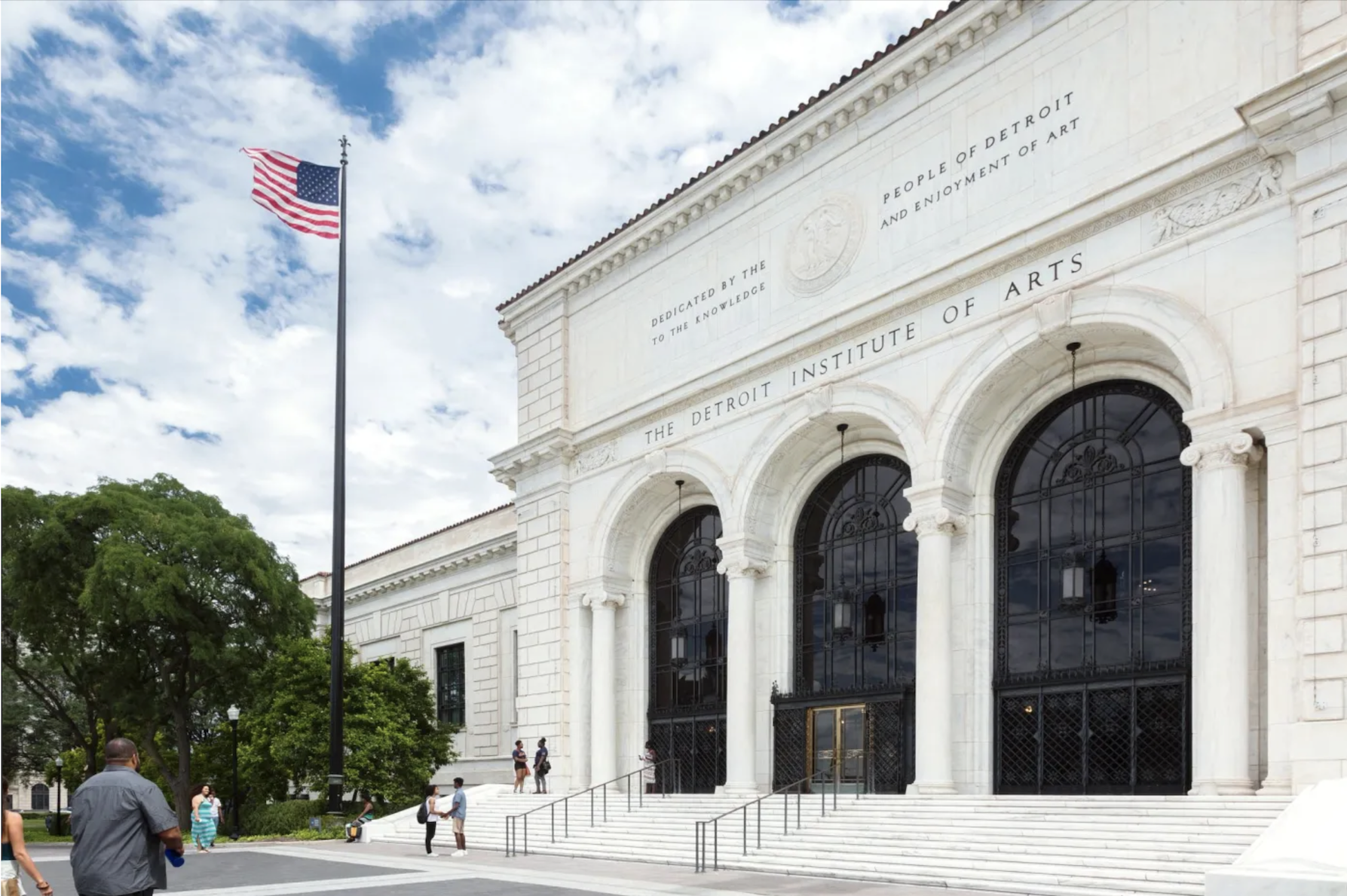
The Detroit Institute of Arts is located in the city’s Cultural Center Historic District in Midtown, directly opposite the Detroit Public Library and near Wayne State University. The museum complex, which is admired for its Beaux-Arts and Italian Renaissance influences, anchors a distinguished civic ensemble and serves as a major cultural landmark for the metropolitan region.
 Founded in 1885 by civic leaders and transferred to municipal ownership in 1919, the museum moved into its present building in 1927, designed by Paul Philippe Cret. In 1932–33, Diego Rivera executed the monumental Detroit Industry Murals in Rivera Court, an icon of U.S. muralism and an enduring visual narrative of labor, technology, and Detroit’s auto industry. A major renovation and expansion, completed in 2007, modernized the galleries and visitor circulation while preserving the building’s historic fabric.
Today, the DIA’s holdings number more than 65,000 objects, encompassing works from the ancient Mediterranean, the Islamic world, sub-Saharan Africa, the Indigenous cultures of the Americas, and Asia, alongside strong European and American collections. Highlights include Pieter Bruegel the Elder’s The Wedding Dance, a touchstone of Northern Renaissance art, and the Detroit Industry Murals, widely regarded as among the most significant works of twentieth-century mural painting in the United States. The museum’s encyclopedic scope allows visitors to trace global artistic traditions over millennia, with particular strengths in seventeenth-century Dutch painting, nineteenth-century American art, and European decorative arts.
The Detroit Industry Murals, executed in buon fresco between 1932 and 1933, constitute a monumental narrative of technology, labor, and natural forces. Commissioned with the support of Edsel B. Ford, Rivera’s cycle draws upon imagery from the Ford River Rouge complex to construct a modernist allegory of industrial production. The murals remain an enduring focal point of the DIA’s identity and a defining example of art commissioned for civic spaces during the Great Depression.
 Among the museum’s lesser-known yet historically rich holdings is a compact but significant group of Delftware dating from the late seventeenth to the eighteenth centuries. Housed within the European Sculpture and Decorative Arts department, these works include plates, chargers, plaques, and elaborate vases that reflect both domestic utility and the display culture of the Dutch Republic.
A particularly notable piece is the garniture of three vases (ca. 1690) from De Paauw (The Peacock) factory, produced under the direction of Petronella van Dijssel. Decorated with stylized flora, insects, and birds, this set exemplifies Delft potters’ adaptation of imported Chinese porcelain designs to European tastes. Another highlight, a flower vase attributed to De Grieksche A (The Greek A) factory and possibly made by Adrianus Kocx, demonstrates the specialized forms developed for displaying tulips and other luxury blooms during the Dutch Golden Age.
 CHINESE 阿伦森 WEBSITE