Extraordinary Remedies: Wonder Medicines in the Van Gelder Collection
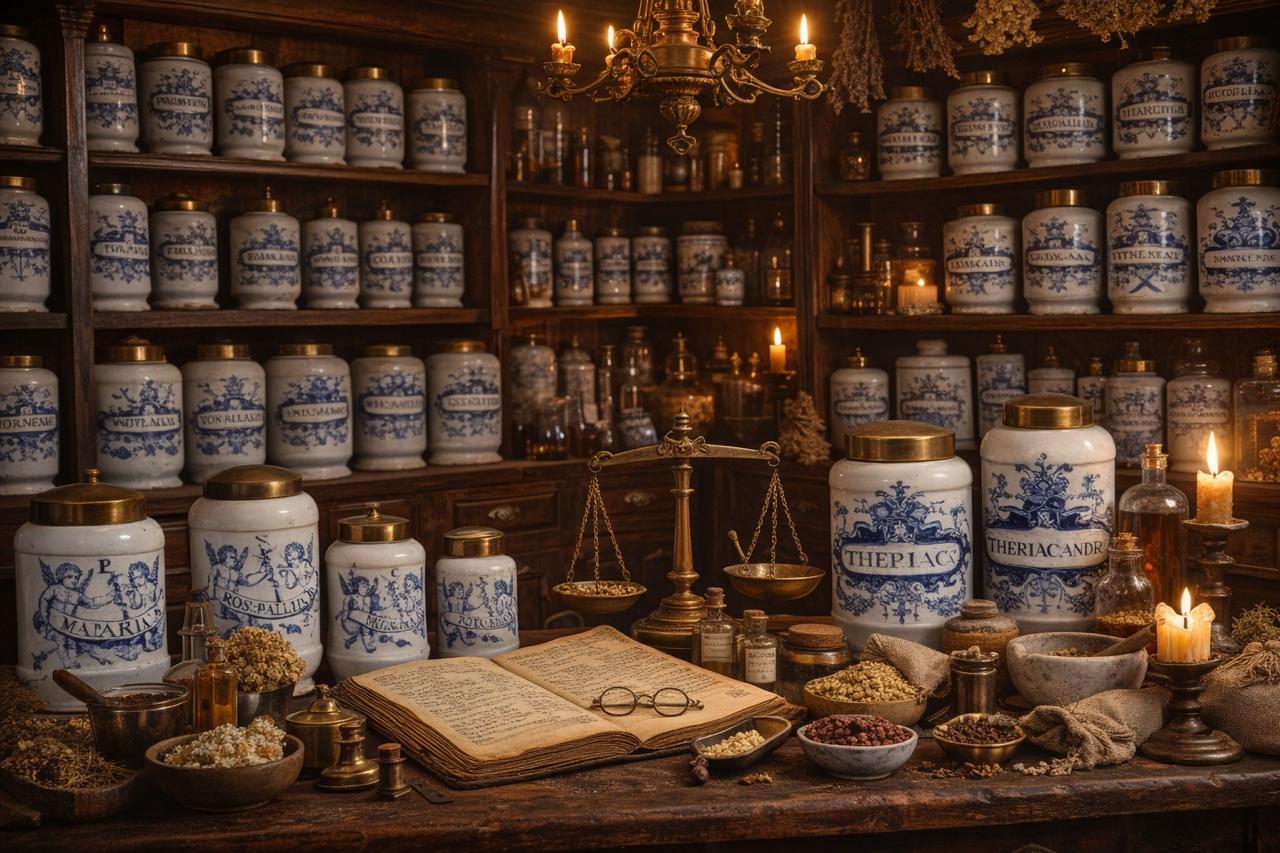
In this months article, we are focussing on the Van Gelder Collection. This exceptional ensemble, comprising more than 350 objects, is widely regarded as the largest and most comprehensive private collection of apothecary ceramics in existence. It was assembled with exceptional care and discernment by the apothecary J.B. (Joop) van Gelder. While his primary focus lay on Delft tin-glazed earthenware, Van Gelder deliberately broadened the scope of his collection. Alongside Delft apothecary vessels, he acquired rare early predecessors from Italy and the Southern Netherlands, as well as later Delft-inspired wares from neighboring regions, thereby creating an unusually wide and coherent overview of European apothecary ceramics.
In this article, we look beyond the objects in the Van Gelder Collection themselves to the substances they formerly contained. Rather than focusing on form or decoration, we explore the collection through the lens of so-called wondermiddelen (wonder medicines): substances whose reputed powers were sustained by long-standing tradition and a belief in wonders that once formed an accepted part of medical practice.
In the early twentieth century, the Dutch physician and medical historian M. A. van Andel published his study Klassieke Wondermiddelen, a work rooted in a growing interest among physicians in the history of their own discipline. Van Andel did not approach these remedies as curiosities or superstitions to be dismissed, but as an accepted part of earlier medical practice, using them to illustrate how deeply tradition and belief in wonders had shaped pre-modern medical practice.1
Remarkably, Van Andel wrote from Gorinchem, the same town in which the pharmacist Van Gelder would later establish his own pharmacy. What at first appears to be a minor coincidence proved a fruitful point of departure for connecting Van Andel’s historical perspective with the material legacy preserved in the Van Gelder Collection. Where Van Andel reconstructed a medical worldview that has largely receded in the western world through texts and historical sources, the Van Gelder Collection preserved its material remains.
Among the many substances discussed by Van Andel, adeps hominis stands out as one of the most striking examples. Known in medical Latin as adeps hominis, and often obtained from the bodies of executed criminals, hence its vernacular designation beulszalf (executioner’s creme), it was prescribed for wounds, rheumatism, and disorders of the nerves.2 Its use reflects a set of assumptions fundamental to apothecary practice: the belief in transferable qualities, the authority of long-established tradition, and the search for substances endowed with extraordinary efficacy. According to this logic, vital force was thought not to vanish immediately at death, but to remain active in bodily matter and capable of being transmitted through it. Fat taken from individuals who had died suddenly in full health and physical strength, was therefore considered especially potent. Although such remedies gradually disappeared from regulated pharmaceutical practice, the broader medical logic they exemplified also informed the use of other animal, vegetal, and mineral substances in early modern medicine, albeit on different grounds.
While the apothecary ceramics assembled by Van Gelder do not include vessels associated with adeps hominis, they do preserve inscriptions naming substances that occupied a similar conceptual space.
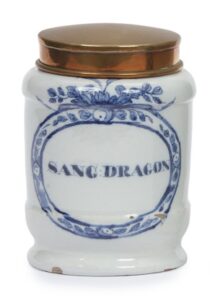
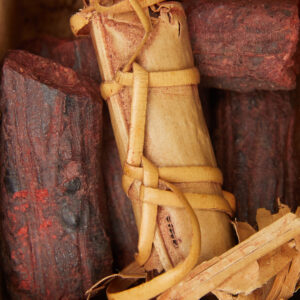
One such substance is dragon blood, Sanguis Draconis. Despite its evocative name, it is neither blood nor connected to the world of dragons, but a deep red gum-like resin obtained from trees native to the Canary Islands and Madeira, as well as from various tropical plants (Fig. 1).3 In early modern Europe, however, the distinction between appearance and material reality was far less decisive. Its vivid color and suggestive name encouraged its interpretation as a powerful vital substance. Sanguis Draconis was used primarily for wound treatment and to staunch bleeding, applications that aligned closely with its perceived sanguine nature. The belief that the “blood of a dragon” could restore or protect human blood exemplifies a medical imagination shaped by analogy and symbolism. A vessel inscribed Sang. Dragon. thus records not only a medicinal substance, but a way of thinking (Fig. 2).
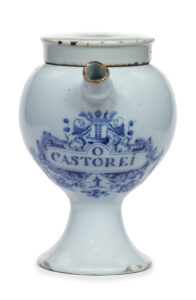
Equally charged, though rooted in the animal world, was castoreum, inscribed on apothecary jars in the collection as O(leum) Castorei (Fig. 3). This pungent substance was obtained from the scent glands of the beaver and was widely prescribed for nervous disorders, convulsions, and what early physicians described as hysteria. Castoreum was surrounded by a persistent and vivid myth, already circulating in antiquity and recorded by authors such as Pliny the Elder: the belief that a hunted beaver would bite off its own testicles to escape, sacrificing part of itself to survive.4 This misconception also led to the erroneous assumption that castoreum itself was derived from the testicles rather than from specialized scent glands. Although anatomically false, the story lent castoreum an aura of self-sacrifice and extraordinary potency. Its repellent odor, rather than undermining confidence in the remedy, was taken as proof of its strength. At the same time, castoreum does possess genuine pharmacological properties, as it contains salicylic acid, a compound derived from the beaver’s diet of willow bark.5 In this sense, Oleum Castorei functioned as a wonder medicine whose reputation was shaped by both myth and measurable effect
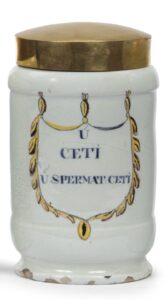
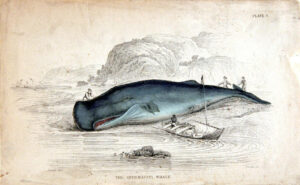
A more subtle, but no less evocative substance is spermaceti. Spermaceti is a waxy material extracted from the head of the sperm whale, an animal that early modern Europeans knew primarily through perilous maritime encounters (Fig. 4). It is encountered in the collection on a vessel inscribed u ceti u spermat:ceti (Fig. 5). Literally, the inscription reads Unguentum Ceti sive Sperma Ceti (ointment of ceti, that is, spermaceti). The double formulation reflects early modern pharmaceutical practice, in which a single substance could circulate under different names in medical literature and prescriptions, and served to ensure clear identification rather than grammatical precision. Whales occupied a liminal position between the known and the monstrous, and substances derived from them inherited this ambiguity. Spermaceti was valued for its cooling, soothing, and restorative qualities and was widely used in ointments for burns, wounds, and skin conditions. Its perceived efficacy drew not only on practical experience, but also on its exotic origin and the dangers involved in its acquisition. As with many wonder medicines, rarity and risk enhanced therapeutic credibility. The cylindrical jar mentioned above, shows that this substance was used around 1810.
Together, these substances, human fat, dragon blood, castoreum, and spermaceti, each grounded in different forms of tradition and experience, reveal a medical culture in which belief, observation, and material practice were closely intertwined. The pharmaceutical ceramics of the Van Gelder Collection give material form to this world and offer a rare and compelling insight into the enduring power of wonder within the history of medicine.
Notes
1. M.A. van Andel, Klassieke Wondermiddelen, Gorinchem, 1928, p. 3
2. Van Andel, 1928, p. 49
3. Nationaal Farmaceutisch Museum, collection no. 193
4. Igor Rosa, From Scythia to Sarmatia – Medical Use of Beaverʼs Body Parts from the Antiquity to the Early Modern Period, Bratislava, 2018, p. 9
5. Rosa, 2018, pp. 7-8
 CHINESE 阿伦森 WEBSITE