The South Sea Bubble of 1720: ‘Actie’ Delftware from the Meentwijck Collection
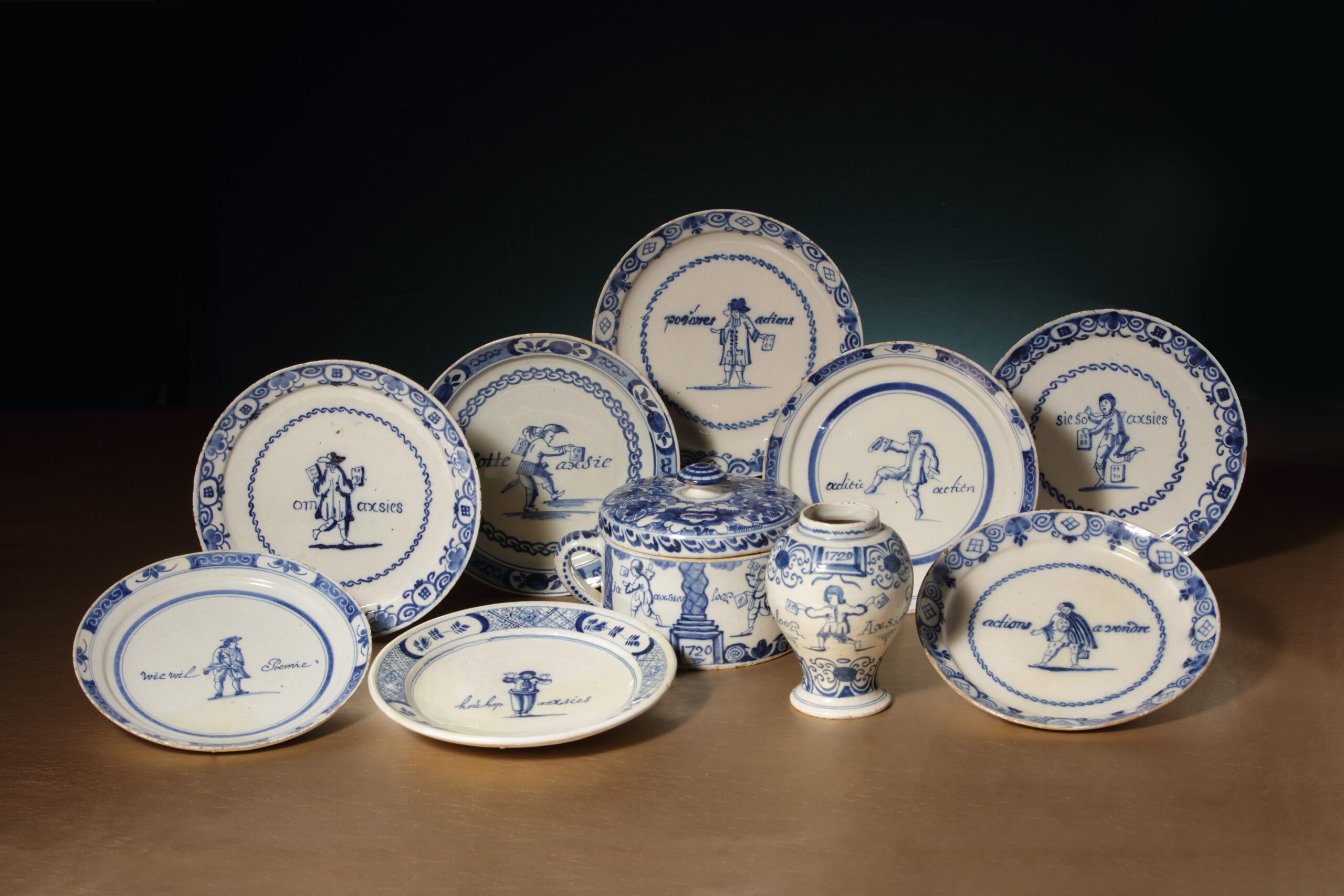
Main image by Michiel Elsevier Stokmans: ‘Actie’ Delftware, from Aronson Antiquairs, to be presented at TEFAF 2026.
With TEFAF 2026 in sight, we are greatly looking forward to presenting our collection in Maastricht and would like to offer a first preview of a remarkable ensemble. The group consists of eight Delftware plates, accompanied by a vase and a butter tub, both dated 1720. Together, they form a rare and unusually coherent ceramic response to one of the earliest market collapses in modern financial history.
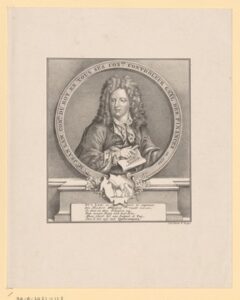
Although comparable in certain respects to the Dutch tulip mania of the 1630s, this crisis grew out of a new form of speculative share trading that increasingly detached itself from underlying value. In England, a large public debt, intensified by years of warfare including the War of the Spanish Succession (1701–1713), was addressed through an unconventional measure, converting government debt into shares issued by chartered trading companies. This solution significantly lowered the interest payments on government debt.1 In 1711 the South Sea Company was founded as part of this framework. Inspired by the English model, the Scottish financier John Law proposed comparable strategies to France, and in 1719 the Compagnie des Indes was created, often referred to as the Mississippi Company (Fig. 1).2 3 Investors bought shares on a massive scale, encouraged by the promise of extraordinary overseas profits and by the visible involvement of government.
The boom could not last. Prices rose so sharply that shares became a vehicle for rapid resale, sometimes even traded for profit before they had been fully paid for. When it became clear that expected commercial returns would never match the inflated prices, markets collapsed and many were left with worthless holdings and severe debts. News of the collapse spread rapidly across Europe, and the events of 1720 were discussed, analyzed, and satirized far beyond England.
Although share trading was not new in the Dutch Republic, notably through long-established companies such as the VOC, widely regarded as the first company in the world to issue permanent, freely tradable shares, the events of 1720 marked a shift in scale and character. Many Dutch investors also participated in South Sea Company shares, linking Dutch capital directly to the speculative boom in London and ensuring that developments abroad were closely followed at home.4 In June of that year, speculation became widespread in the Netherlands, rapid resale replaced long-term investment, and newly proposed companies multiplied at an unprecedented pace. At its height, around thirty-one such companies existed on paper and an estimated 300 million guilders were invested in shares.5 Several cities, including Amsterdam, Leiden, and Haarlem, prevented local companies from taking shape by issuing bans, and by October 1720 trading was being curtailed across the Republic.
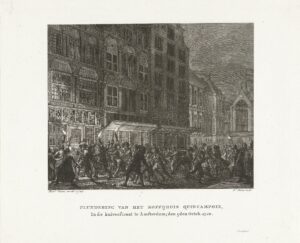
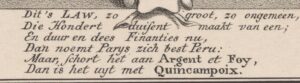
Compared with England and France, the damage in the Dutch Republic remained more limited, partly because state capital was not tied to the same degree to these ventures, and because participation remained relatively contained.6 Even so, the crisis was widely discussed and generated public tension, particularly among the urban poor, who feared economic hardship.7 In Amsterdam, unrest on October 5, 1720 became known as the Actiepest, with violence directed at share traders around the Engelsche Koffiehuis, known as Quincampoix, after the bankers’ district in Paris (Fig. 2).8
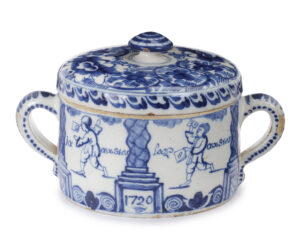
The Dutch response was immediate and highly visible in print. Satire became a dominant way of describing the crisis, and the best-known compilation is Het Groote Tafereel der Dwaasheid (1720), which collected texts and images mocking the logic of “paper wealth,” the theater of speculation, and the speed with which crowds could be drawn into a shared illusion.9 It is within this environment, where topical imagery circulated quickly and widely, that Delftware satire makes particular sense (Fig. 3). Delft potters were well placed to translate familiar figures and short slogans into ceramics, and practical forms such as plates and household vessels offered an ideal surface for direct and recognizable commentary that could even serve as conversation pieces.
 |
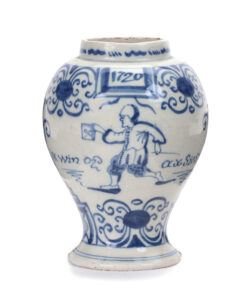 |
The group of Delftware objects that will be presented at TEFAF in March, belongs to this satirical tradition. The so-called actie imagery on Delftware frequently depicts commedia dell’arte characters, Harlequin figures, fools, jugglers, and more conventionally dressed figures representing traders holding share certificates and contracts (Fig. 4). Their inscriptions read like pointed captions, designed to be understood at a glance. Such pieces compress a complex financial event into a sharp visual shorthand, turning speculation into theater and bringing that theater into domestic space.10
The inscriptions found on this group are an integral part of its satirical programme. Rendered in deliberately corrupted Dutch and French, they evoke the shouted slogans and market cries of early-eighteenth-century share trading: “Wie wil premie” (“Who wants a premium?”), “Loop axsies” (“Buy shares!”), “Actions à vendre” (“Shares for sale”), and “Ik win op axsies” (“I profit from shares”). These confident assertions are countered by more sardonic phrases such as “Sotte axsie” (“Foolish shares”) and “Pouvres actions” (“Poor shares”), which, read with the benefit of hindsight, underline the rapid collapse of speculative optimism. The fractured spelling of acties as axsies, along with phrases that verge on nonsense, is intentional and mirrors the confusion, bravado, and collective delusion that characterised the financial mania of the 1720s. Together, these texts transform the objects into rare ceramic witnesses of the South Sea Bubble, capturing both the language of speculation and the moral critique that followed its disastrous end.
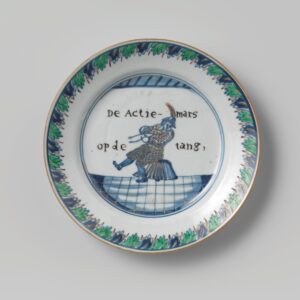
Related Chinese export porcelain versions made for the Dutch market raise the question of purpose and suggest that these objects were likely intended not only as commentary, but also as a cautionary lesson for Dutch audiences, a warning against speculative schemes and the risk of placing hard-earned profits into fragile paper ventures (Fig. 5).11
 |
 Beeldbank Rijksdienst voor het Cultureel Erfgoed/Wikimedia Commons |
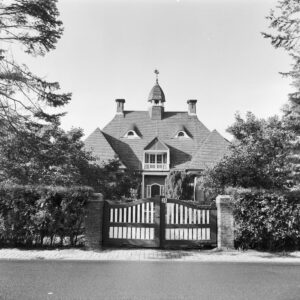
This satirical Delftware ensemble was part of the Meentwijck Collection of Dutch banker and stockbroker Dirk Nienhuis and his wife Liesbeth. Their collection was named after the villa they purchased in Bussum, a house designed in 1912 by the renowned Dutch architect and designer K.P.C. de Bazel (Fig. 6). The villa takes its name from De Bazel’s residence on the nearby Meentweg. Over time, it became closely associated with an impressive and wide-ranging collection of Dutch applied arts from approximately 1890 to 1940, now widely known as the Meentwijck Collection.
Nienhuis began collecting with stamps and weights, favoring objects with intrinsic value that were easily tradable, and later expanded the collection to include ceramics, glass, clocks, jewelry, lamps, and posters. His attention to a period that was not yet widely fashionable meant that prices were often modest at the time, while the quality of his selections helped shape later appreciation, attracting the interest of museums and collectors. Within that context, the Delft plates, alongside the vase and butter tub dated 1720, stand slightly apart from the collection’s usual period and focus. Their presence adds a distinctive historical dimension, bringing the world of commerce and financial history into dialogue with the applied arts that otherwise define the Meentwijck Collection, and may be understood in light of Nienhuis’s professional background in banking and securities trading.
Three centuries after the crash, these objects remain compelling for reasons that go beyond rarity alone. They show how quickly financial crises enter culture, how satire can function as a form of public analysis, and how these Delftware objects, as part of the decorative arts, can carry sharp commentary without leaving the domestic sphere. It is difficult not to recognize familiar patterns, whether in the dot-com boom, housing bubbles, or crypto euphoria. The tools change, but the sequence remains the same, the promise of easy gain, the acceleration of imitation, the moment when belief outruns reality, and the sudden reversal. For that reason, the caution embedded in these objects remains relevant, inviting reflection well beyond their historical moment.
Notes
- Jeroen Salman, “Spelen met de financiële crisis van 1720. De Aprilkaart in Het Groote Tafereel der Dwaasheid,” in: Historisch Tijdschrift Holland, vol. 42, no. 3, 2010, p. 179.
- The poem in this print may be translated as follows: “This is Law, so great, so extraordinary, who turns one into a hundred thousand; and while these finances thrive, Paris calls itself a second Peru; but once silver and trust run dry, it is the end of Quincampoix.” In this context, “Peru” refers to mythical wealth associated with gold and silver, while “Quincampoix” denotes the Parisian district where much of the speculative trading associated with Law took place, and by extension the financial system as a whole. The horse beneath John Law is depicted defecating coins, a satirical image intended to ridicule the illusion of effortless wealth.
- Salman, 2010, p. 179.
- Halde van Rijn, “De windhandel van 1720,” published online on Oneindig Noord-Holland, 26 March 2012.
- J. A. Worp, “De windhandel op het tooneel,” in: Noord en Zuid, vol. 24, Culemborg, 1901, p. 381; and Van Rijn 2012.
- Salman 2010, pp. 179–180.
- Pieter Langendijk, Quincampoix of de windhandelaars en Arlequyn Actionist, 1720′, new edition by C. H. Ph. Meijer, Zutphen, 1892, p. 14.
- Langendijk, ed. Meijer 1892, p. 8 and pp. 14–15.
- Kuniko Forrer, “De wereld is vol gekken: de ontstaansgeschiedenis van Het Groote Tafereel der Dwaasheid,” in: De Boekenwereld, vol. 14, March 1998, p. 109.
- D. Howard and J. Ayers, China for the West, London, 1978, vol. I, pp. 234–235.
- Ibidem.
 CHINESE 阿伦森 WEBSITE