Delft as a Military Hub: Reflections in Faience
William of Orange-Nassau (Dillenburg, 1533 – Delft, 1584), widely known as the Dutch “Father of the Fatherland,” served as stadholder of the provinces of Holland, Zeeland, and Utrecht, and played a central role in organizing resistance against Spanish rule during the Eighty Years’ War (1568–1648). His close association with Delft, where he established his residence in 1572 and was ultimately assassinated, transformed the city into a key political and military centre of the Dutch Revolt. He was buried in the Nieuwe Kerk (New Church) in Delft, and since then it has become customary for members of the House of Orange to be interred there, maintaining a lasting connection between the city and the Dutch royal family. His legacy endures to this day, most notably in the Dutch national anthem, the Wilhelmus. Against this historical backdrop, this article explores Delft’s military significance and its reflection in Delft faience.
William of Orange chose Delft for its strategic advantages. The city proved both loyal to the rebel cause and defensible: it lay beyond the immediate reach of Spanish forces, was protected by strong fortifications, and benefited from an extensive network of waterways that facilitated communication and supply. At the same time, his efforts to impose greater order on the military organization of the revolt proved crucial to its survival. He strengthened discipline, curbed the often unruly conduct of the Geuzen captains, and laid the foundations for a more structured military administration, responsible for the supply of artillery, gunpowder, transport, and provisions, as well as for the improved mustering and payment of troops.
Following his assassination in 1584 by Balthasar Gérard, authority passed to the States General until his son Maurice of Nassau was appointed stadholder in 1585. Building on the organizational and administrative foundations laid by his father, Maurice, in close cooperation with his cousin William Louis, stadholder of Friesland, initiated far-reaching reforms of the Dutch States Army. In 1599, the Ordre op de Wapeninge (Order Concerning the Arming of Troops) was established, setting standardized regulations for the armament and payment of infantry and cavalry units. These measures were particularly significant for the infantry, which formed the backbone of the Republic’s army during the Eighty Years’ War and accounted for a substantial portion of state expenditure. A growing emphasis was placed on the use of firearms, and the training of soldiers was increasingly systematized through drill instructions developed by William Louis and codified in the influential manual by the Southern Netherlandish artist Jacob de Gheyn (1565–1629).
Although Maurice did not reside in Delft, the city retained its military importance. Its role shifted from a centre of political leadership to one of logistical significance. Delft became a crucial hub within the Republic’s military infrastructure, housing both the provincial arsenal of Holland and the Generality’s central magazine. Together, these institutions formed a vital nexus in the supply and distribution of arms and munitions to both the standing army and civic militia units.
At the same time, this infrastructure entailed considerable risk. The catastrophic explosion of the gunpowder magazine in 1654, the so-called Delft Thunderclap, devastated a large part of the city and claimed many lives. Contemporary accounts describe the scale of destruction: approximately 200 houses were completely destroyed, a further 300 lost their roofs and windows, and scarcely a household in the city remained untouched. Entire neighborhoods were erased, and the disaster entered both visual and written memory as one of the most traumatic events in Delft’s history (Fig 1).
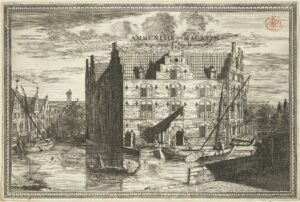
This event did not lead to a complete relocation of military storage from Delft. Already in the 1660s, a new gunpowder magazine was constructed at a distance of “a cannon shot” from the city, in an effort to prevent a recurrence of such devastation. At the same time, the arsenal in the city centre was extended (Fig. 2). Further expansion followed in the 1690s, when the arsenal doubled in size; to accommodate this enlargement, thirty-one houses were purchased and demolished.
The concentration of military resources profoundly shaped the character of Delft. Practices such as inspection, storage, and distribution formed part of daily life, reinforcing broader military reforms that emphasized order, coordination, and discipline. Even after the Peace of Münster in 1648, which marked the formal end of the Eighty Years’ War, the Dutch Republic did not enter a period of lasting stability. The Republic remained engaged in successive conflicts, including the Anglo-Dutch Wars, colonial confrontations overseas, and the crisis of the Rampjaar (Disaster Year) of 1672, when it faced invasion on multiple fronts. Within this context of persistent military tension, Delft retained, and indeed reaffirmed, its importance as a centre of military infrastructure.
By the eighteenth century, Delft’s role within this system had become more stable and institutionalized. While the city no longer functioned as a centre of military innovation or political leadership, its arsenals and depots remained in operation. The military thus persisted as a continuous presence within the urban fabric, embedded in its structures, labour, and daily routines.
Within this context, military imagery on seventeenth- and eighteenth century Delftware might be expected as a logical and meaningful theme, reflecting a system deeply embedded in the identity of the city. Yet, surprisingly few such objects have survived. Military subjects are far more commonly encountered on Delft and Northern Netherlandish tiles and tile panels, where they appear in greater number and variety. Engravings of soldiers by Jacob de Gheyn, for instance, served as an important source of inspiration and were widely adapted in seventeenth-century tile production.
Based on surviving objects, a modest interest in sixteenth- and seventeenth-century military themes in Delftware emerges towards the mid eighteenth century. This renewed attention may be linked to the political and military developments surrounding the War of the Austrian Succession (1740–1748). As an ally of Austria and Great Britain, the Republic became increasingly involved in the conflict, particularly when French forces advanced into the Southern Netherlands. The invasion of 1747 exposed the vulnerability of the Republic and led to significant political change.
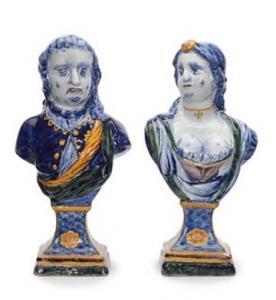
In response to this crisis, William IV (1711–1751), Prince of Orange-Nassau, was appointed stadholder of all seven provinces, becoming the first to hold this office on a hereditary basis. At the same time, he was installed as Captain-General of the Union, consolidating both political and military authority. His wife, Anna of Hanover (1709–1759), Princess of Brunswick-Lüneburg and daughter of King George II of Great Britain, embodied the Republic’s dynastic ties with Britain and played an active political role, later serving as regent. Their elevation was accompanied by a surge in Orangist sentiment and public expressions of loyalty, reflected in Delft faience, such as a pair of bustes featuring the royal pair (fig. 3).
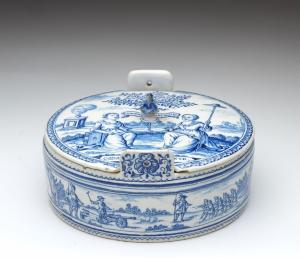
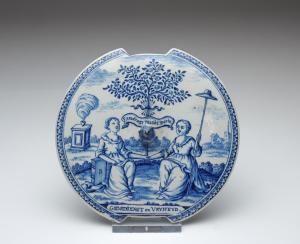
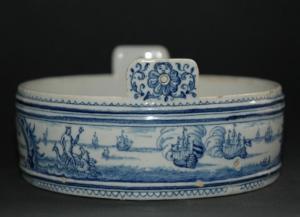
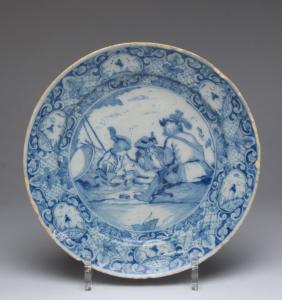
A small group of Delftware butter tubs preserved in the collection of Museum Prinsenhof Delft (fig. 4), decorated with military motifs and bearing an Orangist association, combines these themes. The Orangist secretary of Delft, Gaspard Rudolph van Kinschot, commissioned the butter dishes on the occasion of the inauguration of William IV as Captain-General of the Union on May 15, 1747. The museum’s collection also includes two plates dating from the first half of the eighteenth century, both depicting card-playing soldiers after a print by Cornelis Bloemaert II (1603-1692) (fig. 5), as well as a plate dating from the same period, showing the conquest of Maastricht by the Duke of Parma in 1579 (fig. 6).
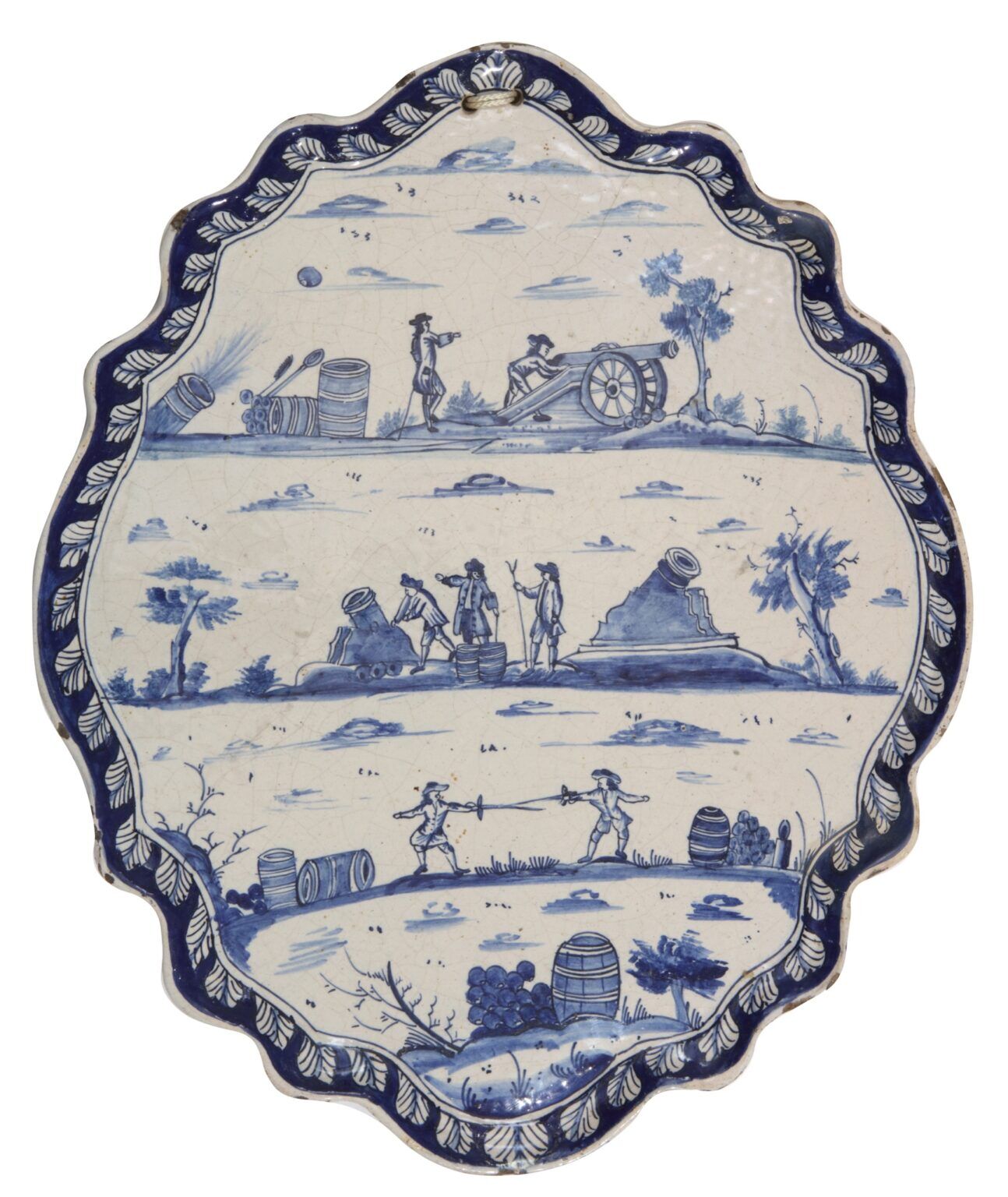
An intriguing plaque from the Aronson Collection (main image), depicting military exercises, may be understood as part of this broader eighteenth-century emergence of the visual expression of military identity in Delftware. Although it appears to be unique, with no closely comparable examples currently known, it fits within this developing context. The composition is arranged in three horizontal registers, each illustrating a different aspect of military drill and exercise. The upper two registers depict artillery drills with a cannon and seem to be inspired by Jacques Callot’s (1592–1635) series Les exercices militaires (fig. 7), while the lower register shows two soldiers engaged in a fencing exercise.
While Callot produced numerous prints depicting military drill and the handling of weapons, these were not conceived as formal instructional tools comparable to the manuals of Jacob de Gheyn. Rather, they functioned as widely circulated visual observations of contemporary military practice. Their clarity of gesture and sequence nevertheless endowed them with a quasi-didactic quality, making the principles of drill and discipline accessible to a broader audience beyond the strictly military sphere.
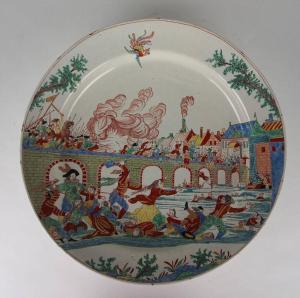
Whether this plaque was intended as an instructive object or as a commemorative reflection on the importance of drill and discipline, introduced by Maurice and William Louis in the seventeenth century, remains uncertain. What is clear, however, is that it demonstrates the remarkable breadth of subject matter explored by Delft pottery painters and reveals how military themes, though relatively rare, could be adapted into complex and intellectually layered compositions within Delft faience.
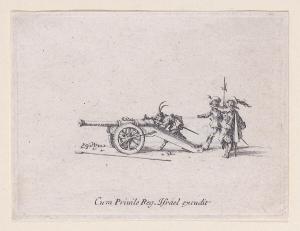
Jacques Callot , 1635, Metropolitan Museum, New York (inv. no. 57.650.398(12))
NOTES
1. K.W. Swart (eds. Raymond Fagel, M.E.H.N. Mout and Henk van Nierop), Willem van Oranje en de Nederlandse Opstand 1572–1584, The Hague, 1994, p. 69
2. A Geuzen captain was a leader of irregular rebel forces during the early stages of the Dutch Revolt, often commanding groups of insurgents or privateers who operated with a considerable degree of autonomy before the army became more formally organized.
3. The States General was the central governing body of the Dutch Republic, representing the collective interests of the seven United Provinces.
4. M.A.G. de Jong, ‘Militaire hervormingen in het Staatse leger en de opbouw van het wapenbedrijf 1585–1621’, in: Bijdragen en Mededelingen betreffende de Geschiedenis der Nederlanden, vol. 118, The Hague, 2003, p. 470.
5. M.A.G. de Jong, Militaire hervormingen in het Staatse leger en de opbouw van het wapenbedrijf 1585–1621, vol. 118, The Hague, 2003, p. 469. A “Generality magazine” (Generaliteitsmagazijn) was a centrally administered arsenal supplying the army of the Union as a whole, as opposed to provincial magazines maintained by the separate provinces.
6. Reinier Boitet, Beschryvinge van de Stad Delft, Delft, 1729, p. 564
7. Ibidem
8. ‘Zwaar Geschut’, City Archive Delft, published online, July 15, 2023
9. Wilhelm Joliet, Wisselwerking van sponsen en decors, Harlingen – Rotterdam, Wapenhandelinghe van roers, musquetten ende spiessen, n.d.
10. Caption with inventory number B 2-428-A
 CHINESE 阿伦森 WEBSITE