
Images on this website are licensed under a
Creative Commons Attribution-NoDerivs 3.0 Unported License.
OBJECT
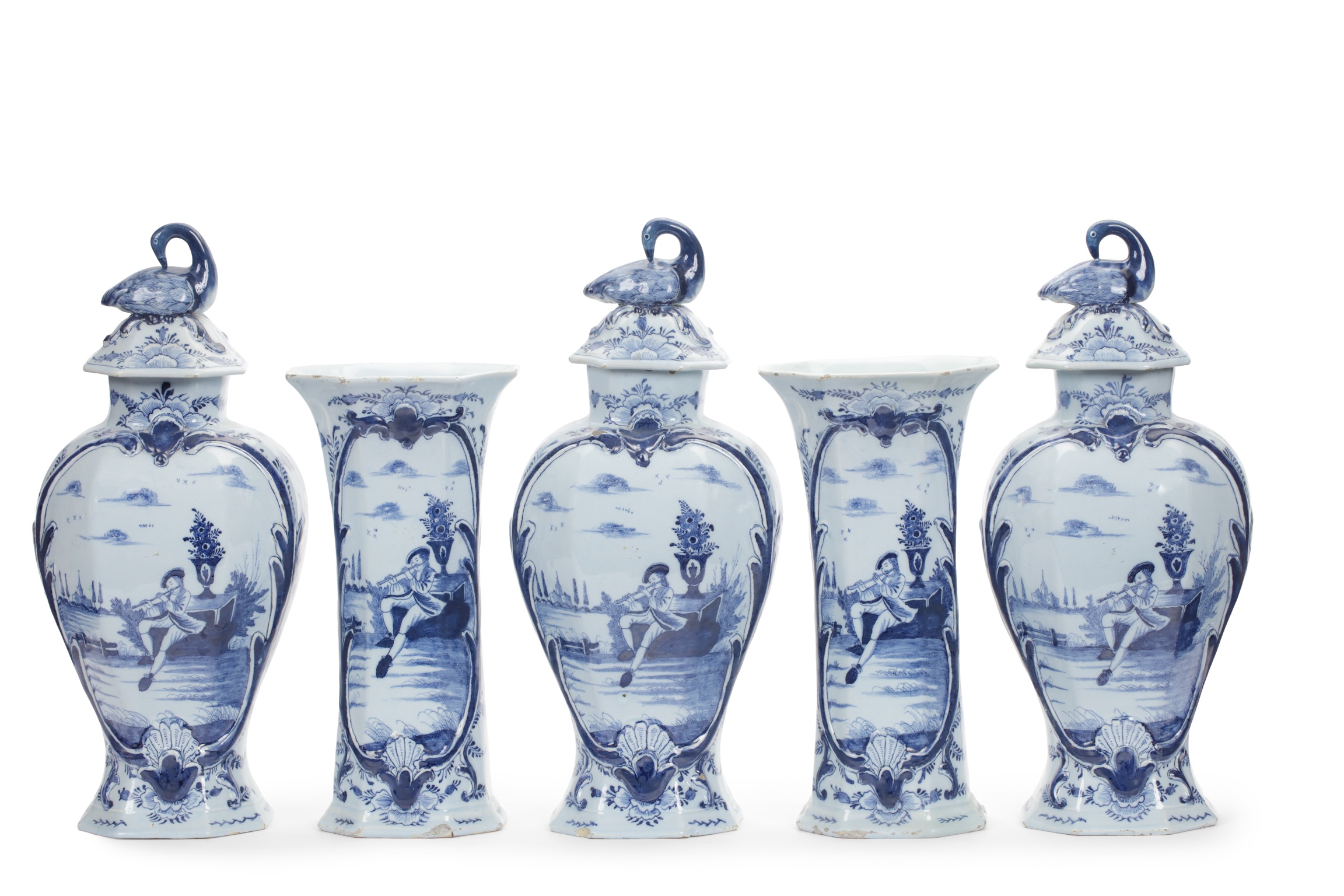
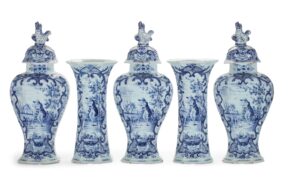
D2670. Garniture Set
Delft, circa 1780
DIMENSIONS
Heights: 29.8 and 40.2 cm. (11.7 and 15.8 in.)
PROVENANCE
Dutch Private Collection, Maastricht;
Aronson Antiquairs, Amsterdam
NOTE
This garniture is firmly rooted in the tradition of Delftware sets that emerged in the Netherlands during the late seventeenth century, a period when the fashion for grouping vases on mantels, above doorways, or atop cabinets had become an established feature of elite interior decoration. Inspired initially by the arrival of Chinese porcelain through the VOC, these symmetrical arrangements evolved into a distinctly European phenomenon, with Delft potters producing their own interpretations. By the eighteenth century, the garniture had developed into standardized combinations, most commonly five pieces, combining covered vases with beakers in harmonious, coordinated designs.
The present set belongs to this mature phase of Delftware garniture production, when potters increasingly drew on European artistic movements to shape both form and decoration. Its molded cartouches, enriched with shell motifs, and the overall sense of movement in the design are characteristic of the rococo style, which had become fashionable across Europe by the mid-eighteenth century. This style encouraged asymmetrical curves, playful ornament, and a shift from exotic chinoiserie subjects to pastoral and romantic European scenes. The swan finials, an unusual choice within the Delft tradition, complement the rococo taste for naturalistic and graceful forms, while distinguishing the set from more common finial types such as foo dogs or birds with cherries.
In keeping with the historical role of such sets, this garniture would have been prominently displayed in a position of honor, its unified yet varied forms creating a rhythmic visual effect across a mantelpiece or cabinet cornice. The combination of octagonal shapes, rococo ornament, and European subject matter situates it within the broader decorative trends of its time, while still preserving the essential qualities that defined Delftware garnitures from their inception: symmetry, coordinated design, and the fusion of artistic style with the social function of display. Around the same time, interior designers transformed cabinet cornices from straight into serpentine. It was only logical that from about 1730–40, the next progression in this development would be the integration of wooden consoles into the cabinet cornices, the perfect stage for the presentation of a garniture.
 CHINESE 阿伦森 WEBSITE