

Images on this website are licensed under a
Creative Commons Attribution-NoDerivs 3.0 Unported License.
OBJECT
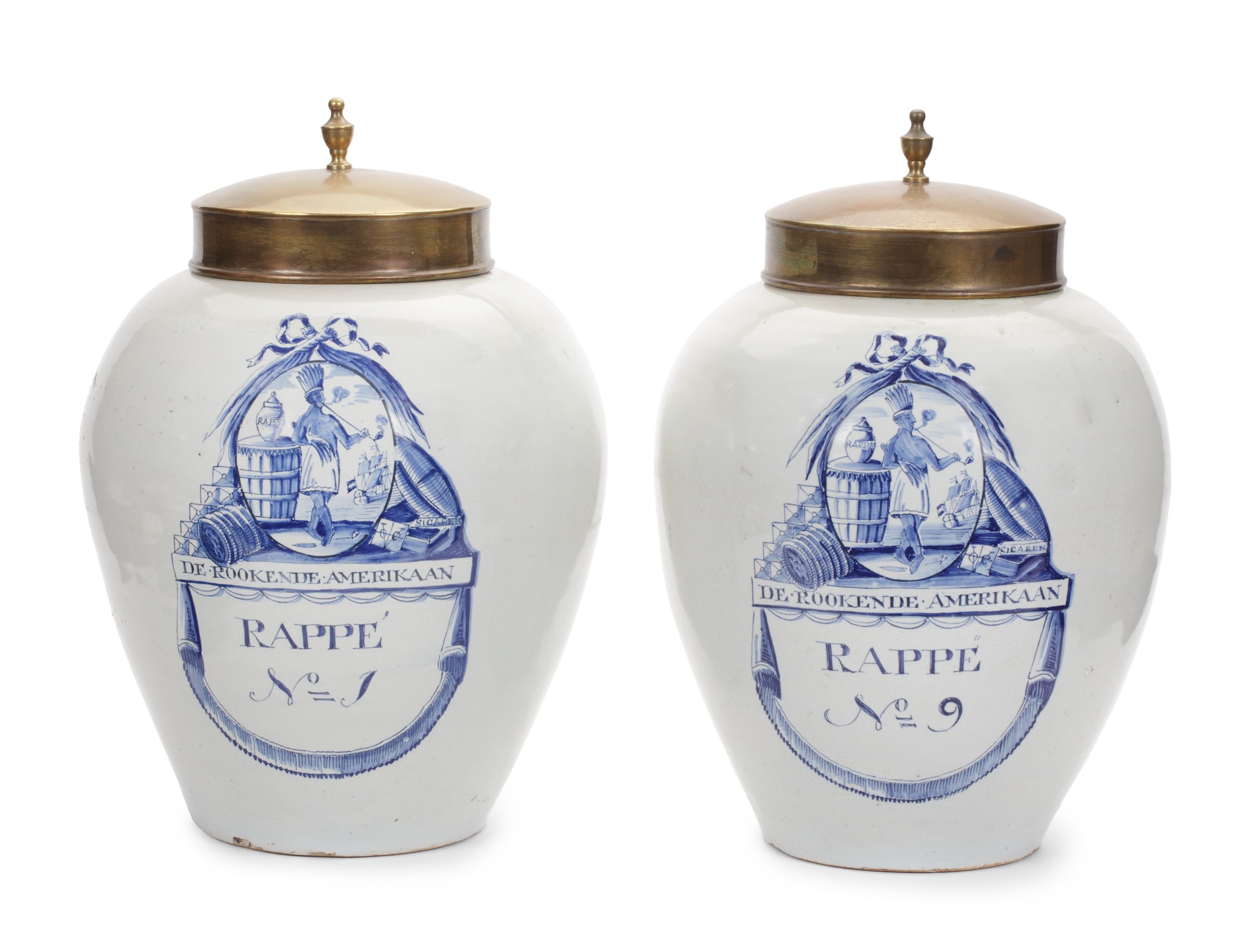
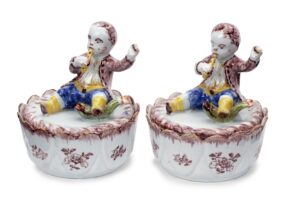
D2669. Pair of Tobacco Jars
Delft, circa 1780
Marked with three bells in blue for De Drie Klokken (The Three Bells) factory
DIMENSIONS
Height: 36 cm. (14.2 in.)
PROVENANCE
Dutch Private Collection, Maastricht;
Aronson Antiquairs, Amsterdam
NOTE
Each jar is painted on the front of the ovoid body with a Native American chieftain smoking a long-stemmed pipe beside a barrel, within an oval cartouche crowned with ribbon and bow, flanked by a stack of chests on one side and a boat on the other, and inscribed VOC Sigaren.
These Delftware tobacco jars reflect the Dutch engagement in the seventeenth- and eighteenth-century transatlantic tobacco trade, in which the West India Company played a major role. Tobacco cultivated in regions such as Surinam, Brazil, Virginia, and Maryland was processed at its origin, packed into barrels and chests, and shipped to Amsterdam, a principal hub for its import and distribution. In the Netherlands the leaves were further processed into products including the strong, moist snuff known as rappé (from tabac rappé), referenced by the inscriptions on the jars and by the numbered designations for different grades or blends.
Of particular importance is the inscription De Rookende Amerikaan (The Smoking American), a designation that is rare and historically charged on Delftware tobacco jars. In seventeenth- and eighteenth-century Dutch usage, the term Amerikaan was often employed broadly and imprecisely, frequently functioning as a synonym for the Indigenous peoples of the Americas. In visual culture, the “American” was commonly represented as a Native American figure, identified by attributes such as feathered headdress, minimal dress, and the long-stemmed pipe, iconography clearly present on these jars. De Rookende Amerikaan reflects a generalized European conception of the New World and its inhabitants.
The imagery of the smoking chieftain, flanking containers, and distant ship evokes both the commodity’s overseas origins and the maritime networks that enabled its circulation. In their original commercial context, jars of this type served as prominent shop furnishings, storing bulk tobacco while simultaneously advertising its exotic provenance and commercial appeal.
 CHINESE 阿伦森 WEBSITE