
Images on this website are licensed under a
Creative Commons Attribution-NoDerivs 3.0 Unported License.
OBJECT
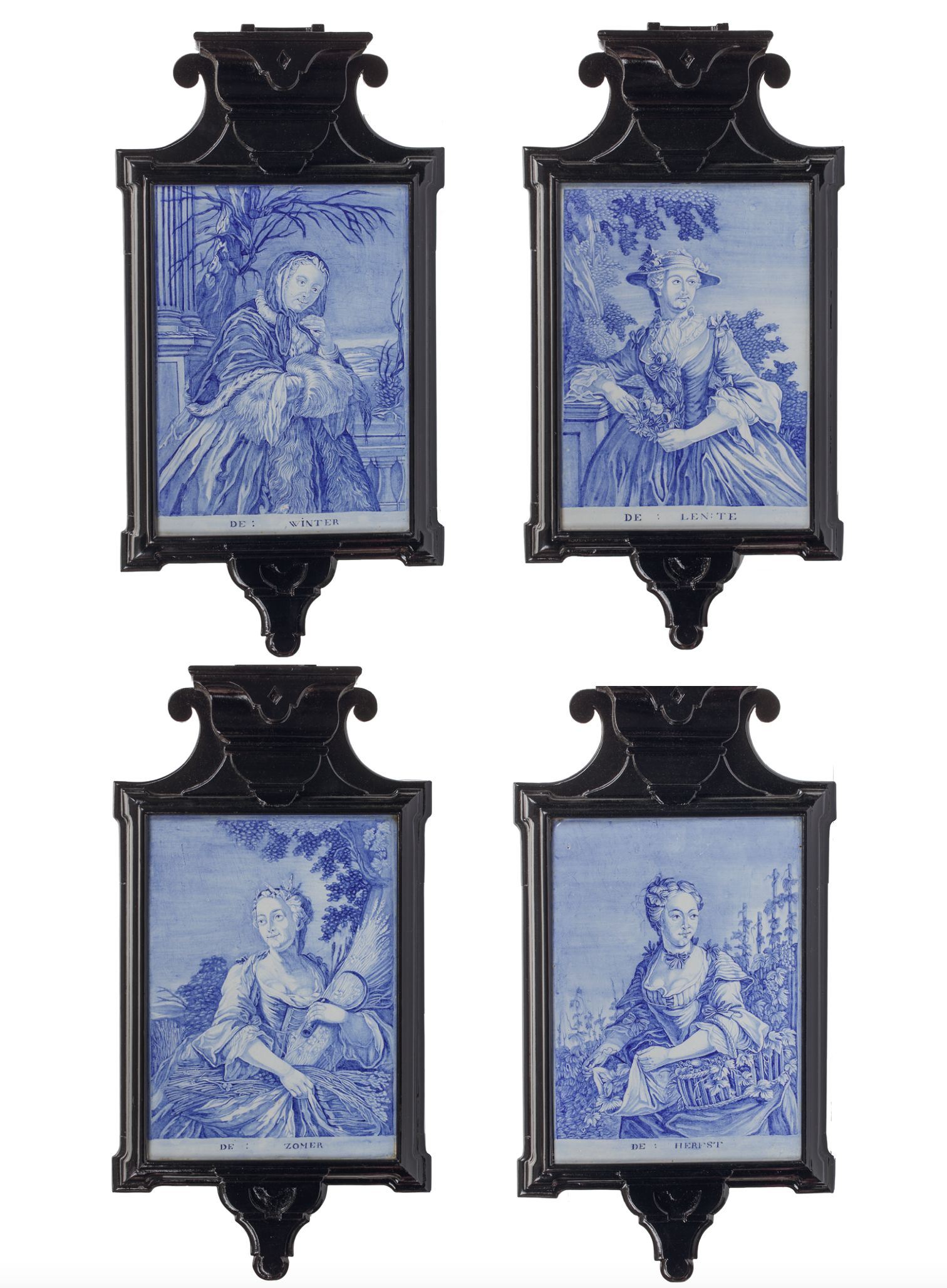
D2666. Set of Plaques of the Four Seasons
Delft, circa 1770
DIMENSIONS
Heights: 38.6 cm. (15.2 in.); Widths: 28 cm. (11 in.)
PROVENANCE
Jacques Fijnaut, Amsterdam;
Sotheby’s Amsterdam, October 12, 2004,
no. 156;
The Collection of Archibald Stirling of Keir, Scotland
NOTE
The representations of the Four Seasons on this set of plaques are based on a series of engravings by the Parisian printmaker A. J. de Fehrt (1723–1774), who occasionally signed his works J. A. or Bernard de Fehrt. His designs, in turn, derive from the celebrated pastel series of the Four Seasons by the Venetian artist Rosalba Carriera (1675–1757), executed around 1731 and now preserved in the Staatliche Gemäldegalerie, Dresden. In Carriera’s cycle, the allegory of Winter has traditionally been interpreted as a self-portrait of the artist, lending the series an additional autobiographical dimension.
The presence of the complete cycle on these Delft plaques underscores the remarkable continuity of the Four Seasons as a pictorial theme. Since antiquity, Spring, Summer, Autumn, and Winter were conceived not merely as divisions of time, but as allegorical figures embodying nature’s rhythms, agricultural labor, and the human experience of cyclical change. Roman mosaics and Pompeian wall paintings already established an iconographic canon, presenting Spring with flowers, Summer with wheat or a sickle, Autumn with grapes or vine leaves, and Winter wrapped in heavy garments.
This tradition was revitalized during the Renaissance and Baroque periods, most notably in pictorial cycles by artists such as Nicolas Poussin (1594–1665), whose Four Seasons (1660–1664) fuse classical mythology with Christian symbolism. In the eighteenth century, these established visual conventions continued to circulate widely through prints, which served as important models for artists and artisans alike.
Within Delftware production, the theme of the Four Seasons enjoyed considerable popularity. In addition to plaques such as the present set, Delft potters produced allegorical figures and other decorative objects reflecting the same subject matter. These plaques thus illustrate how international artistic models, transmitted through prints and painting, were adapted into Delftware, reaffirming the enduring appeal of the Four Seasons as an allegory of time, nature, and human life.
 CHINESE 阿伦森 WEBSITE