
Images on this website are licensed under a
Creative Commons Attribution-NoDerivs 3.0 Unported License.
OBJECT
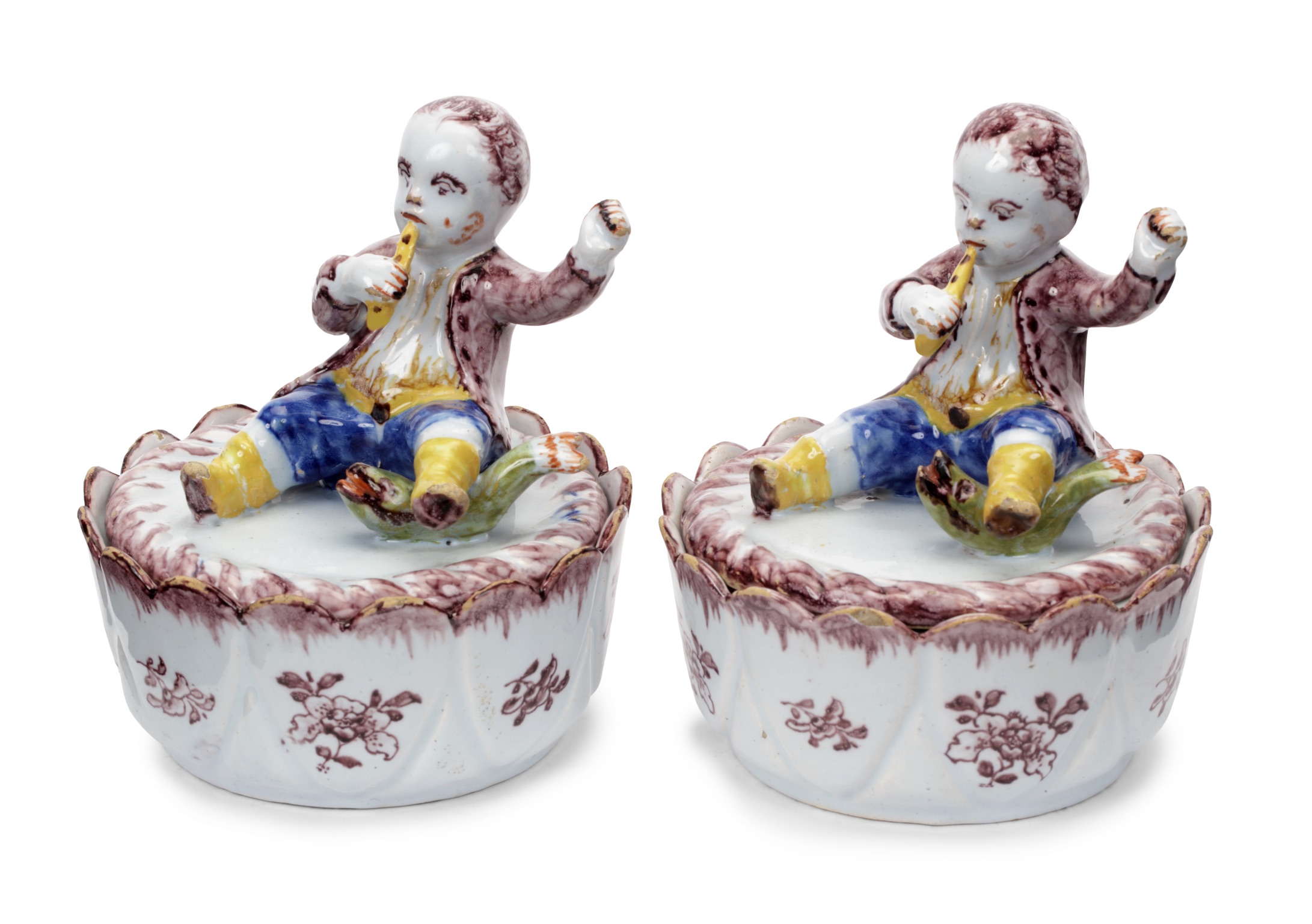
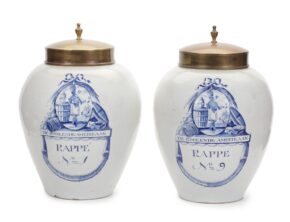
D2663. Pair of Figural Tureens
Delft, circa 1765
Each marked and numbered A / IH 12 107 in manganese for Jacobus Halder, the owner of De Grieksche A (The Greek A) factory from 1764 until 1768
DIMENSIONS
Heights: 13.5 cm. (5.3 in.);
Diameter: 11 cm. (4.3 in.)
PROVENANCE
Belgian private collection until 2023;
Collection of Michel van Gelder (1864–1929), Château Zeecrabbe, Uccle, Brussels
NOTE
Jacobus Adriaensz. Halder’s tenure as owner of the renowned Delft pottery De Grieksche A lasted only from December 1764 to 1768, yet in those few years he left a clear imprint on the factory’s production. Born in September 1741 to Margaretha van Rheenen and Adrianus Halder, he grew up in a period when Delftware faced increasing competition from foreign ceramics. In 1763 he married Johanna Radder, and soon after the couple acquired De Grieksche A from Jan Theunis Dextra (likely aided by Johanna’s inherited wealth from her first marriage). Two years later, Halder registered his “A / IH” mark with the Saint Luke’s Guild, at first as a shopkeeper, but by the time he sold the business in 1768 to Johannes van Briel and Petronella van der Laan, he had achieved the title of master potter.
During his brief but active ownership, Halder oversaw a diverse production that balanced tradition with innovation. The factory continued to produce classic blue-and-white Delftware, but also ventured into more elaborate figural pieces and imaginative figurative tablewares. Among his most distinctive contributions was a small group of petit feu Rococo objects inspired by Meissen porcelain, their refined colors and playful forms showing a keen awareness of changing European tastes. These works, produced at a time when Delft potters were under pressure from English creamware and German porcelain, reflect Halder’s determination to keep his wares competitive. Yet the limited number of surviving examples hints that this experimental line may have met with only moderate commercial success, or that the necessary specialist skills were lost when Halder left the factory. The present butter tubs, marked with his “A / IH” monogram, are part of this creative chapter, embodying both the craftsmanship and the inventiveness that defined De Grieksche A during his tenure.
 CHINESE 阿伦森 WEBSITE