
Images on this website are licensed under a
Creative Commons Attribution-NoDerivs 3.0 Unported License.
OBJECT
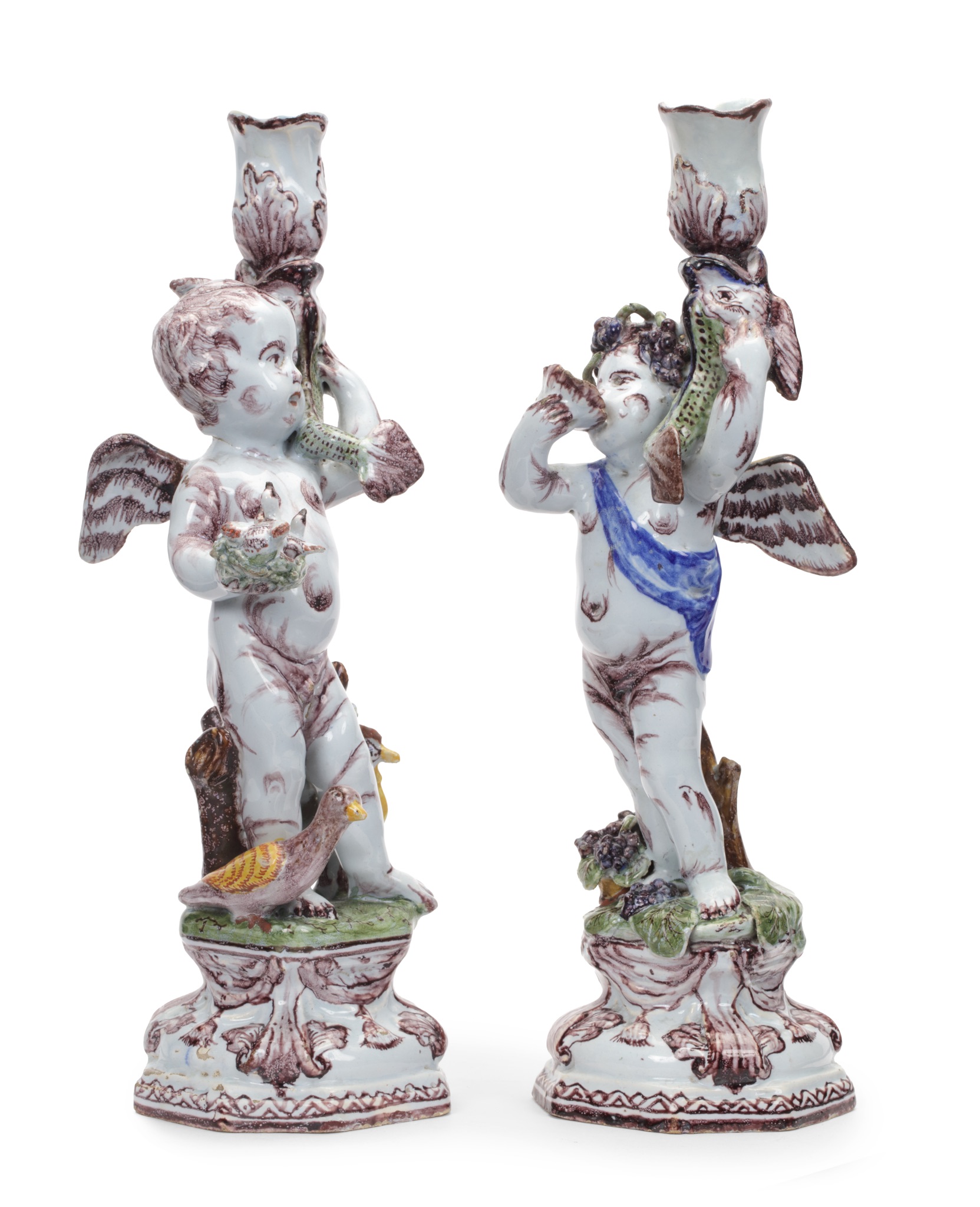
D2662. Pair of Figural Candlesticks
Delft, circa 1765
Marked and numbered AIH 110 12 in manganese for Jacobus Halder, the owner of De Grieksche A (The Greek A) factory, from 1764 until 1768
DIMENSIONS
Heights: 28.5 and 29 cm. (11.2 and 11.4 in.)
PROVENANCE
Belgian Private Collection
NOTE
This important pair of figural candlesticks represents the high point of mid-eighteenth-century figural production in Delft and reflects the full assimilation of the rococo idiom into Dutch ceramic art. Modeled as winged putti supporting candle sockets, the candlesticks combine sculptural ambition with decorative function and were intended as prominent ornaments within refined domestic interiors.
During the third quarter of the eighteenth century, Delft potters increasingly adopted European sculptural models, moving away from earlier Asian themes toward subjects inspired by French and German art. The present candlesticks clearly reflect the influence of German porcelain, particularly Meissen, whose figural candleholders were widely admired and collected across Europe. Imported porcelain not only shaped taste but also provided concrete models for Delft factories, where vormers adapted such designs to the possibilities of tin-glazed earthenware.
The putti are animated with characteristic rococo vitality. Their asymmetrical poses, expressive gestures, and lively interaction with attributes such as birds and fish convey a sense of movement and playfulness. These motifs draw upon a long European tradition in which putti symbolized abundance, nature, and festivity, subjects well suited to objects intended for display in convivial settings. While indebted to porcelain prototypes, the sculptural treatment retains a distinctly Dutch sensibility, with robust modeling and an engaging directness characteristic of Delftware.
Figural candlesticks of this quality were luxury objects, displayed prominently on mantelpieces, console tables, or within display cabinets as part of the decorative ensemble of rococo interiors. Although the popularity of Delft figural wares declined toward the end of the eighteenth century in favor of porcelain, pairs such as this remain compelling testimonies to the artistic ambition and technical sophistication of Delft potters at a moment when they successfully engaged with international taste while maintaining a distinctive local identity.
 CHINESE 阿伦森 WEBSITE