
Images on this website are licensed under a
Creative Commons Attribution-NoDerivs 3.0 Unported License.
OBJECT
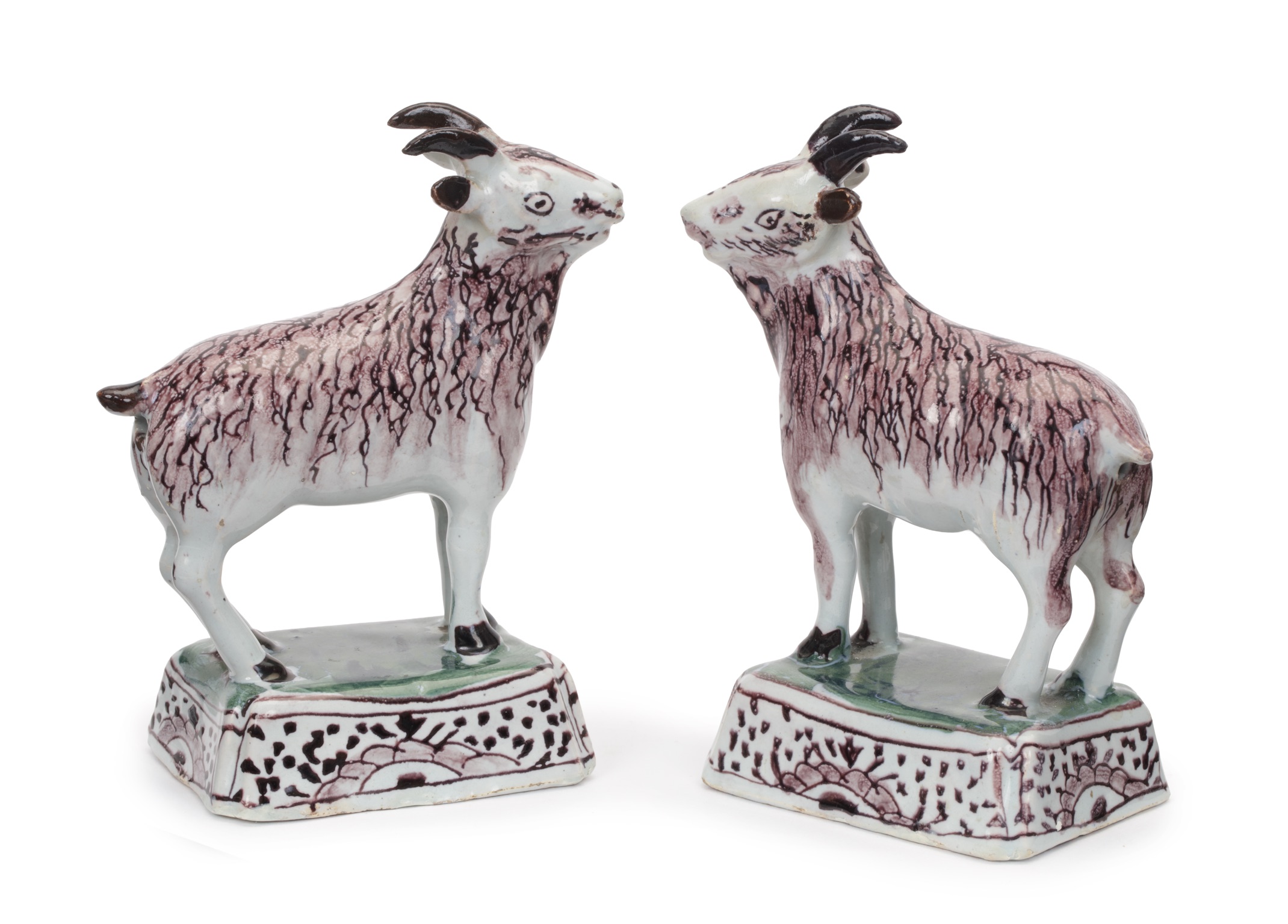
D2659. Pair of Goats
Delft, circa 1775
DIMENSIONS
Heights: 12 cm. (4.7 in.)
PROVENANCE
Dutch Private Collection;
Aronson Antiquairs, Amsterdam;
The Van der Vorm Collection;
Aronson Antiquairs, Amsterdam, 1993;
The collection of A.Vromen Jr., Doetinchem
LITARTURE
Aronson 2019, pp. 114-115, no. 58
NOTE
From the mid-eighteenth century onward, Delft potters produced a wide variety of animal figures intended purely for decoration, reflecting changing tastes in interior design. This development grew out of a tradition established in the late seventeenth century, when Delftware, particularly blue-and-white wares, became fashionable among elite patrons such as Queen Mary II, consort of King-Stadholder William III. By the eighteenth century, Delft factories expanded their repertoire to include more polychrome objects, often modeled as domestic and farm animals, which appealed to a broader clientele unable or unwilling to invest in more costly German porcelain.
The production of such figures was technically complex and labor-intensive. A skilled modeler first created a prototype in wood or clay, from which molds were cast. Thin sheets of clay were shaped within the molds, then joined together with clay paste before firing and glazing. Pairs such as this were intended for symmetrical display on mantelpieces, in glass-fronted cabinets, or on étagères, often as part of larger decorative ensembles. While early models drew heavily on Chinese porcelain prototypes, Delft painters adapted the palette, favoring colors such as the distinctive aubergine-purple seen here. By the third quarter of the eighteenth century, European porcelain factories, particularly Höchst under Johannes Zeschinger—also provided inspiration for both subject matter and color schemes, aided by the movement of German and French craftsmen to the Netherlands.
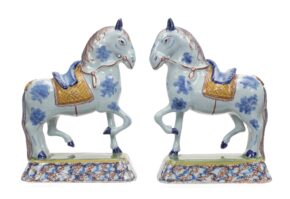
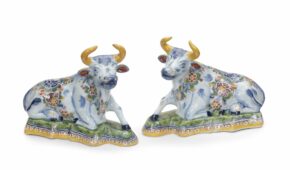
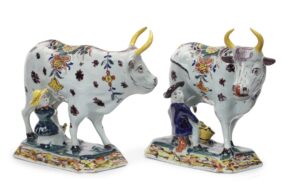
In an agricultural society like the Netherlands, farm animals were a natural subject for Delftware figures, and goats were among the popular motifs alongside horses, cows, and dogs. Such figures not only reflected everyday rural life but also reveal the Delft potters’ ability to blend charm, craftsmanship, and the influence of international ceramic trends into decorative objects for fashionable eighteenth-century interiors.
 CHINESE 阿伦森 WEBSITE