
Images on this website are licensed under a
Creative Commons Attribution-NoDerivs 3.0 Unported License.
OBJECT
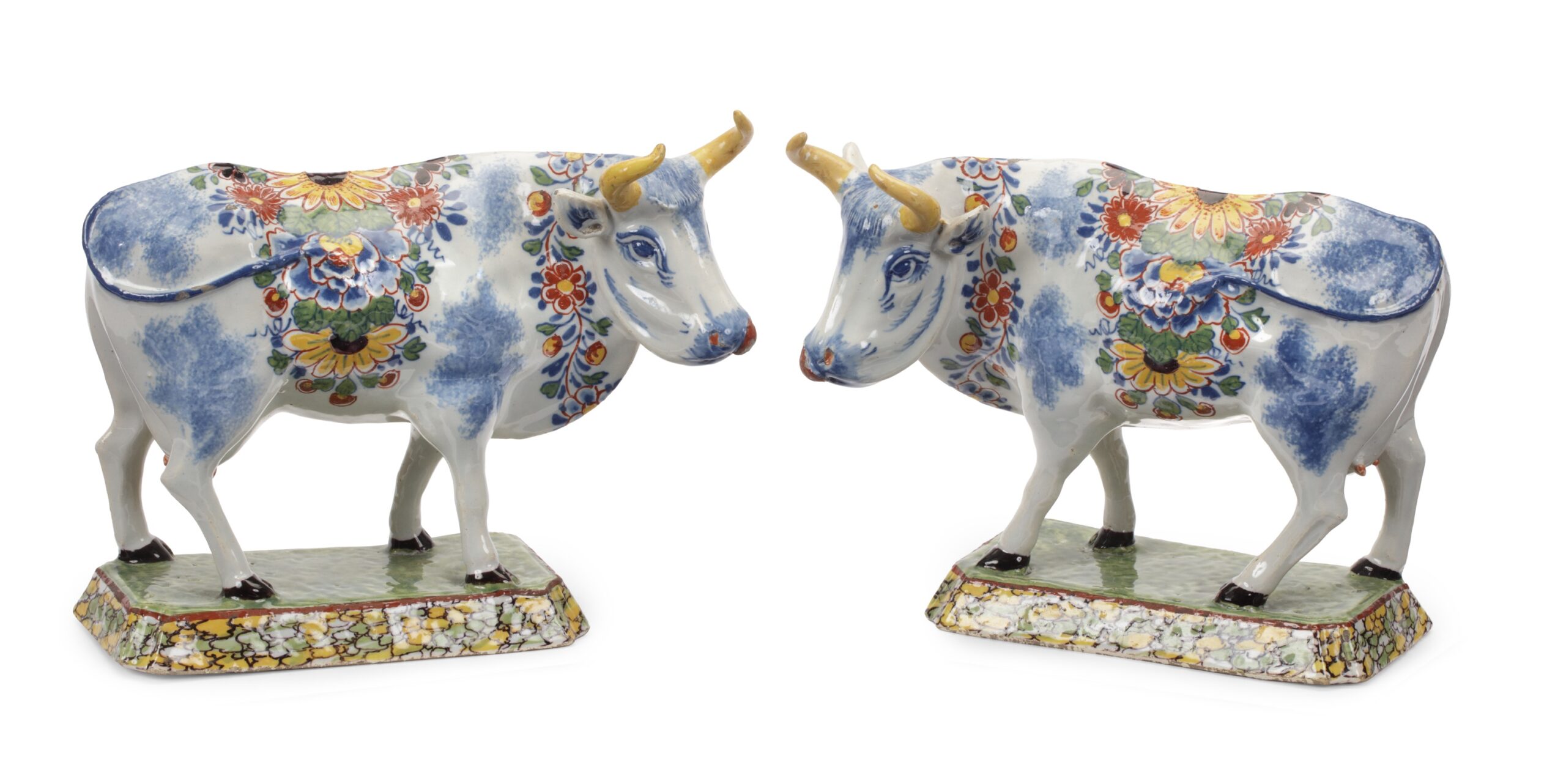
D2658. Pair of Cows
Delft, circa 1760
DIMENSIONS
Height: 17 cm. (6.7 in.);
Length: 20.5 cm. (8 in.)
PROVENANCE
Dutch Private Collection, Maastricht;
Aronson Antiquairs, Amsterdam
NOTE
This pair of Delftware cows derives directly from a long-standing civic tradition in the Netherlands: the ceremonial parade of the Butchers’ Guild. Each year, on the feast day of Saint Luke, the guild’s patron saint, symbolized by the apocalyptic winged ox, the guild celebrated its finest bull or cow in a public procession. The chosen animal was lavishly adorned with floral garlands, ribbons, and gilded horns, often topped with citrus fruit, and led through the town accompanied by drummers, pipers, and a jubilant crowd of guild members and townspeople.
The visual language of this parade is unmistakably echoed in the present figures. The cows are modeled standing and facing one another, their calm yet attentive postures suggesting a moment of ceremonial display rather than agricultural labor. The painted floral swags draped across their backs and necks, together with the yellow horns, closely reflect contemporary descriptions of the guild animal’s decoration. These embellishments transformed the beast into a symbol of abundance, civic pride, and communal festivity, an image that Delft potters translated into ceramic form for the domestic interior.
Historical accounts underscore the persistence and significance of this tradition. Even after the decline of the guild system, butchers continued to parade especially fine animals through town as a form of advertisement and celebration. As Jan ter Gouw noted in De Volksvermaken (1871), the decorated ox remained synonymous with excellence and prosperity, giving rise to the saying “the guild ox is on parade”, a proverbial expression for a true feast.
By casting the cow as a festive and honored subject, Delftware examples such as this pair preserve the memory of a public ritual that once animated Dutch urban life. Removed from the street and installed on mantelpieces or cupboards, the cows functioned as enduring reminders of collective celebration, civic identity, and the ceremonial culture surrounding food, abundance, and community in the early modern Netherlands.
 CHINESE 阿伦森 WEBSITE