

Images on this website are licensed under a
Creative Commons Attribution-NoDerivs 3.0 Unported License.
OBJECT
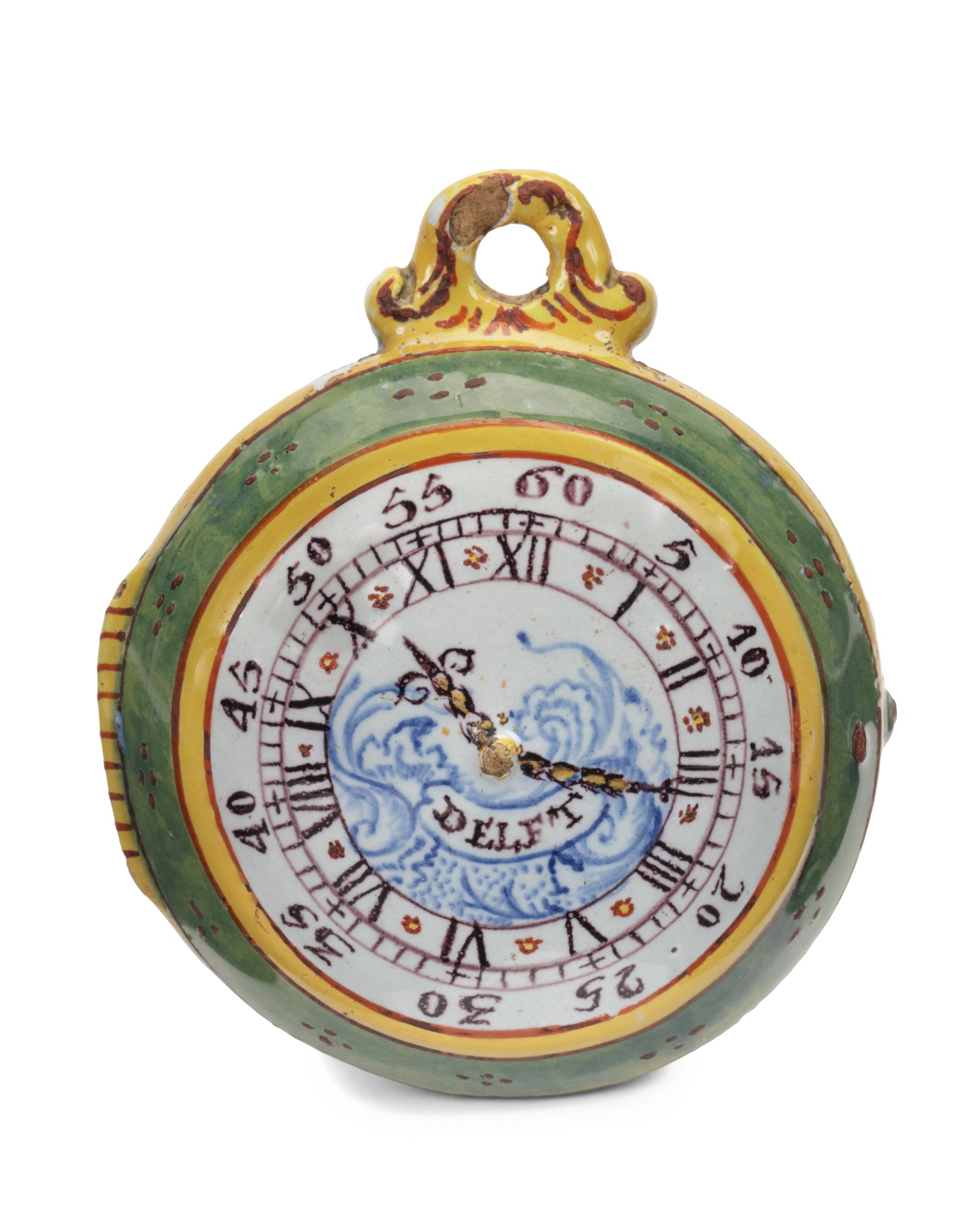
D2652. Model of a Pocket Watch
Delft, circa 1765
DIMENSIONS
Height: 7.3 cm. (3 in.)
PROVENANCE
Dutch Private Collection, Maastricht;
Aronson Antiquairs, Amsterdam;
Collection of Benjamin F. Edwards, St Louis, Missouri;
Aronson Antiquairs, Amsterdam
LITERATURE
Aronson 2001, no. 48 and Aronson 2014, pp. 124-125, no. 62.
NOTE
This Delftware model of a pocket watch is a trompe-l’œil model intended to sit in the circular aperture of a Delftware watch stand and “stand in” for a real timepiece. In an era when clocks were costly and not present in every room, such stands allowed a portable pocket watch to be set on a mantel or desk and used as a temporary clock. When the owner was out, or the watch was in the pocket, the aperture was filled with a ceramic substitute like the present example, preserving the appearance of a complete clock ensemble. The convenience and charm of the type made watch stands popular adjuncts to the rococo interior; they were even incorporated into some rococo inkstands.
The decoration of this model underscores both its function and its fashion. The painted dial combines a minute ring of Arabic numerals with an inner chapter ring of Roman hours, punctuated by tiny florets, an accurate evocation of contemporary watch faces, while the two painted hands are set to about 10:16. At the center, a blue rococo scroll cartouche sweeps across the field around the word “DELFT,” announcing the place of manufacture and aligning the piece with local pride in Delftware production. The illusion continues in the casing: a green “case” with a yellow bezel, a molded hinge to one side and a winding “crown” to the other, a pierced back for ventilation, and a double-scroll suspension loop at the top. Together these details translate a fashionable personal accessory into a witty and decorative ceramic object: one designed not to keep time, but to complete the tableau of a domestic interior where Delftware and horology met on the mantel.


 CHINESE 阿伦森 WEBSITE