
Images on this website are licensed under a
Creative Commons Attribution-NoDerivs 3.0 Unported License.
OBJECT
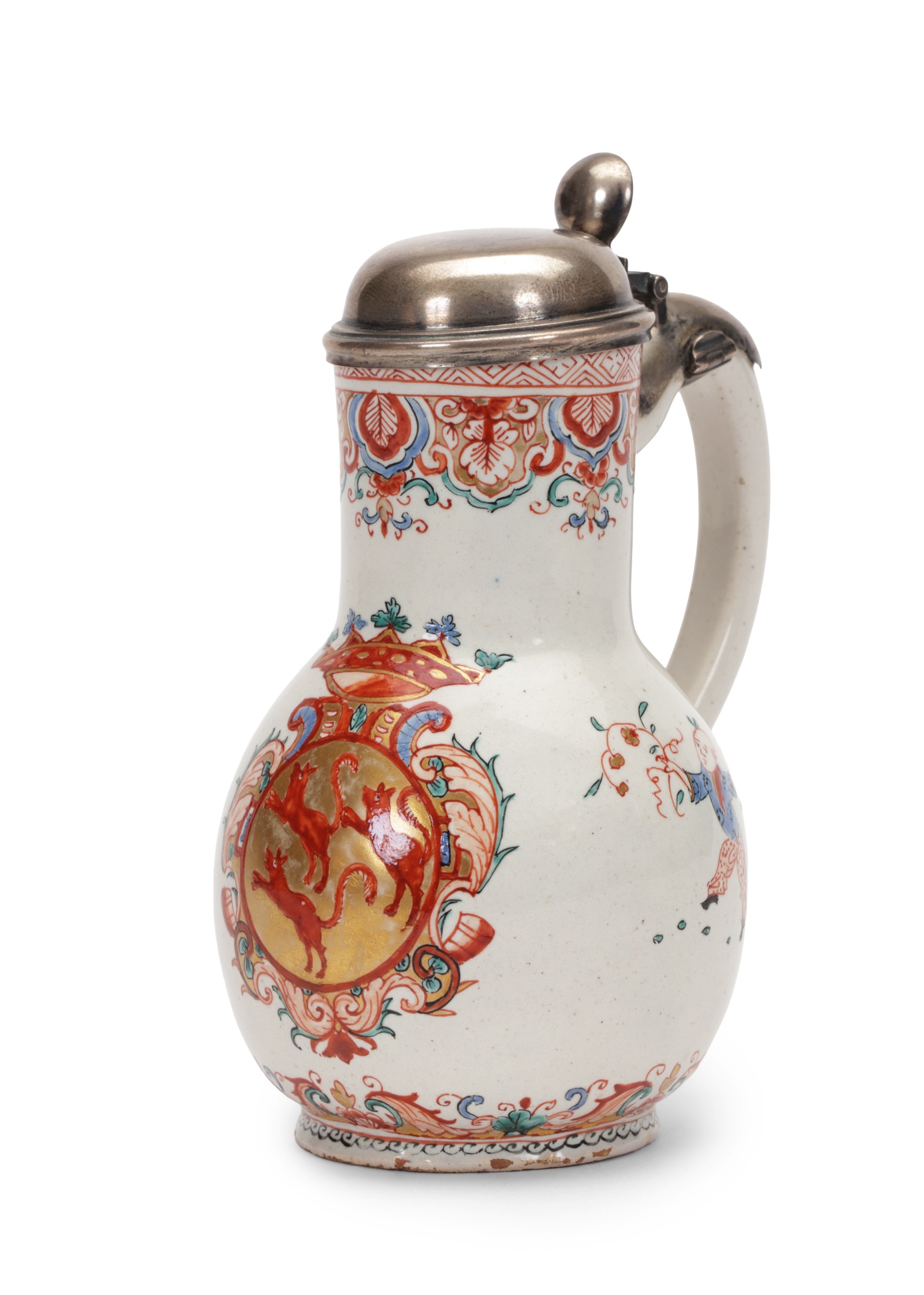
D2643. Silver-Mounted Gilded Jug
Delft, circa 1735
DIMENSIONS
Height: 10.7 cm. (4.2 in.); Overall height: 12.6 cm. (5 in.)
PROVENANCE
Dutch Private Collection, Maastricht;
Aronson Antiquairs, Amsterdam;
Collection Nijstad, Lochem
LITERATURE
exh. cat. Meesterwerken uit Delft, Museum
Het Prinsenhof Delft, June 2 – August 15, 1962,
p. 90, no. 273;
Aronson 2017, pp. 76-77, no. 39,
NOTE
This finely painted polychrome petit feu and gilded ewer, fitted with a Dutch silver cover, forms part of a rare eighteenth-century children’s service associated with the Van der Heim family. The pear-shaped body is decorated in blue, iron-red, green, and gold, displaying the arms of the Van der Heim family set within elaborate foliate mantling and surmounted by a crown. Flanking the heraldry are two dancing boys, each holding foliate sprigs in both hands, their animated figures providing a lively counterpoint to the formal armorial device. The neck is encircled by a band of floral and foliate lappets alternating with diaper panels, while the loop handle is embellished with a sinuous flowering vine.
The silver cover, fitted with a circular thumbpiece and attached to the handle by a hinged foliate mount, is marked for Michael Mennigh, active in The Hague from 1718 to 1738, and dated 1735. Although both Lunsingh Scheurleer (1984, p. 121) and Van Aken-Fehmers (1999, p. 263) have dated the service to around 1750, the hallmark places the silverwork, and by extension possibly the production of the ewer, within Mennigh’s documented period of activity.
Comparable objects from this children’s armorial service are preserved in the Kunstmuseum The Hague, underscoring the significance of this ensemble within the decorative traditions of elite Dutch families. The present ewer, with its delicate petit feu palette, gilding, and heraldic decoration, offers a refined example of how Delftware potters and contemporary silversmiths collaborated to create luxury objects that combined personal identity, craftsmanship, and domestic ceremony.
 CHINESE 阿伦森 WEBSITE