
Images on this website are licensed under a
Creative Commons Attribution-NoDerivs 3.0 Unported License.
OBJECT
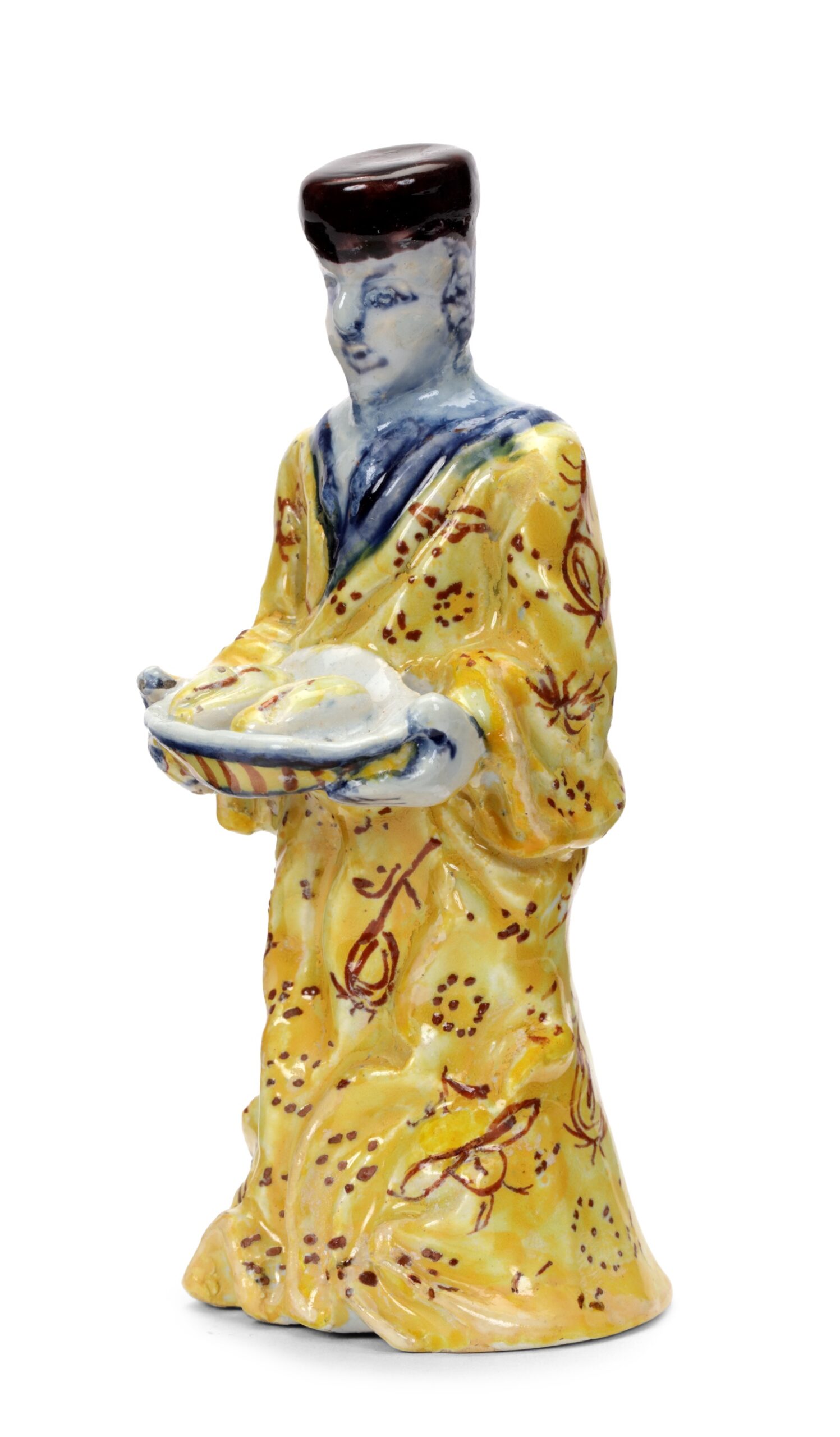
D2642. Figure of an Asian Man
Delft, circa 1740
DIMENSIONS
Height: 11.8 cm. (4.7 in.)
PROVENANCE
Dutch Private Collection, Amsterdam
NOTE
This Delftware figure reflects the European fascination with Asia that developed in the seventeenth century and reached its height in the early eighteenth century. Driven by the activities of the Dutch East India Company (VOC), Asian goods such as porcelain, lacquer, and carved figures entered the Dutch Republic and inspired a wide range of artistic responses, from direct imitation to imaginative hybrid forms known as chinoiserie.
The figure is clearly inspired by Chinese prototypes. Shown wearing flowing robes and holding a shallow dish, he recalls types well known in China during the Kangxi period (1662–1722). Delft potters likely based their designs on Chinese figures in enameled biscuit porcelain from Jingdezhen, or on comparable sculptures carved in soapstone or wood. Such objects reached the Netherlands as early as the seventeenth century, initially as rare curiosities brought back by VOC employees or acquired by elite collectors. Their presence is documented, for example, in W. and J. Blaeu’s Nieuwe Atlas (1655), which includes an illustration of a seated Guanyin closely resembling contemporary Chinese sculpture.
From the late seventeenth century onward, the VOC imported increasing numbers of Chinese and Japanese figures, making them accessible to a wider audience. By the eighteenth century they had become established elements of the domestic interior, displayed on mantelpieces, cabinets, and shelves. Delft chinoiserie figures often closely follow their Asian models, suggesting that Chinese originals were used to create plaster molds by Delft vormers (shapers).
Delftware figures were produced in several variants: plain white-glazed examples, blue-and-white, polychrome, and red earthenware. The present polychrome decoration, with its vivid yellows, blues, and iron-red accents, reflects mid-eighteenth-century taste and the Delft factory’s confident adaptation of foreign models. Contemporary paintings and prints, such as Pieter Jansz. de Ruyven’s Schoorsteenstuk met aardewerk en papegaaien (1719) and Pieter van den Berge’s De namiddag (circa 1710), show comparable figures arranged as decorative accents within fashionable interiors.
 CHINESE 阿伦森 WEBSITE