

Images on this website are licensed under a
Creative Commons Attribution-NoDerivs 3.0 Unported License.
OBJECT
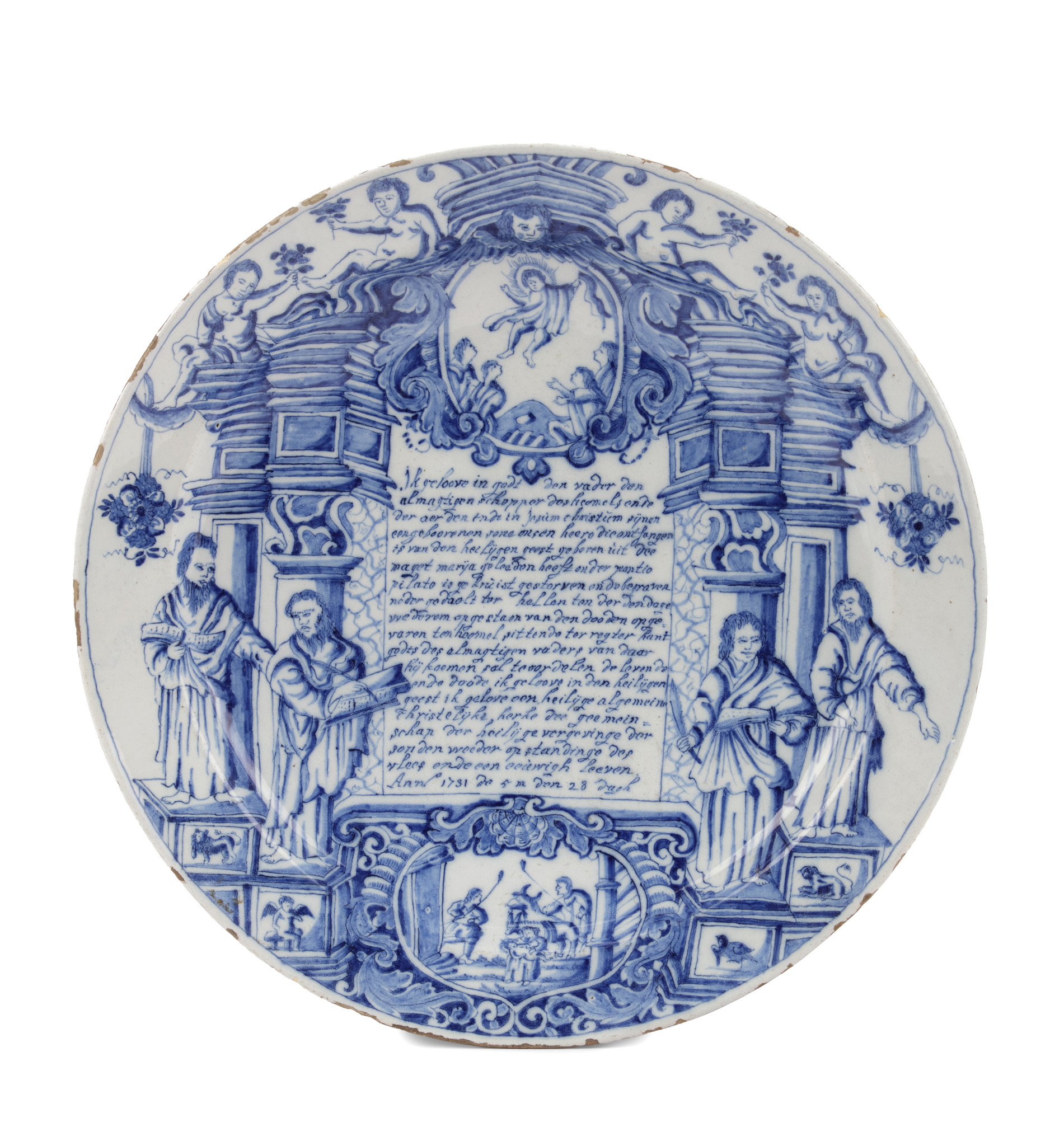
D2640. Biblical Charger
Delft, dated 1731
DIMENSIONS
Diameter: 34 cm. (13.4 in.)
PROVENANCE
Dutch Private Collection;
Aronson Antiquairs, Amsterdam, 1993
NOTE
This Delftware charger is painted with a narrative composition drawn from the Christian biblical tradition. Intended primarily for display on walls or dresser shelves, it functioned as a focal point of narrative, devotion, and status within the domestic interior.
The production of biblical subjects in Delftware reflects the profound influence of printed sources, woodcuts, etchings, and engravings, that circulated widely throughout the Dutch Republic. These prints provided Delft painters with a repertoire of scenes from the Old and New Testaments, which were skillfully adapted to the curved ceramic surface, balancing narrative clarity with decorative rhythm.
While earlier biblical chargers sometimes date to the late seventeenth century, the present charger, dated 1731, demonstrates the sustained popularity of the form into the early eighteenth century. The inscribed text, dated “Anno 1731 den 28 Juny,” likely represents a personal or communal statement of faith, consistent with a tradition in which such chargers served not only decorative but also devotional and commemorative functions.
Biblical chargers occupy a distinctive place within Delft’s output. Unlike utilitarian tableware, their scale and narrative ambition assert a dual role as vehicles of visual storytelling and as refined interior ornaments. They embody the intersection of Protestant and Catholic devotional cultures in the Dutch Republic: while the printed Word remained central to Protestant religious life, visual representations of scripture continued to find resonance across confessional boundaries.
The central composition is framed by an elaborate ornamental border incorporating architectural elements and stylized motifs, a hallmark of Delft chargers of this period. Biblical chargers occupy a distinctive place within Delft’s ceramic output, asserting a dual role as vehicles of visual storytelling and refined interior ornaments. By incorporating the inscribed Word as the focal element, this charger underscores the primacy of scripture in Protestant devotional culture while affirming Delft’s position as a center of artistic production in the eighteenth century.




 CHINESE 阿伦森 WEBSITE