
Images on this website are licensed under a
Creative Commons Attribution-NoDerivs 3.0 Unported License.
OBJECT
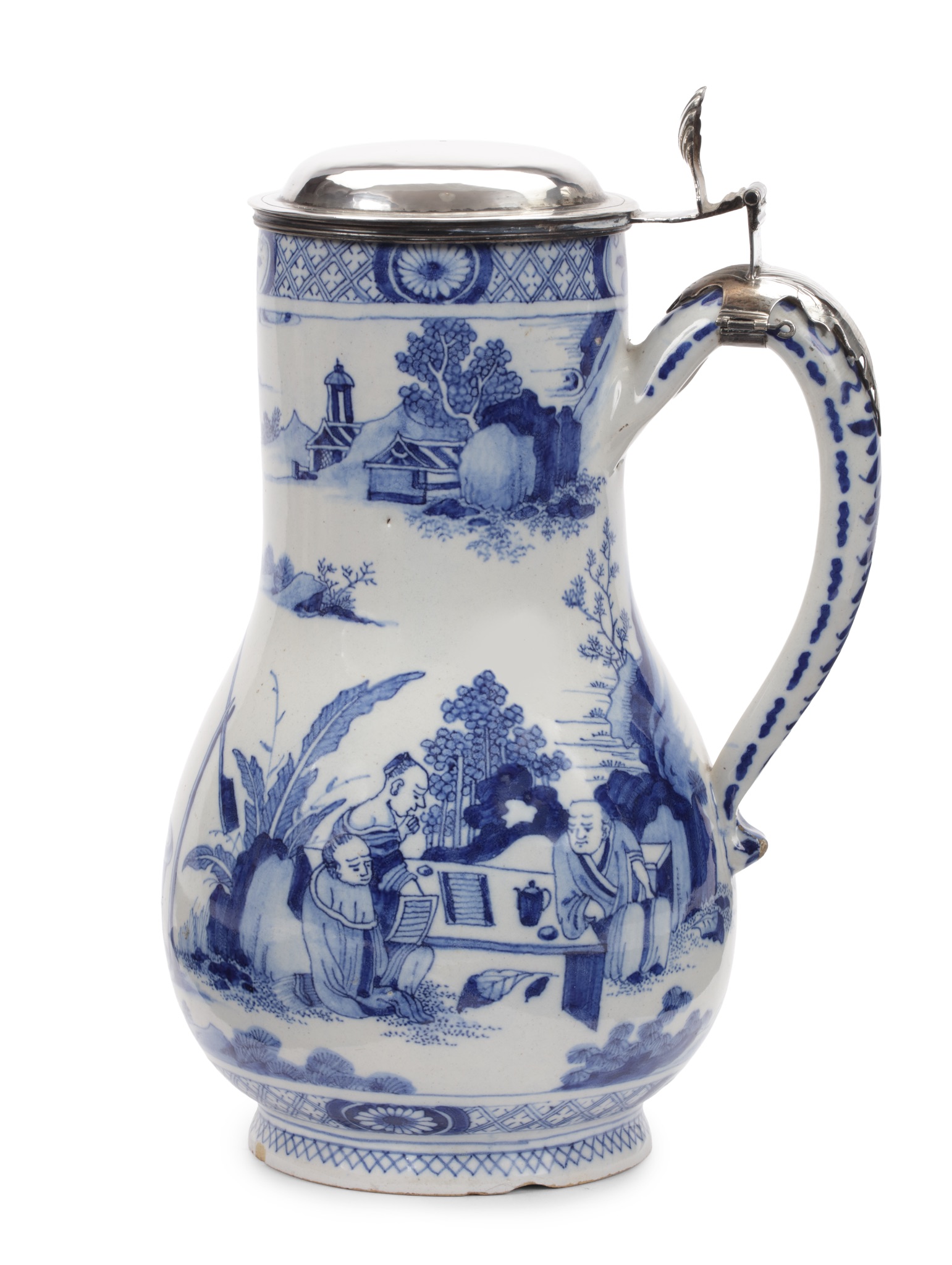
D2639. Silver-Mounted Tankard
Delft, circa 1725
Marked with an unidentifiable letter D in blue;
The silver mark of Abraham Marshoorn, active 1722–1754; working in Amsterdam 1722–1734, with the city assay mark of Amsterdam. We gratefully acknowledge the assistance of our colleague Emiel Aardewerk in the identification of these marks.
DIMENSIONS
Height: 23.5 cm. (9.3 in.)
NOTE
This tankard is fitted with a domed silver cover and thumbpiece, almost certainly added shortly after firing by a Dutch silversmith. Such mounts protected the rim, improved functionality, and enhanced the object’s visual and material value, positioning the tankard as a refined domestic object suited to polite social settings.
The decoration consists of a continuous chinoiserie landscape populated by figures engaged in everyday activities. The principal scene shows several men gathered around a well or water source, one seated at a table with books or papers while others stand nearby in conversation. The setting is completed with stylized rockwork, trees, and architectural features such as a pavilion or tower in the background. These elements are characteristic of Delft painters’ engagement with Chinese visual sources.
The imagery derives from Chinese woodblock prints and export porcelain, which circulated widely in Europe from the seventeenth century onward through the networks of the Dutch East India Company. Scenes of figures near wells, tables, or garden structures frequently appear on late Ming and early Qing porcelain, where they form part of a broader pictorial vocabulary depicting scholars or gentlemen in outdoor settings. In Delft, such scenes were adopted for their compositional appeal rather than for their specific narrative content.
The well depicted here should not be interpreted as part of a Buddhist story. Instead, it functions as a pictorial motif drawn from secular Chinese imagery. While wells could carry symbolic meanings in Chinese culture, Delft painters generally approached such elements as visually engaging components that organized space and introduced variety within a landscape.
The form of the vessel is distinctly European, designed for the consumption of beer or wine, and demonstrates how Asian-inspired imagery was applied to Western shapes. The combination of a Delftware body with a silver mount underscores the object’s dual character: ceramic in origin, yet integrated into the material culture of early eighteenth-century Dutch interiors.
 CHINESE 阿伦森 WEBSITE