

Images on this website are licensed under a
Creative Commons Attribution-NoDerivs 3.0 Unported License.
OBJECT
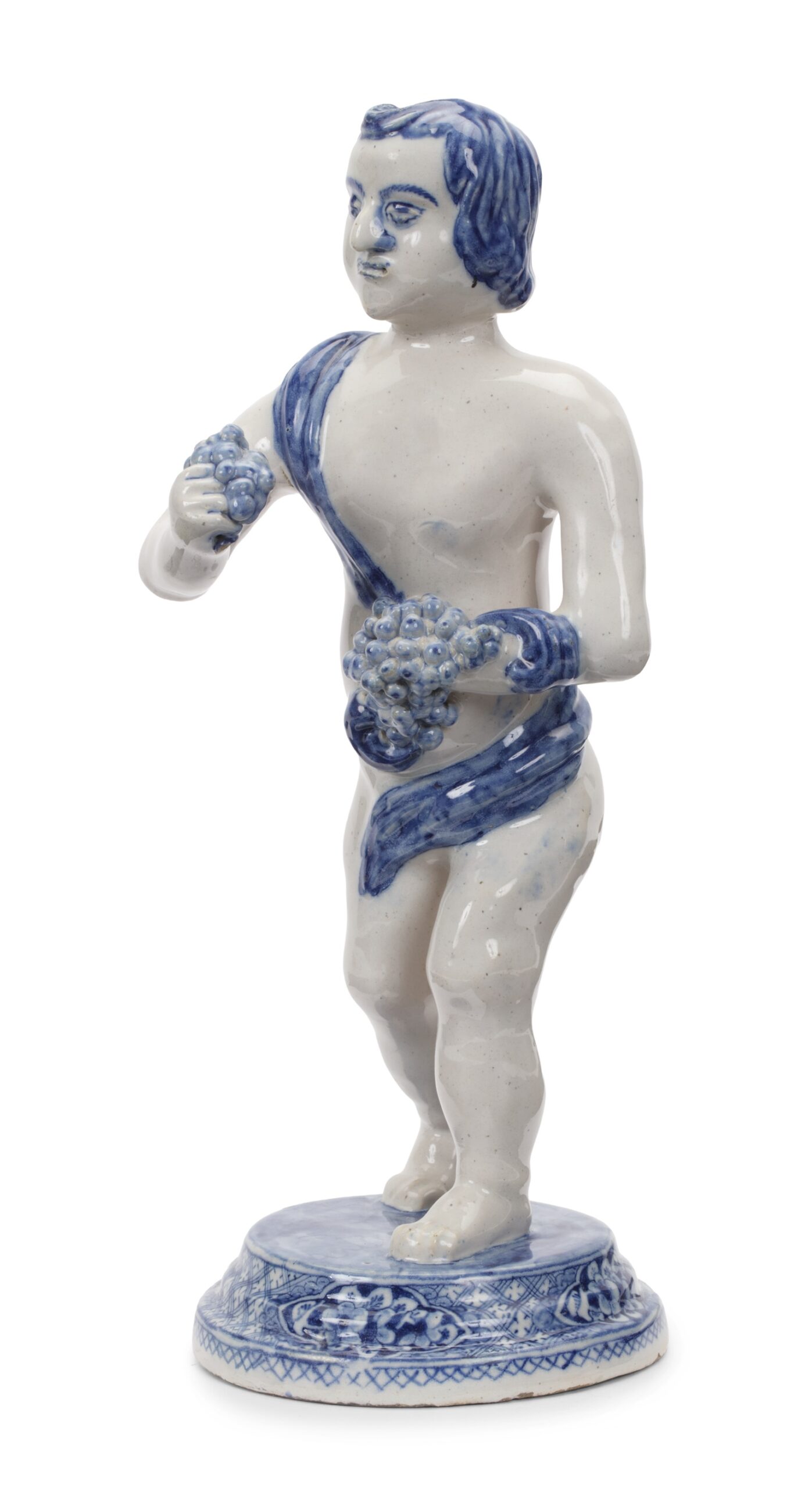
D2638. Figure of a Bacchus
Delft, circa 1720
DIMENSIONS
Height: 27 cm. (10.6 in.)
PROVENANCE
French Private Collection
NOTE
This unusual Delft figure represents Bacchus, the Roman god of wine, fertility, and festivity (equivalent to the Greek Dionysus). The nude male figure is shown in motion, modeled with one foot slightly forward on a round, raised pedestal. In both hands he holds clusters of blue grapes, the fruit most closely associated with Bacchus.
In the early eighteenth century, Europe witnessed a renewed fascination with the classical world, a movement nourished by Enlightenment ideals and the early stirrings of Neoclassicism. Mythological subjects became highly fashionable across the arts, and Bacchus in particular embodied themes of abundance, indulgence, and festivity, concepts that resonated strongly in Dutch banquet culture. Delft potters responded to this taste by producing both functional and decorative objects incorporating Bacchic imagery. From freestanding statuettes to jovial decorations on wine coolers and cisterns, Bacchus appeared as the embodiment of convivial pleasure and the delights of the table.
This figure of Bacchus appears to be unique; no other directly comparable Delft example is currently known. It can, however, be related in conception to other surviving Delft representations of classical deities. These include a polychrome Mercurius and Diana in the Kunstmuseum, The Hague (inv. no. 1059398); a blue-and-white Mercurius and Diana also in the Kunstmuseum (inv. no. 1059395); and a single polychrome Mercurius in the Rijksmuseum, Amsterdam (inv. no. BK-NM-13345). The Bacchus figure stands within this rare tradition of Delft sculptural works.
 CHINESE 阿伦森 WEBSITE