
Images on this website are licensed under a
Creative Commons Attribution-NoDerivs 3.0 Unported License.
OBJECT
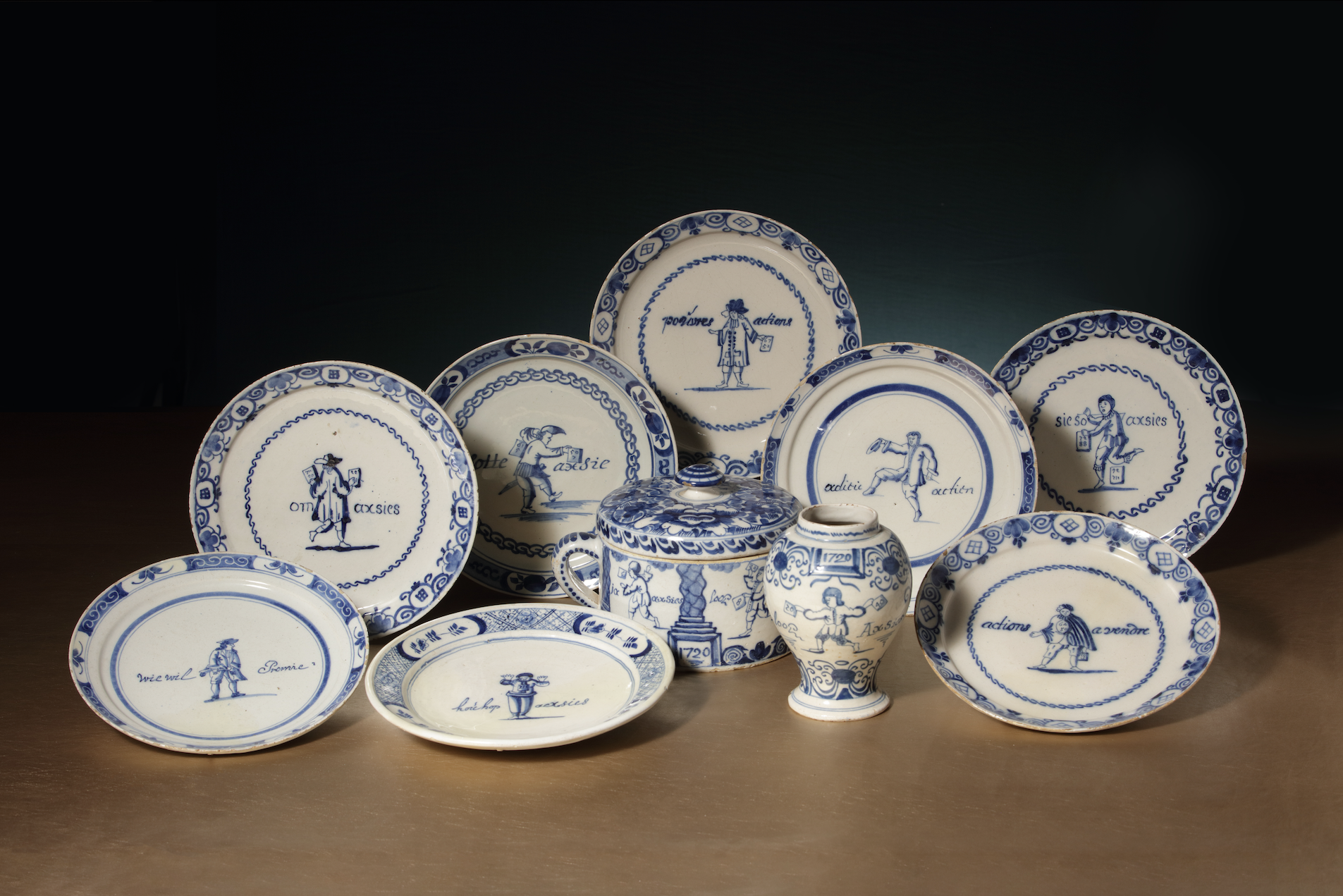
D2637. Set of South Sea Bubble Objects
Delft, dated 1720
DIMENSIONS
Vase: Height: 14.8 cm. (5.8 in.);
Butter tub: Height: 14 cm. (5.5 in.)
Dishes: Diameters 22.2-22.6 cm. (8-8.9 in.)
PROVENANCE
Meentwijck Collection;
Aronson Antiquairs, Amsterdam
LITERATURE
Butter tub: Aronson, 2009, p. 68, no. 42;
Plate “Wie wil Premie?” in Aronson 2011, p. 51, no. 29;
Plate “Actions a vendre” in Aronson 2012, pp. 56-57, no. 32.
NOTE
The figures decorating this vase, butter tub, and accompanying eight plates refer to the South Sea Bubble of 1720, the major financial crisis caused by speculation in the South Sea Company in England. The frenzy soon spread to France and the Dutch Republic, where it became known as the Tafereel der Dwaasheid (“The Great Scene of Madness”). The event was vividly documented in the contemporary satirical compendium Het Groote Tafereel der Dwaasheid (1720), which includes engravings such as De windhandel of bubbel compagnien (“The Air Trade or Bubble Companies”), Arlequin actionist (“Harlequin Shareholder”), and Nederland in gekheid (“The Netherlands in Foolishness”).
The absurdity of the bubble and the widespread financial losses it caused inspired a small but notable group of satirical European ceramics. In the Netherlands, Delftware examples, often called actie borden (“shares plates”), frequently depict jugglers, fools, or Harlequin figures holding share certificates, echoing the humor and critique of contemporary penny prints. These images mocked the folly of speculative investing and served as cautionary reminders to Dutch audiences following the collapse of John Law’s financial system in France (see Howard & Ayers, China for the West, 1978, vol. I, pp. 234–235).
Although only a few Dutch Delft plates with this subject survive, related Chinese export porcelain versions were produced around 1722 in three distinct series for the Dutch market. These typically feature Commedia dell’Arte figures, with or without satirical inscriptions, and are among the most remarkable special commissions made for Dutch clients by the VOC.
The present Delftware group, comprising a vase, a pot, and eight plates, belongs to this rare satirical tradition. By combining spirited imagery with pointed social commentary, these objects capture both the artistic ingenuity of Delft potters and the cultural impact of one of the most notorious financial crises of the early eighteenth century.
 CHINESE 阿伦森 WEBSITE