
Images on this website are licensed under a
Creative Commons Attribution-NoDerivs 3.0 Unported License.
OBJECT
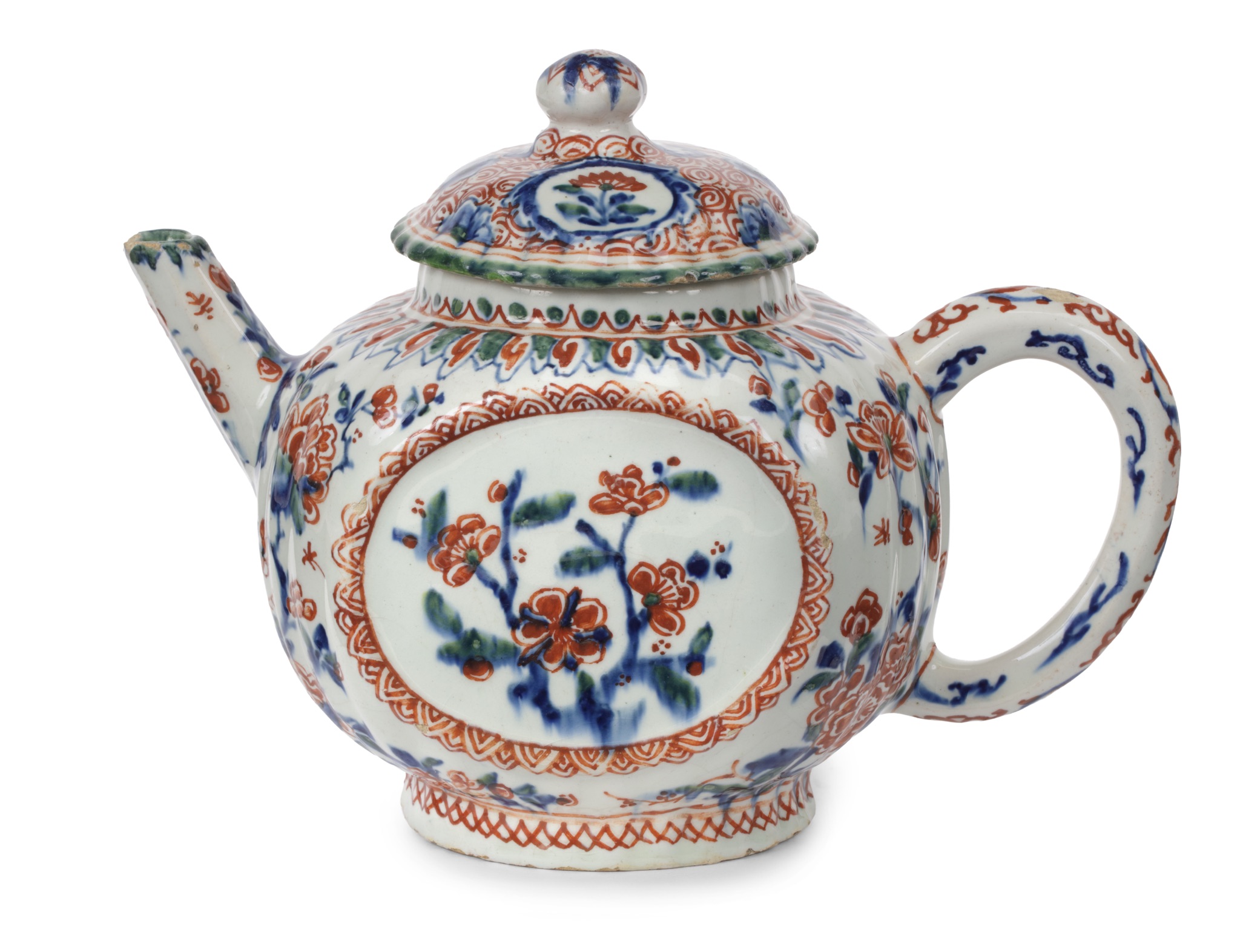
D2634. Cashmere Palette Teapot
Delft, circa 1710
Marked LVE O J A in blue for Lambertus van Eenhoorn, the owner of De Metaale Pot (The Metal Pot) factory from 1691 to 1721
DIMENSIONS
Height: 13.8 cm. (5.4 in.); Length: 18.3 cm. (7.2 in.)
NOTE
This teapot is a refined example of Delftware decorated in the so-called cashmere palette, a distinctive polychrome scheme closely associated with Van Eenhoorn’s tenure at De Metaale Pot (The Metal Pot). The decoration of the present teapot is organized around circular panels enclosing flowering branches, framed by scrolling borders and textile-like bands that further evoke woven patterns. These motifs reveal a synthesis of Asian and European sources: the floral imagery ultimately derives from Chinese and Japanese porcelain, while the overall compositional balance and ornamented borders reflect Western design principles. The cashmere palette lends these elements a painterly delicacy, emphasizing surface richness without overwhelming the form.
The shape of the teapot itself reflects the growing importance of tea consumption in the Dutch Republic during the late seventeenth and early eighteenth centuries. Tea was introduced to Europe in the early seventeenth century through the Dutch East India Company and quickly became associated with refinement, sociability, and elite domestic ritual.
Tea was presented to guests in tea canisters, and then strongly brewed in small pots. These concentrated brews were then diluted with hot water from a bouilloire, a silver, copper (although this material was thought not so suitable for boiling water) or pewter kettle on a stand over a brazier. When the guest wanted to try a different kind of tea, he or she could rinse the cup in the slop bowl. The new drink should be sipped as hot as possible, but if too hot, it could be poured on the saucer to cool a little and sipped from there. With tea being very expensive, the cups were small, so it was not uncommon if one would have up to twenty or even fifty cups during a tea party. Although early Delft teapots were modeled after imported Chinese porcelain examples, by around 1700 Delft potters had developed their own interpretations, adapting Asian forms to European tastes and practical use.
 CHINESE 阿伦森 WEBSITE