
Images on this website are licensed under a
Creative Commons Attribution-NoDerivs 3.0 Unported License.
OBJECT
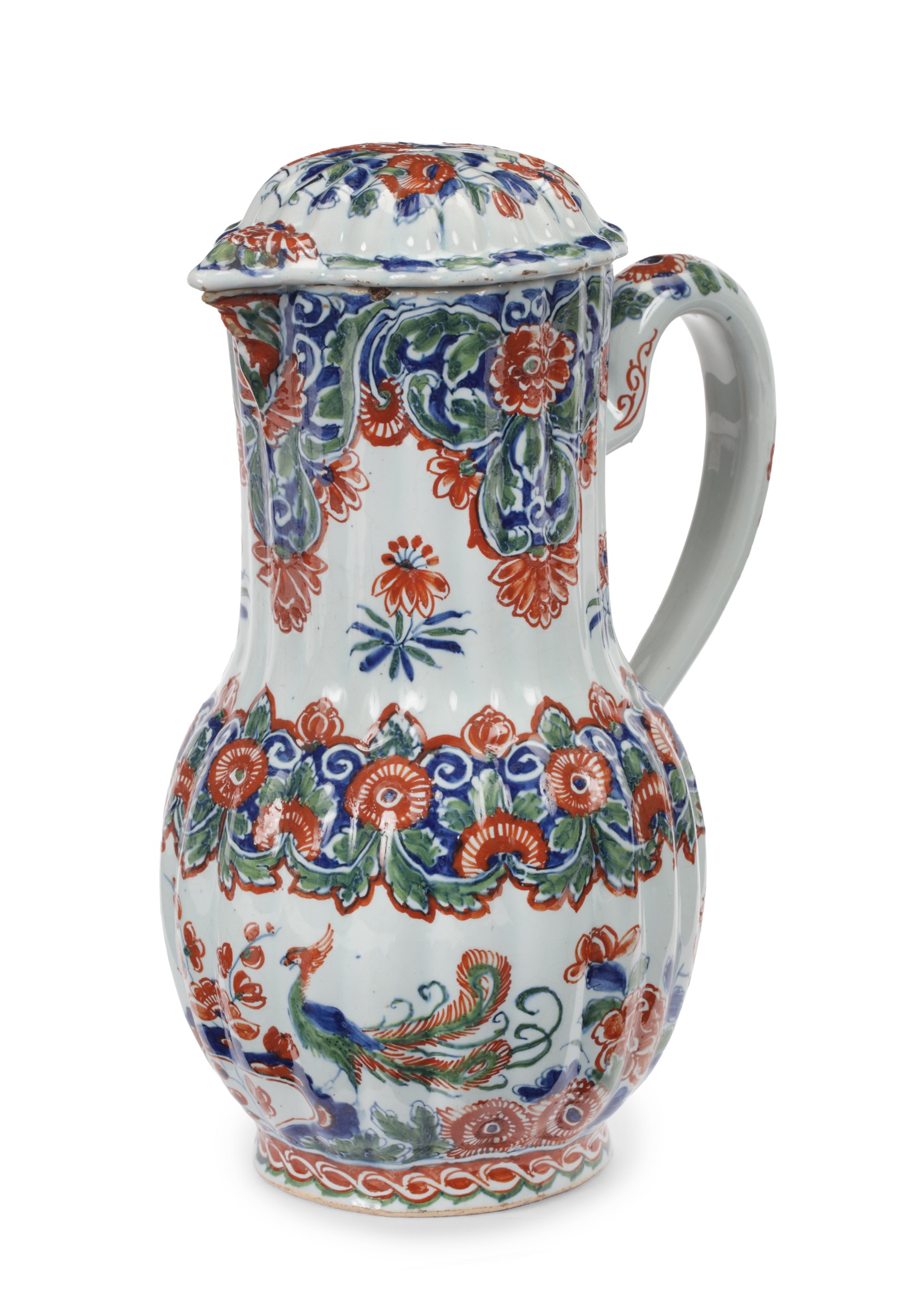
D2631. Cashmere Palette Jug & Cover
Delft, circa 1710
Both marked PAK No 6 in iron red for Pieter Adriaensz. Kocx, the owner of De Grieksche A (The Greek A) factory from 1701 to 1703, or his widow Johanna van der Heul, the owner of the factory from 1703 to 1722
DIMENSIONS
Height: 20.8 cm. (8.2 in.)
PROVENANCE
Private collection, Maastricht;
Aronson Antiquairs, Amsterdam 2012;
Paul Blancan Collection, France
NOTE
The cashmere palette, a term introduced by nineteenth-century writers and merchants, likely in reference to fashionable Indian shawls, appears to have reached the Netherlands largely by way of France. The underlying color scheme was inspired by Kangxi-period (1662–1722) Chinese porcelain painted in the famille verte palette, characterized by green, iron-red, underglaze and enamel blue, manganese, touches of yellow, and black outline (encre de Chine). Such porcelains were imported into the Dutch Republic by the VOC during the late seventeenth century.
Its adaptation to European ceramics, however, owed much to French ornamental design. The translation of Chinese motifs and “embroidered” borders was shaped heavily by Jean Bérain (1640–1711), whose decorative vocabulary dominated the arts under Louis XIV. Bérain’s designs influenced Rouen faience and the earliest Saint-Cloud porcelains (circa 1695–1725), and in turn informed the work of Daniel Marot (1663–1752). As court designer to William III and Mary II, Marot played a significant role in shaping taste in the Dutch Republic, and his designs almost certainly impacted Delftware painters working in the cashmere style.
The forms of Delftware objects painted in this palette, such as the present example, often derive from contemporary silver shapes. Yet the complexity of these forms and the rapid shift in taste toward the Rococo contributed to the decline of the cashmere style. By circa 1720, Delft factories had largely ceased its production.
Although short-lived in its original period, the cashmere palette experienced renewed popularity in the late nineteenth century, when numerous imitations were produced and falsely marked with the PAK monogram of Pieter Adriaensz. Kocx of De Grieksche A. Many of these reproductions are exceptionally convincing, serving as a continuing reminder of the need for connoisseurship and caution in the field.
 CHINESE 阿伦森 WEBSITE