
Images on this website are licensed under a
Creative Commons Attribution-NoDerivs 3.0 Unported License.
OBJECT
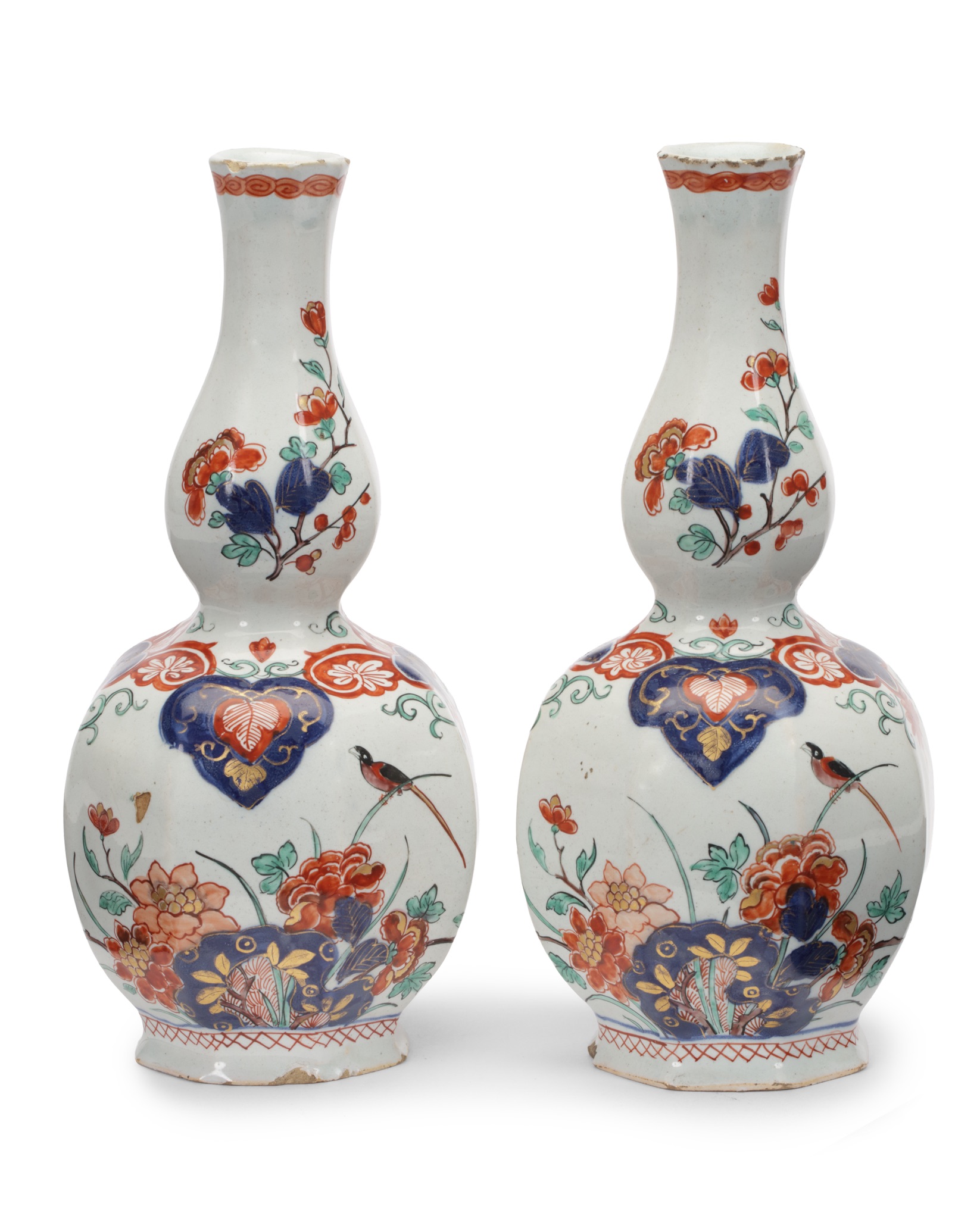
D2630. Pair of Kakiemon Vases
Delft, circa 1710
Both marked PAK No 7 in iron red for Pieter Adriaensz. Kocx, the owner of De Grieksche A (The Greek A) factory from 1701 to 1703, or his widow Johanna van der Heul, the owner of the factory from 1703 to 1722
DIMENSIONS
Height: 19.8 cm. (7.8 in.)
NOTE
This pair of vases exemplifies the refined Delft interpretation of the Kakiemon style, one of the most influential decorative idioms adopted from Japanese porcelain in the early eighteenth century.
The Kakiemon style originated in Japan at the Arita kilns during the mid-seventeenth century and was exported to Europe via the port of Nagasaki. Unlike the densely ornamented Imari wares, Kakiemon porcelain was admired for its restrained compositions, asymmetrical placement of motifs, and the generous use of empty space. Typical elements include delicately rendered flowering plants, birds, and small animals, executed in a limited but luminous palette. These wares were highly prized in Europe and became an important source of inspiration not only for Delft potters but also for continental manufactories such as Meissen and Chantilly.
Delft potters began producing Kakiemon-inspired wares around the turn of the eighteenth century, adapting the Japanese aesthetic to tin-glazed earthenware and Western vessel forms. The present vases demonstrate a sophisticated understanding of the Kakiemon vocabulary. Each vase is decorated with flowering branches and birds arranged in a deliberately open composition, allowing the white ground to function as an active visual element. This controlled sparseness stands in marked contrast to earlier Delft traditions of all-over decoration and reflects a conscious effort to emulate the elegance and refinement of Japanese originals.
Technically, the vases reflect the refined level of expertise reached in De Grieksche A factory by the early eighteenth century. The decoration is executed in the Kakiemon palette using the petit feu enamel technique. After the initial high-temperature firing of the tin glaze with blue, the iron-red, and pastel colored enamels were applied and fixed in a subsequent low-temperature firing. Gilding was introduced at this final stage, secured during the same petit feu firing, allowing for delicate placement and a soft, luminous finish. This carefully orchestrated sequence of firings underscores the technical sophistication of Delft potters around 1710 and their ability to translate Japanese Kakiemon aesthetics into the Delftware tradition, preserving the elegance of the prototypes while asserting a distinctly Delft sense of brushwork and surface.
 CHINESE 阿伦森 WEBSITE