
Images on this website are licensed under a
Creative Commons Attribution-NoDerivs 3.0 Unported License.
OBJECT
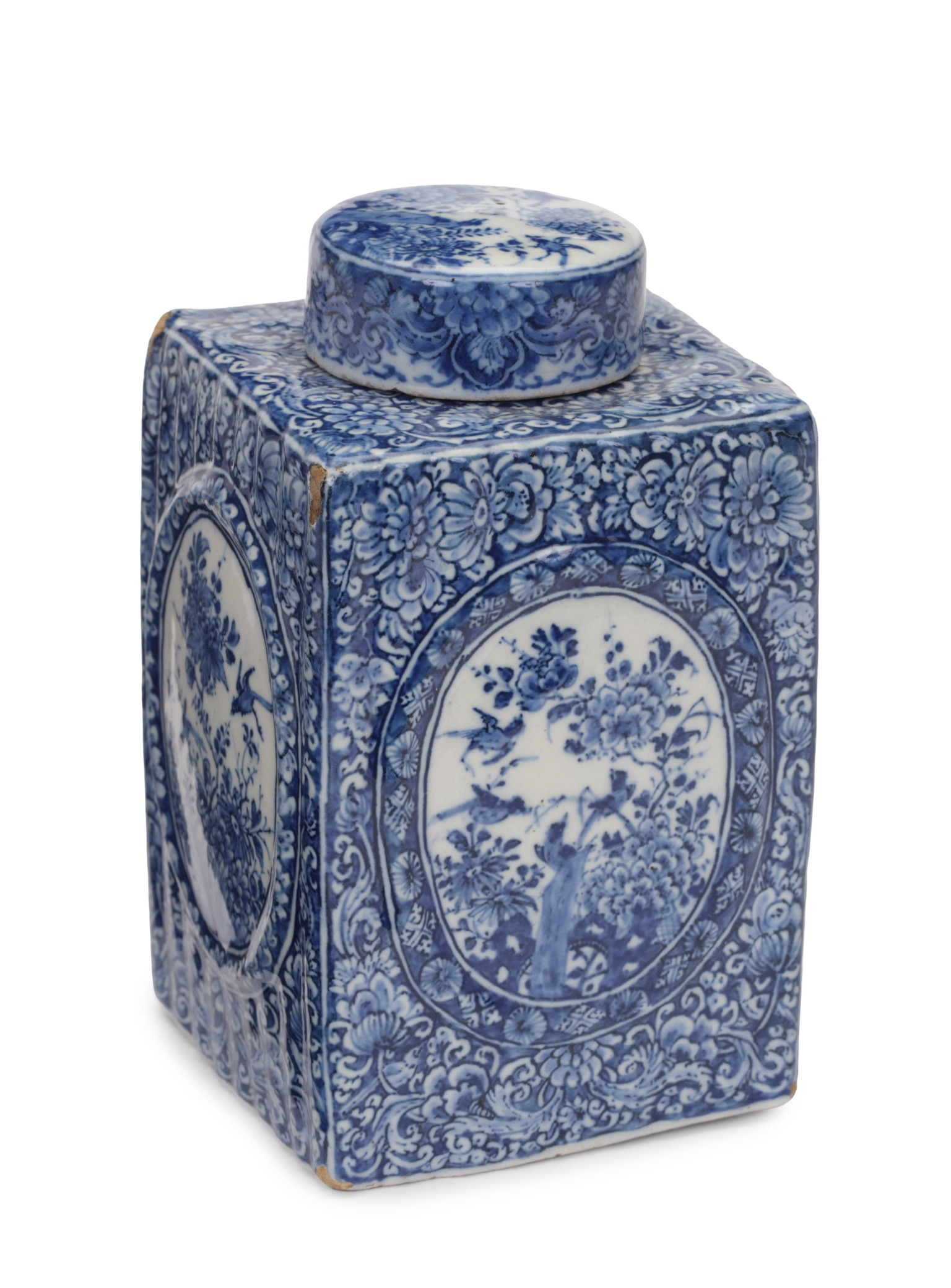
D2627. Tea Canister
Delft, circa 1710
DIMENSIONS
Height: 11.6 cm. (4.6 in.)
NOTE
When the Dutch East India Company (VOC) expanded its trading networks across Asia in the seventeenth century, it introduced to the Netherlands a range of commodities that reshaped daily life. Chinese porcelain quickly became a symbol of refinement, yet botanical imports, most notably tea, had an even more profound cultural impact. Although tea was known in Europe before the VOC’s involvement, described by writers such as the Portuguese friar Gaspar da Cruz and the Dutch traveler Jan Huygen van Linschoten, it was only in the final decades of the seventeenth century that tea gained widespread popularity in the Dutch Republic. What began as a medicinal infusion soon evolved into a fashionable social beverage.
Early proponents extolled tea’s supposed restorative properties, claiming it improved health and sharpened the mind. By the 1680s, “taking tea” had become a familiar domestic ritual, fostering new forms of sociability. Afternoon gatherings centered on tea provided opportunities for polite conversation, the display of imported luxuries, and the enjoyment of exotic goods. This emerging ritual created a demand for specialized equipment. While early tea services often combined imported Chinese porcelain with locally produced wares, coordinated sets became common by the eighteenth century, reflecting an increased emphasis on aesthetic harmony.
Among the most important objects in this context were tea canisters, used to store the expensive imported leaves, typically green hyson or black bohea teas. Both functional and decorative, the canister was presented to guests so they could examine the quality of the tea before it was infused in a small pot. Delftware canisters demonstrate the technical mastery of local potters and frequently incorporate motifs drawn from both Chinese porcelain and European ornamental traditions, illustrating the cross-cultural exchanges that shaped Dutch tea culture.
 CHINESE 阿伦森 WEBSITE