
Images on this website are licensed under a
Creative Commons Attribution-NoDerivs 3.0 Unported License.
OBJECT
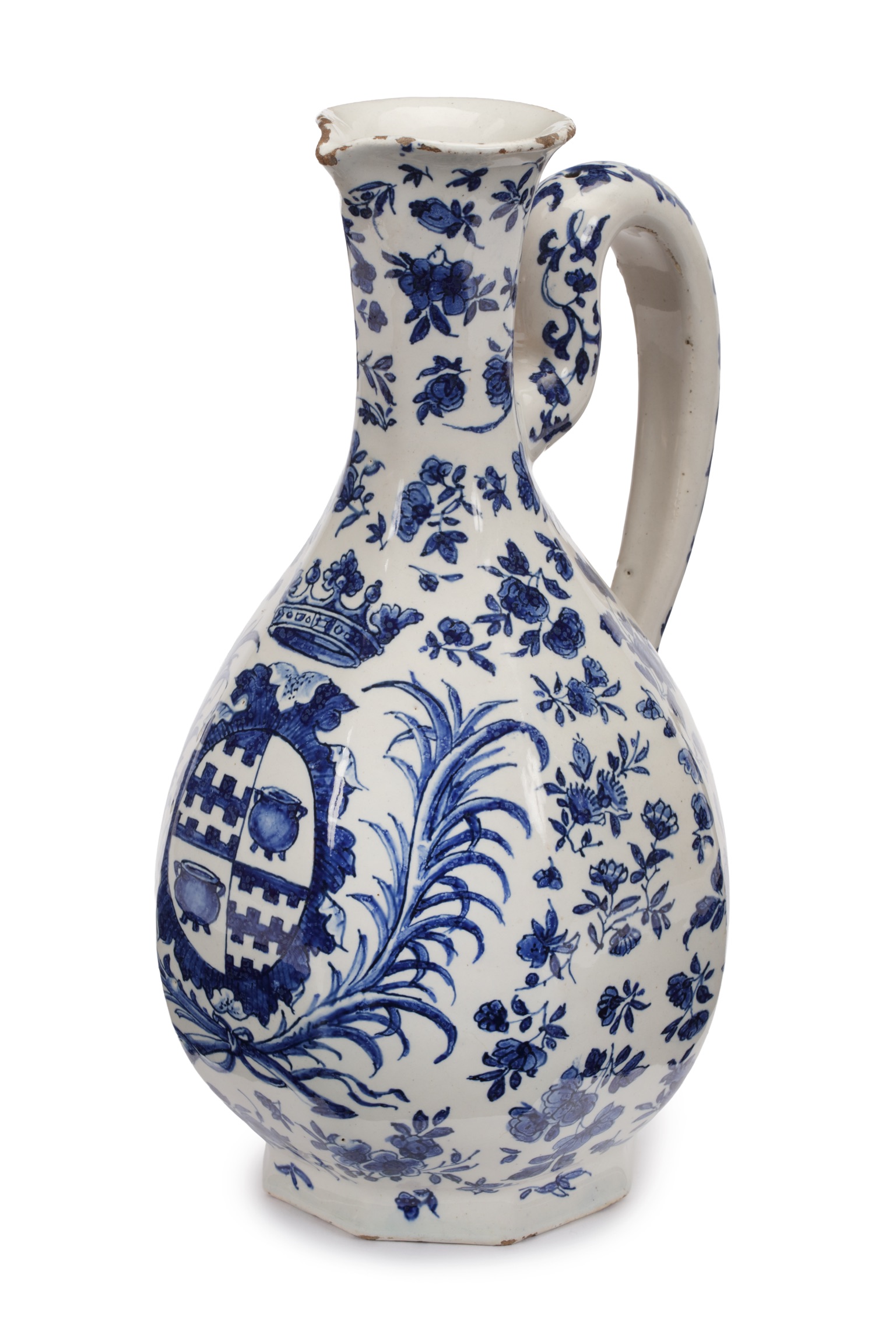
D2622. Armorial Ewer
Delft, circa 1700
Marked LV in blue for Louis Victor, the owner of De Dubbelde Schenkkan (The Double Jug) factory from 1688-1715
DIMENSIONS
Height: 23.3 cm. (9.2 in.)
NOTE
This Delftware ewer is adorned with the coat of arms of Dammas Barthoutz van Slingeland (1688–1771), a member of one of Dordrecht’s most prominent patrician families. The Van Slingelandts were deeply embedded in the administrative structure of the Dutch Republic, with successive generations serving as magistrates, burgomasters, and provincial officials. Their name was further associated with notable landholdings, including the Heerlijkheid Slingelandt and the estate Haaswijk near Dordrecht.
Dammas was the son of Barthout Damasz van Slingeland and Emerentia Repelaer, linking two influential Dordrecht lineages. Following family tradition, he entered civic service and held the office of schepen (alderman) by 1718, later advancing to burgomaster. Tax records attest to his ownership of both a country residence and substantial urban property, underscoring his social standing and financial means.
This ewer, produced between 1688 and 1715 at the Delft factory De Dubbelde Schenkkan, was likely commissioned to mark a significant personal or public milestone in Dammas’ early adulthood. Armorial Delftware of this type, uniting heraldic imagery with sophisticated ceramic workmanship, was often created to commemorate appointments to civic office, marriages within regent families, or the succession to estates. Such pieces functioned both as ceremonial objects and as expressions of family identity and prestige.
Today, armorial Delftware such as this ewer provides valuable insight into the interplay of political ambition, patrician self-representation, and artistic patronage in the Dutch Republic during the late seventeenth and early eighteenth centuries.
 CHINESE 阿伦森 WEBSITE