
Images on this website are licensed under a
Creative Commons Attribution-NoDerivs 3.0 Unported License.
OBJECT
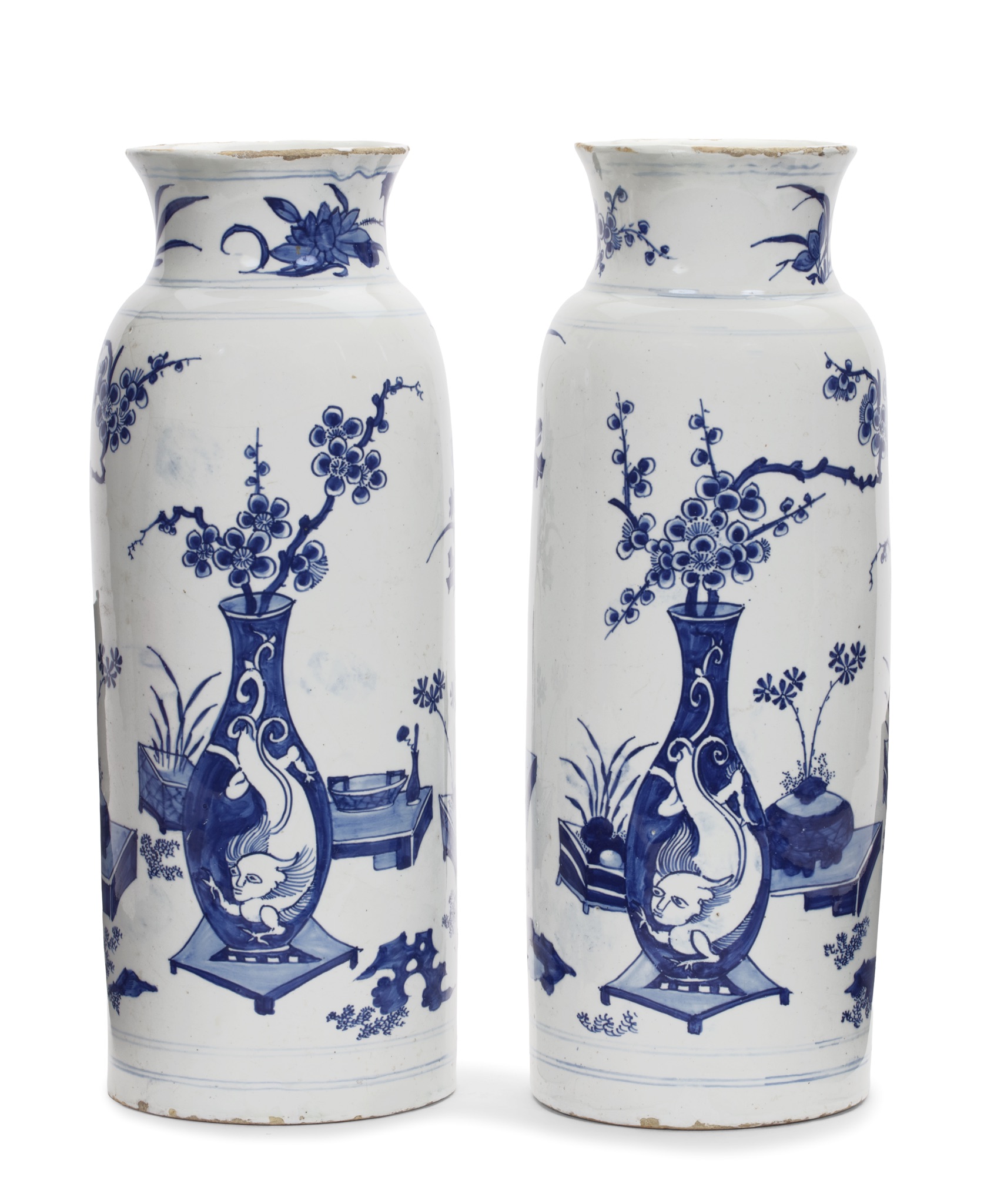
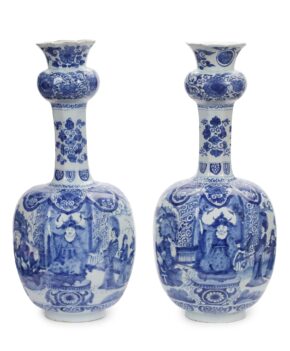
D2613. Pair of Rouleau Vases
Delft, circa 1690
DIMENSIONS
Heights: Both 28.9 cm. (11.4 in.)
PROVENANCE
Dutch Private Collection, Maastricht;
Aronson Antiquairs, Amsterdam
NOTE
This pair of tall, cylindrical rouleau vases, with straight sides, high shoulders, and slightly flaring necks, reflects the enduring influence of Chinese porcelain from the Transitional period (1620-1683) on Delftware of the late seventeenth and early eighteenth centuries. The rouleau form was a favored export shape in Chinese porcelain, admired in Europe for its elegant proportions and suitability for bold vertical decoration. Delft potters, responding to the growing demand for chinoiserie, adapted the form in tin-glazed earthenware, preserving its imposing silhouette while translating the decoration into their own painterly idiom.
Each vase is painted in cobalt blue with a central motif of an elongated vase filled with blossoming prunus branches, placed on a low stand and flanked by ornamental garden and scholar’s objects, including potted plants and small tables. This “vase within a vase” composition, together with the surrounding “hundred treasures” elements, draws on Chinese symbolic traditions that associated such motifs with refinement, prosperity, and the cultured life of the scholar. In the Delft interpretation, the outlines are more pronounced and the cobalt tones range from deep inky blues to lighter washes, enhancing visibility in European interior settings.
Pairs of rouleau vases such as this were often displayed symmetrically on mantelpieces, or atop cabinets. Their combination of elegant form, exotic decoration, and the rich blue-and-white palette made them ideal statement pieces in fashionable late seventeenth- and early eighteenth-century interiors. This pair not only reflects the technical skill of Delft potters in emulating complex Chinese prototypes but also demonstrates their ability to adapt foreign designs to suit European taste and decorative conventions.
 CHINESE 阿伦森 WEBSITE