
Images on this website are licensed under a
Creative Commons Attribution-NoDerivs 3.0 Unported License.
OBJECT
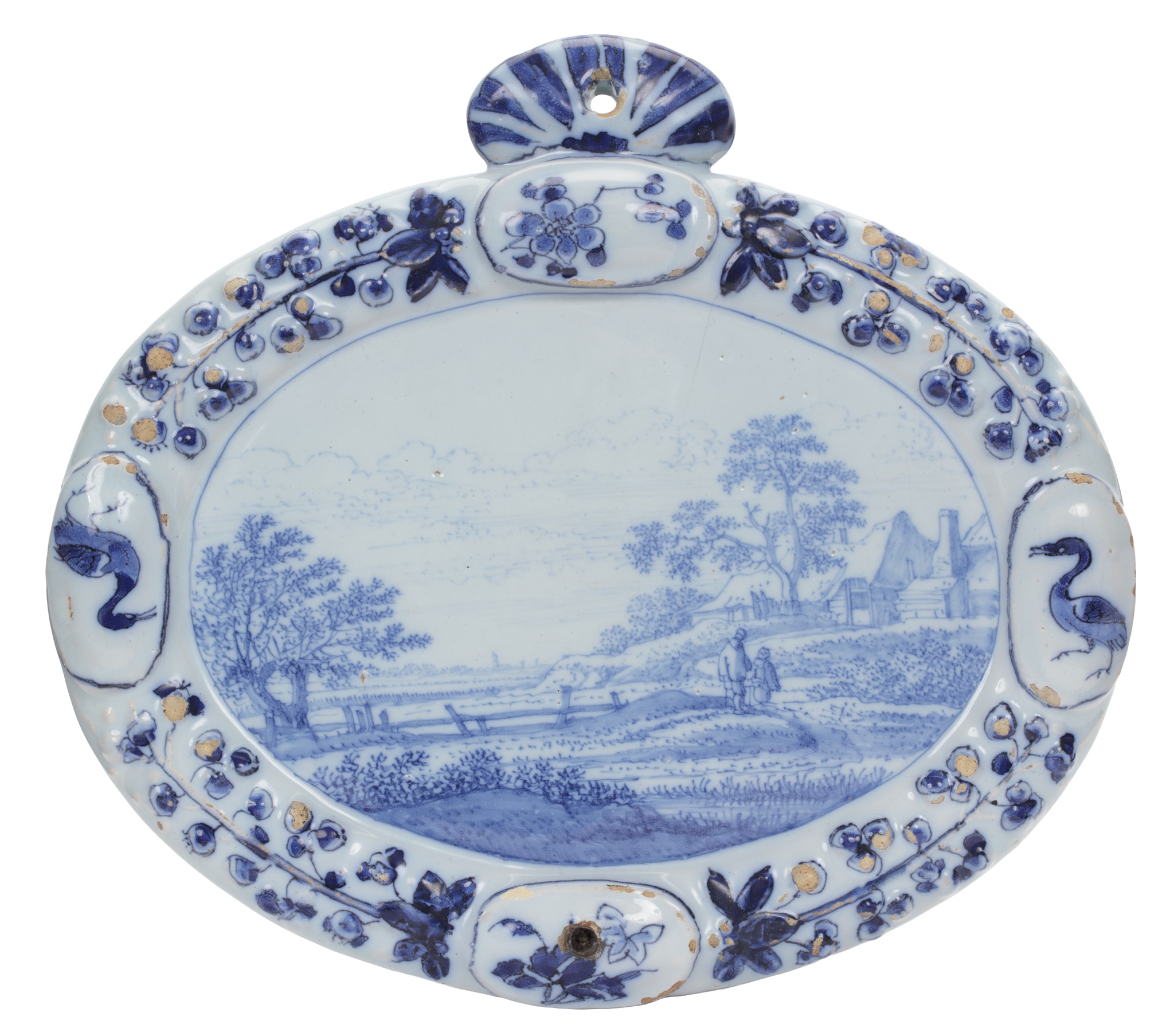
D2609. Oval Plaque
Delft, circa 1680
Attributed to Frederik van Frytom (circa 1632-1702)
DIMENSIONS
Width: 21.5 cm. (8.5 in.)
PROVENANCE
Dutch Private Collection;
Terra Verde Collection
NOTE
Holland’s most celebrated painter of seventeenth-century Delft faience, Frederik van Frytom, was born Frederik Barents(z). He is recorded as a faience painter as early as 1653, when he was about twenty years old. The origins of the surname Van Frytom remain unclear: it is unknown in Dutch and appears nowhere outside Delft at the time. Only Frederik and his sister Martha adopted it, sometime between 1657 and 1658, likely to distinguish the painter professionally from the more common patronymic Barents.
Although trained as an easel painter, Van Frytom devoted most of his career to decorating faience, translating his drawings of the Dutch countryside onto earthenware. He was one of the few independent Delftware painters in Delft, having received special guild permission to work outside the factories. Nonetheless, he appears in the inventories of De Metaale Pot, owned by Lambertus Cleffius, between 1679 and 1691, suggesting that he purchased production capacity there or collaborated with Cleffius. Several related plaques bearing the initials LC support this connection.
Van Frytom specialized in tile plaques, dishes, and plates, with only a few exceptions, such as a small signed jug and two unsigned pieces. Most of his work is unsigned, but occasional signatures and dates make it possible to identify his hand. His monochrome blue palette and reserved white areas give his pastoral scenes depth and luminosity. Unusually, he seems to have been responsible for both the painting and the clay models, which was an uncommon practice in Delft. His meticulous approach suggests that he allowed others to prepare materials only under close supervision.
His landscapes use multiple spatial planes, with pointillist touches in the foreground and distant ruins or hilltop buildings, while small, gracefully draped figures animate the scenery. Approximately fifty plaques are attributed to him today, a few signed but most unsigned.
 CHINESE 阿伦森 WEBSITE