
Images on this website are licensed under a
Creative Commons Attribution-NoDerivs 3.0 Unported License.
OBJECT
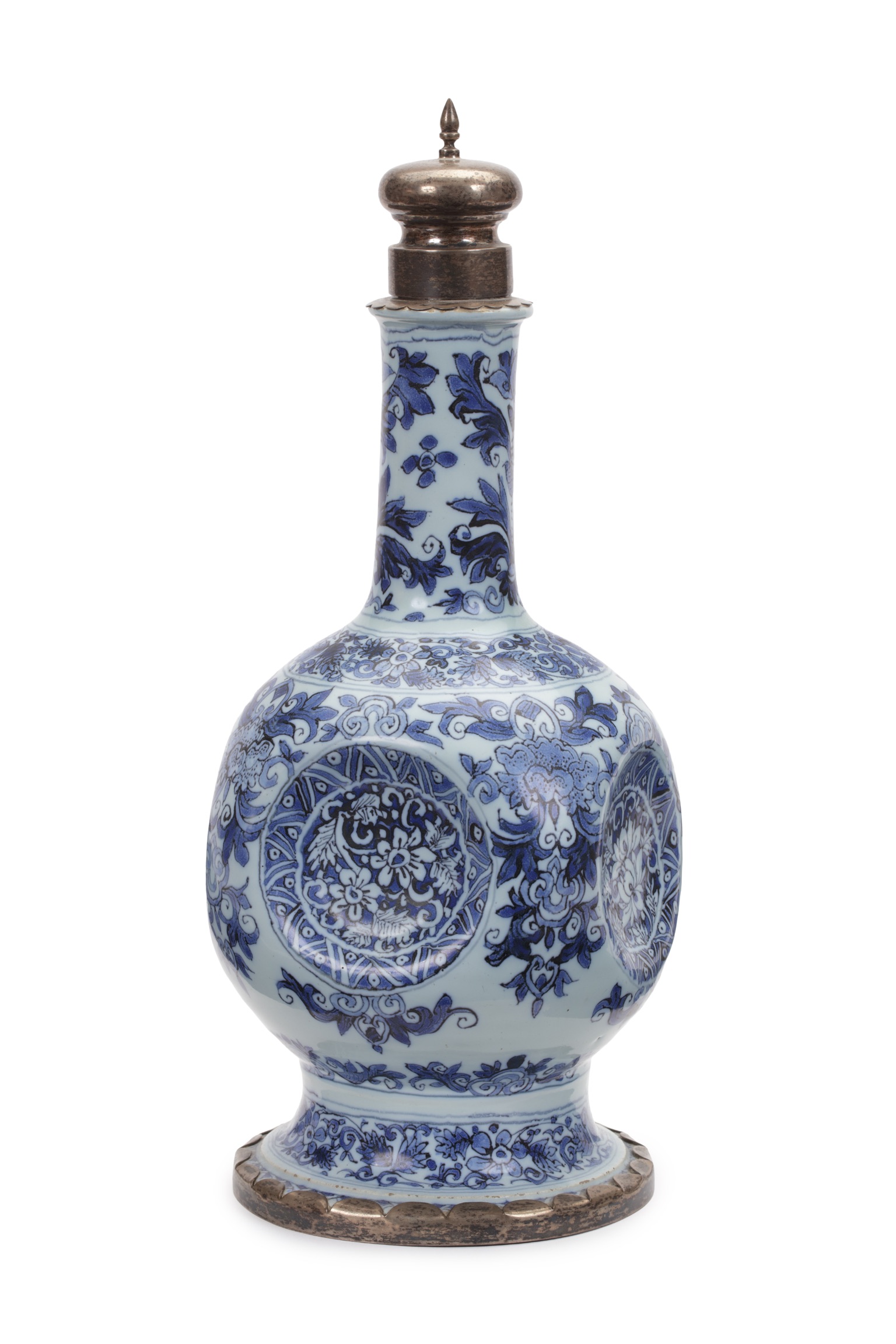
D2608. Silver-Mounted Bottle Vase
Delft, circa 1680
Marked SVE II in blue for Samuel van Eenhoorn, the owner of De Grieksche A (The Greek A) factory from 1678 until 1685
DIMENSIONS
Height (including stopper): 31 cm. (12.2 in.)
PROVENANCE
De Ramaix Collection
NOTE
The shape of this bottle belongs to a well-established formal tradition that originated in Chinese porcelain of the late Ming dynasty and was subsequently adopted and reinterpreted in Europe. Characterized by a globular body combined with a tall, slender neck and a slightly flaring foot, this form was originally conceived for the containment and pouring of liquids such as wine, oils, or aromatic substances. The elongated neck allowed for controlled dispensing, while the rounded body provided a visually balanced and stable profile.
During the so-called Transitional period in China (circa 1620–1650), porcelain bottles of this type became increasingly common. This period, marked by political upheaval following the death of the Wanli Emperor and culminating in the collapse of the Ming dynasty and the establishment of the Qing dynasty, coincided with significant stylistic developments in ceramic production. Transitional porcelain favored continuous decorative schemes that extended uninterrupted around the vessel, in contrast to the compartmentalized designs characteristic of earlier Kraak wares. The globular bottle form was particularly suited to such decoration, offering an expansive surface for flowing landscapes, flora, fauna, and figural scenes.
From the 1630s onward, large quantities of Chinese porcelain, including bottles of this type, were imported into the Dutch Republic. Delft potters adopted the bottle shape while subtly adapting its proportions to European tastes and manufacturing constraints. Delft examples typically exhibit a slightly heavier foot and a more pronounced transition between the body and neck, reflecting both functional considerations and aesthetic preferences within the Dutch context.
In Europe, such vessels were often enhanced with silver or pewter mounts, which both protected the rim and reinforced the vertical emphasis of the form. These mounts also signal the object’s transformation from a utilitarian container into a luxury item intended for display within domestic interiors.
 CHINESE 阿伦森 WEBSITE