
Images on this website are licensed under a
Creative Commons Attribution-NoDerivs 3.0 Unported License.
OBJECT
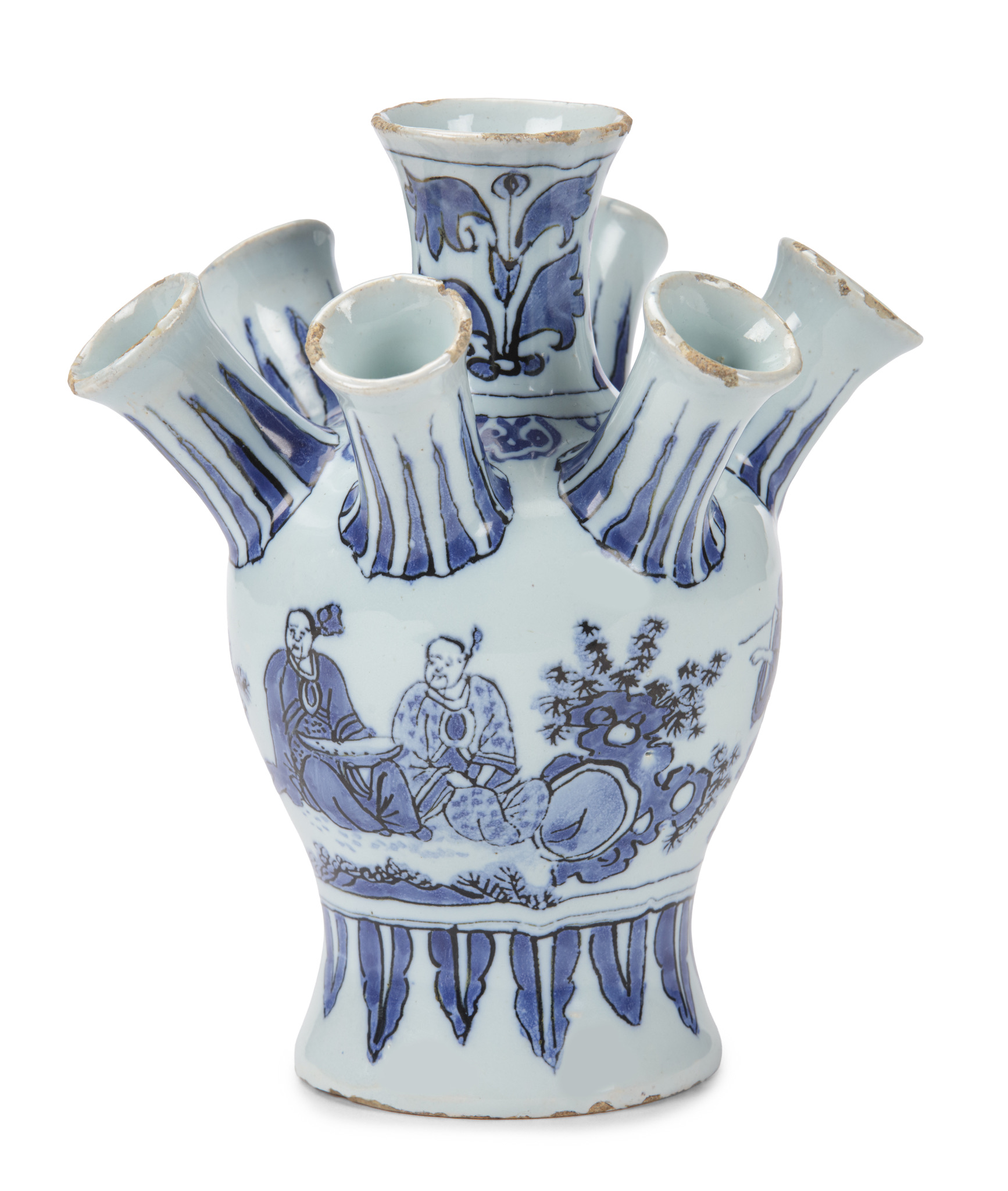
D2607. Flower Vase
Delft, circa 1680
Marked 2 / SVE in manganese for Samuel van Eenhoorn, the owner of De Grieksche A (The Greek A) factory from 1678 until 1685
DIMENSIONS
Height: 14.4 cm. (5.7 in.)
NOTE
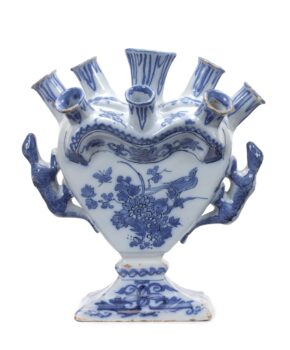
This flower vase represents a rare and historically significant early phase in the development of Delft flower holders, produced circa 1680 at the factory De Grieksche A (The Greek A) under the ownership of Samuel van Eenhoorn.
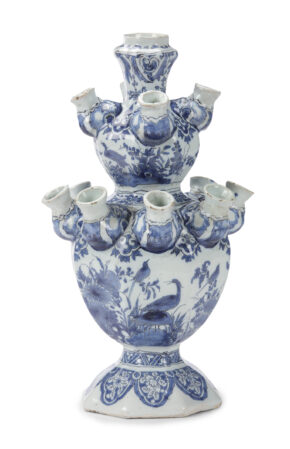
The vase is conceived as a compact, globular body fitted with a short central neck and three outward-projecting tubular spouts, creating a sculptural yet highly functional arrangement for individual flower stems. This configuration differs markedly from the tiered, architectural flower pyramids that would dominate Delft production from the 1690s onward. Its restrained scale and integrated silhouette point to an experimental stage in which potters explored how flowers might be displayed within ceramic vessels before standardized models emerged.
The origins of this form are likely to be sought outside Delft. Comparable early flower holders were produced in Nevers around 1660, where French faience potters developed small-scale multi-spouted vases inspired by Mediterranean maiolica traditions and possibly by metal or glass flower containers.
The painted surface with Chinese-inspired figural scenes and ornamental borders derived from Wanli and Transitional porcelain. This decoration underscores the hybrid nature of the object: while its form reflects Western European experimentation with flower display, its imagery aligns it firmly with the Delft potters’ engagement with East Asian visual sources. Such combinations are characteristic of De Grieksche A, a factory renowned for its technical ambition and its role in shaping new ceramic types.
Flower vases of this early date are exceedingly rare. Most surviving Delft examples postdate circa 1690, when demand for elaborate flower holders increased alongside the fashion for exotic blooms. As an early and unusual model, this vase occupies a crucial position in the history of Delftware, marking the transition from isolated experiments toward the fully developed flower pyramids of the late seventeenth and early eighteenth centuries. It stands as an important testament to Delft’s role in adapting international ceramic ideas into innovative local forms, and to the pioneering output of De Grieksche A under Van Eenhoorn.
 CHINESE 阿伦森 WEBSITE