
Images on this website are licensed under a
Creative Commons Attribution-NoDerivs 3.0 Unported License.
OBJECT
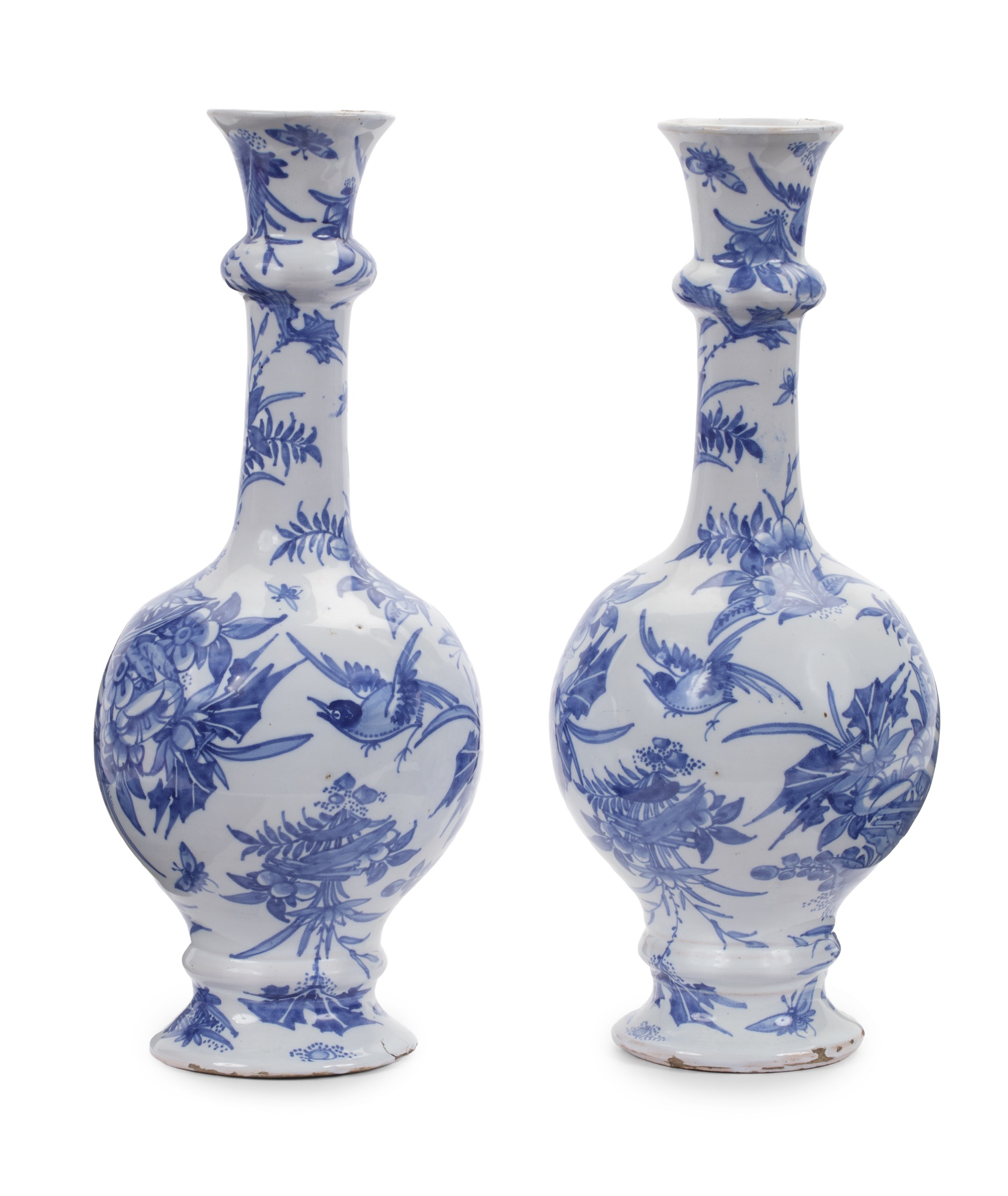
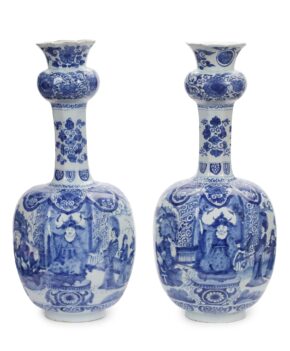
D2604. Pair of Bottle Vases
Delft, circa 1670
DIMENSIONS
Height: 34.5 cm (13.6 in.)
PROVENANCE
Lempertz, Köln, 2010;
The Collection of Dr.Wilhelm Kappesser, Darmstadt, Germany
EXHIBITION
Mainz, Mittelrheinisches Landesmuseum, Keramik aus Privatbesitz, exhibition organized by the Gesellschaft der Keramikfreunde E.V. “KERAMOS”, 10 May-4 June 1979
NOTE
Shaped with a slender, elongated onion neck and a rounded body, this pair of bottle vases is continuously decorated with scenes derived from Chinese woodblock prints, depicting birds and insects animatedly fluttering among flowering plants. The uninterrupted pictorial surface reflects a decorative approach that privileges narrative flow over compartmentalization. For much of the twentieth century, roughly between 1920 and 1990, faience decorated in this manner was erroneously attributed to a small manufactory in Frankfurt am Main. This attribution has since been decisively overturned. Archaeological evidence, including factory waste recovered in Delft, combined with securely dated Delftware bearing identical motifs, has firmly established Delft as the center of production. Scholarly research by Dr. Van Dam and others has been particularly instrumental in this reassessment. A key comparative example in the collection of the Kunstmuseum in The Hague, dated 1661, predates the onset of faience production in Frankfurt and provides compelling chronological proof for a Delft origin. The decorative vocabulary of these vases must be understood in the context of the importation of high-quality Chinese porcelain into the Dutch Republic between circa 1630 and 1640. These so-called “transitional wares” exerted a profound influence on Delft potters. The term refers to the period of political upheaval following the death of the Wanli Emperor in 1619, culminating in the fall of the Ming dynasty and the establishment of the Qing dynasty in 1644. Unlike earlier Kraak porcelain, which was structured by radiating panels, transitional porcelain featured continuous scenes, often populated by landscapes, animals, insects, or figures engaged in quiet conversation or dynamic action. Early faience objects such as the present pair belong to a group produced in Delft between approximately 1660 and 1680, characterized by chinoiserie landscapes incorporating flora, fauna, and delicate natural motifs. On the basis of stylistic analysis, archaeological findings, and securely dated comparanda, these vases can now be confidently reattributed to Delft, correcting a long-standing misinterpretation in the scholarly literature.
 CHINESE 阿伦森 WEBSITE