
Images on this website are licensed under a
Creative Commons Attribution-NoDerivs 3.0 Unported License.
OBJECT
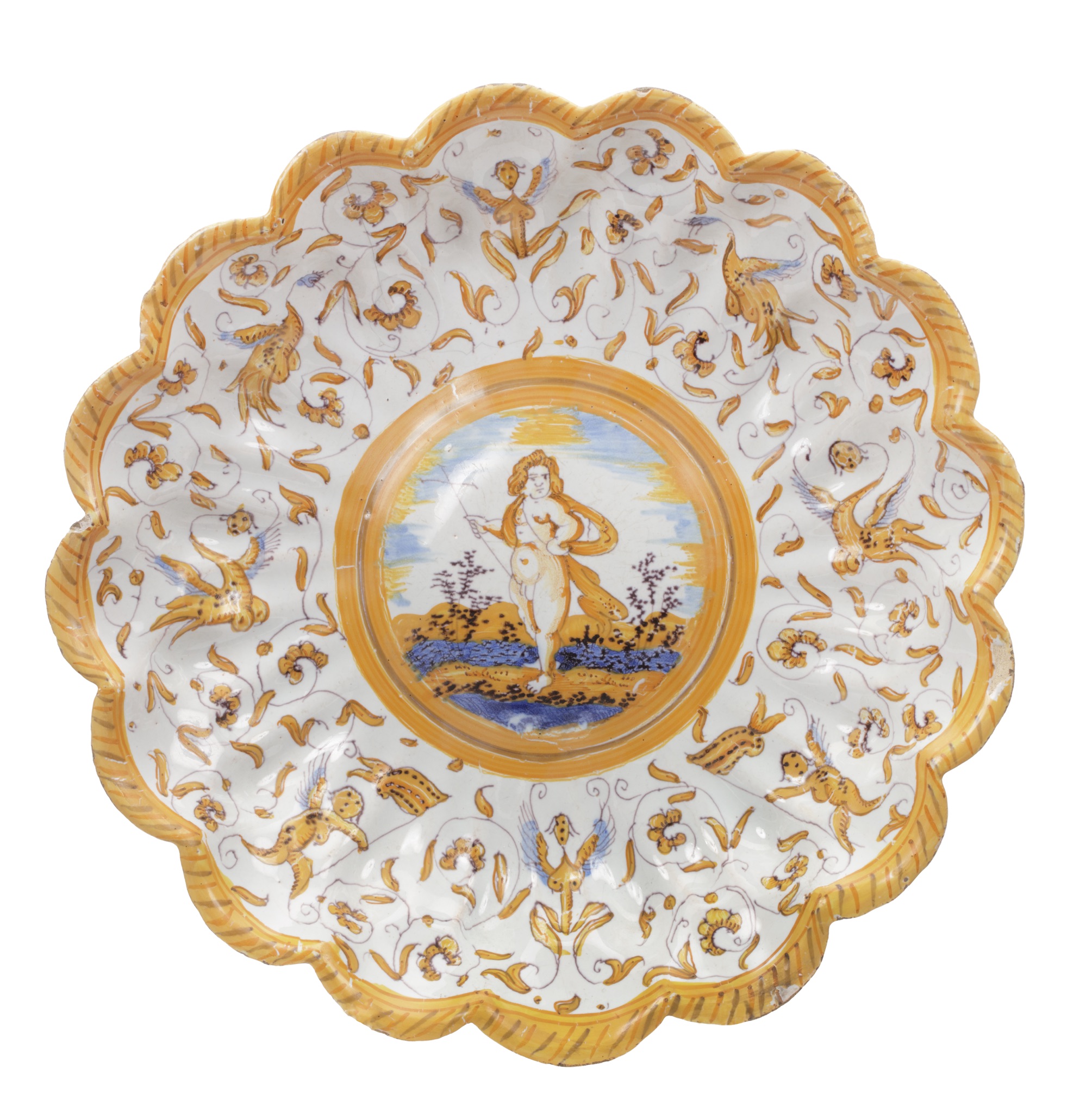
D2602. Large Crespina
Delft, circa 1640
Attributed to Willem Jansz. Verstraeten
DIMENSIONS
Diameter: 26.9 cm. (10.6 in.)
NOTE
This large scalloped crespina is painted in the tradition known as Grotesques à la Patanazzi, named for the refined maiolica dishes produced by the Patanazzi family in Urbino around 1515. The decoration reflects the enduring influence of Italian Renaissance grotesques, with fantastical winged figures, birds, scrolling foliage, and hybrid creatures arranged in a rhythmic pattern. At the center, within concentric ochre borders, stands a cherub wearing only a sash and holding a cross, set against a stylized landscape in ochre, manganese, and blue. The broad, undulating rim is painted with radiating ochre stripes, framing the lively ornamental field. By around 1600, Haarlem had become a leading center for majolica production in the Northern Netherlands, due in part to the migration of skilled potters from Southern Europe. Archival records list some forty-five potters active in the city, though the work of only one, Willem Jansz. Verstraeten, can be securely identified. After training in Delft, Verstraeten established his own pottery in Haarlem in 1625, producing wares of exceptional quality, often inspired by Italian prototypes from Faenza, Montelupo, and Urbino. His adoption of creamy opaque tin glazes, restrained figural decoration, and technical innovations such as glazing the reverse allowed his workshop to compete directly with imported Chinese porcelain. The present large crespina, with its vibrant grotesque ornament and central classical figure, reflects both the technical skill and cosmopolitan design vocabulary of Haarlem’s majolica tradition. Combining Italianate motifs with Dutch craftsmanship, it stands as a testament to the international currents that shaped the decorative arts of the early seventeenth century.
 CHINESE 阿伦森 WEBSITE