
Images on this website are licensed under a
Creative Commons Attribution-NoDerivs 3.0 Unported License.
OBJECT
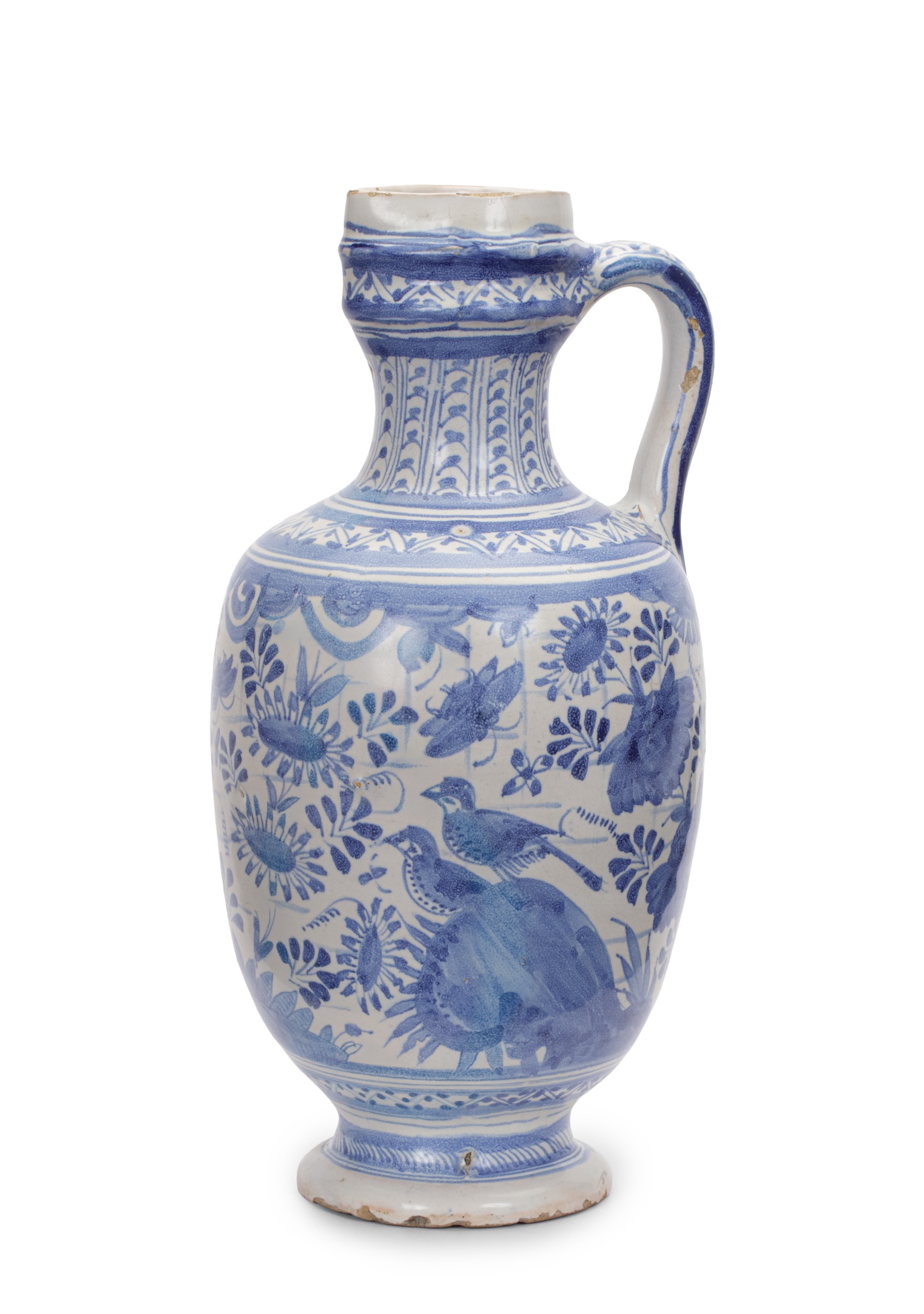
D2601. Jan Steen Jug
Delft, circa 1640
Attributed to De Porceleyne Schotel (The Porcelain Dish) factory
DIMENSIONS
Height: 26.3 cm. (10.4 in.)
PROVENANCE
Dutch Private Collection,Maastricht;
Aronson Antiquairs, Amsterdam
NOTE
This type of Delftware jug belongs to the first generation of blue-and-white wares that entered Dutch homes in the mid-seventeenth century and soon appeared in contemporary painting. These early examples mark the moment when Delft potters successfully adapted Chinese porcelain models to local taste, creating objects that reflected both global exchange and Dutch domestic refinement. Dutch artists of the seventeenth century were quick to recognize the visual and symbolic appeal of such Delftware. Willem Kalf (1619–1693) used comparable vessels to heighten the sense of luxury in his still lifes, while Jan Steen (1626–1679) placed them in lively scenes of daily life. In Girl Eating Oysters (c. 1658–60, Mauritshuis, inv. no. 818), a flirtatious diner sits beside a blue and white jug, and in The Doctor’s Visit (c. 1665–68, Mauritshuis, inv. no. 168), a maid holds a similar vessel in a humorous depiction of love-sickness. Steen’s repeated inclusion of the form suggests that such jugs served as studio props, reflecting how familiar Delftware had become in mid-seventeenth-century interiors. These jugs are traditionally linked to the Delft factory De Porceleyne Schotel (The Porcelain Dish), whose painters favored Chinese-inspired motifs, flowers, birds, and rockwork, interpreted with a lively and expressive Delft hand. Their presence extended beyond Steen’s domestic scenes: a related example appears in Laurens Craen’s Still Life with a Lobster and Delft Jug (Christie’s Amsterdam, 7 November 2001, lot 77). Viewed in this wider visual context, the present jug bridges domestic use and artistic representation, capturing an early moment when Delftware both emulated Asian porcelains and established a visible, even narrative, role in Dutch cultural life.
 CHINESE 阿伦森 WEBSITE