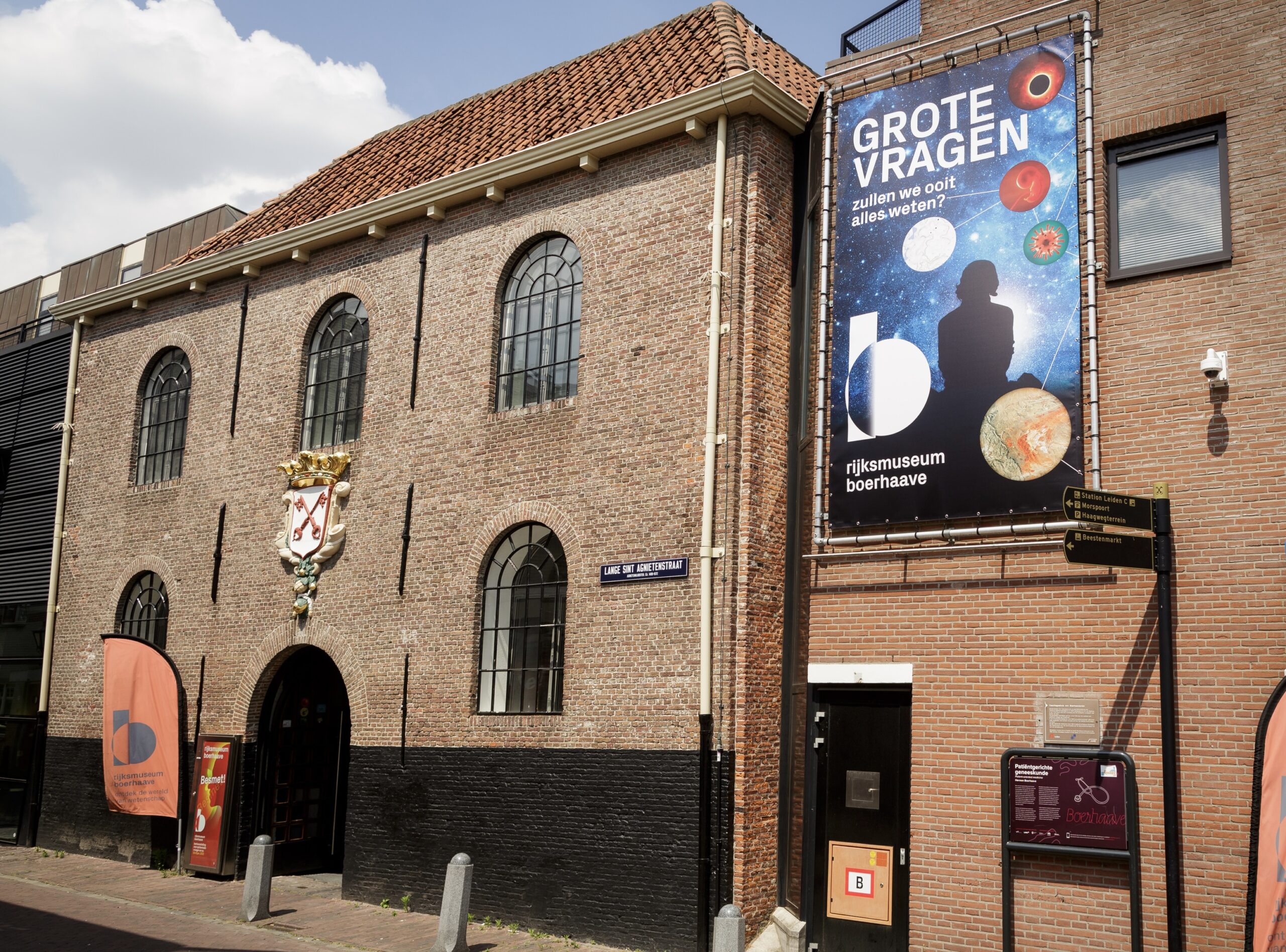
Located in the historic city of Leiden, Rijksmuseum Boerhaave (the Boerhaave Museum) is the Netherlands’ leading institution dedicated to the history of science and medicine. Established in 1931 as the Nederlandsch Historisch Natuurwetenschappelijk Museum (Netherlands Historical Museum of Science and Medicine) and initially housed in the former Boerhaave Laboratory, the museum was founded by scholars determined to preserve the material heritage of scientific practice at a time of rapid modernization. It was later named in honor of Herman Boerhaave (1668–1738), the influential physician and scientist whose methods of clinical teaching and experimental inquiry laid the foundations of modern medicine.
Ironically, the foundation of the museum was prompted by the very scientific progress it now documents. At Leiden University, the physicist Heike Kamerlingh Onnes (1853–1926), Nobel Prize laureate and pioneer in low-temperature physics, best known for his discovery of superconductivity, modernized the university’s laboratories at a remarkable pace. As new equipment replaced the old, earlier scientific instruments quickly became obsolete.
Since 1991, the museum has been housed in the former St. Caecilia Hospital and convent, a site long associated with care, healing, and learning. Originally founded as a plague hospital, it later became the first academic hospital in Leiden. The building provides a historically resonant setting for a museum devoted to the development of medical and scientific knowledge.
Today, the Boerhaave Museum holds a collection of approximately 126,000 objects, ranging from scientific instruments and anatomical models to manuscripts, prints, and teaching aids. Together, they chart five centuries of discovery and innovation, with particular emphasis on the Dutch contribution to medicine, chemistry, physics, and natural philosophy.
Among the most evocative objects in the collection is a significant group of Delft apothecary jars. Displayed within the broader narrative of scientific progress, these Delftware vessels offer a tangible connection to the material culture of medicine. Examples representing a wide range of decorative styles and produced at several Delft potteries, including De Drie Klokken (The Three Bells), De Porceleyne Klaauw (The Porcelain Claw), and De Grieksche A (The Greek A), are preserved in the museum’s holdings.
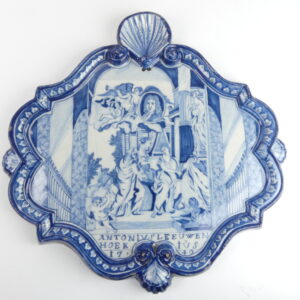
Alongside this collection of apothecary vessels, an important Delft plaque depicting Antonie van Leeuwenhoek, signed H.V.M. and dated 1740, forms part of the museum’s collection (Fig. 1). Van Leeuwenhoek (1632–1723) was a Dutch tradesman, surveyor, wine gauger, glassmaker, and pioneering microbiologist. He is best known for the microscopes he designed and crafted himself and for his groundbreaking contributions to cell biology and microbiology. Beginning in 1674, he made numerous discoveries that became known through his correspondence with the Royal Society in London.
Together, these objects underscore the vital role Delft played not only in the refinement of ceramic artistry, but also in the broader culture of scientific inquiry that shaped the Dutch Republic.
 CHINESE 阿伦森 WEBSITE