
Images on this website are licensed under a
Creative Commons Attribution-NoDerivs 3.0 Unported License.
OBJECT
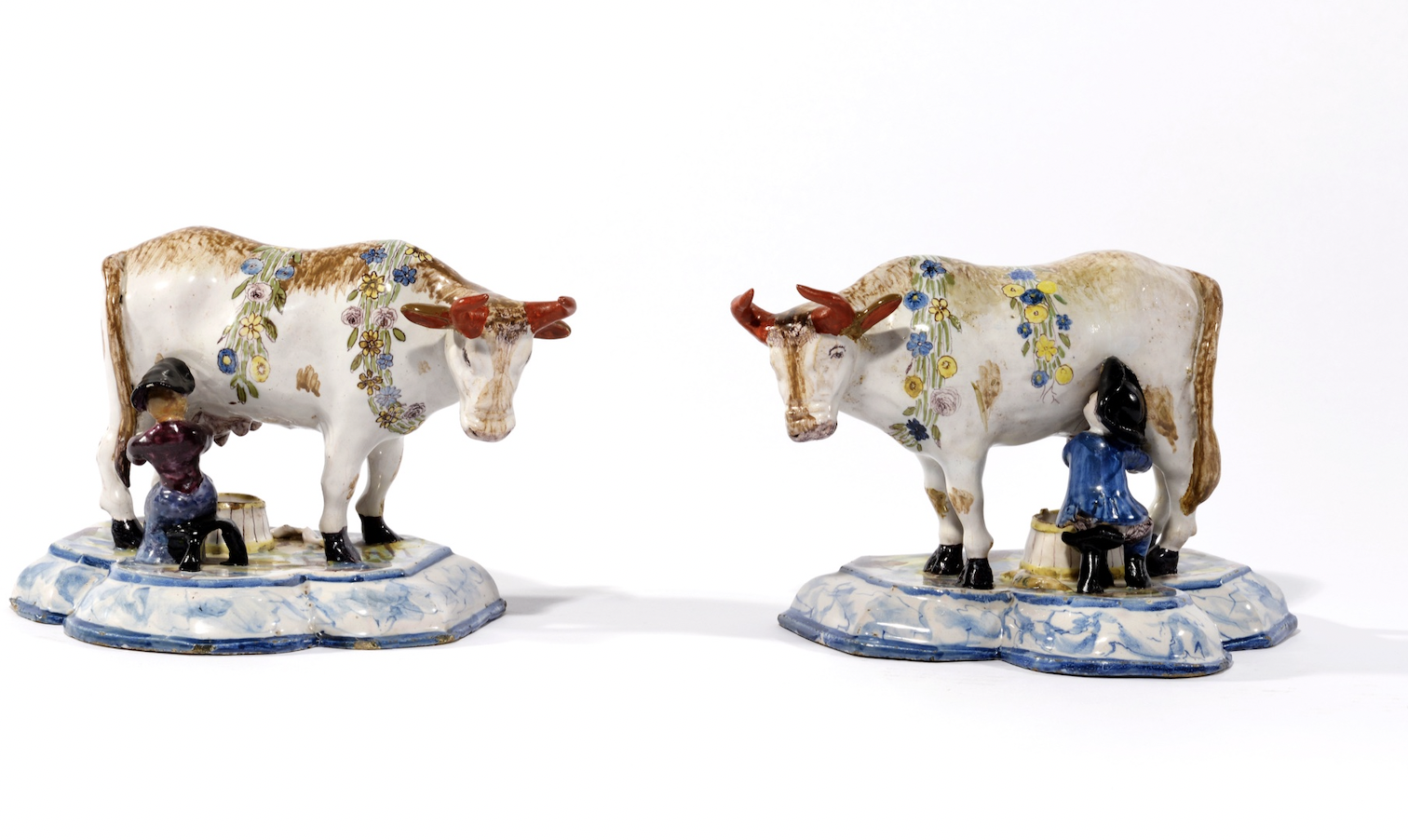
•D1639. Pair of Polychrome Milking Groups
Amsterdam, circa 1770
Each marked GDG in manganese or blue on the yoke for Gerrit de Graaf, a tile painter at d’Oude Prince (The Old Prince) factory
DIMENSIONS
Height: 14 cm. (5½ in.); length: 20.9 and 21.6 cm.
(8¼ and 8½ in.)
PROVENANCE
Belgian Private Collection;
Aronson Antiquairs, Amsterdam;
Dutch Private Collection
NOTE
Gerrit de Graaf was a painter at d’ Oude Prins (The Old Prince) factory, a tile manufactory located on the Anjeliersstraat in Amsterdam. He began working as an apprentice around 1745, and from 1770 onward he possibly managed the painting department. Characteristic of his style were the blue and manganese color scheme and his slightly nervous (kriebelig) execution, identifiable through the several pieces that are known bearing his monogram or his complete signature. Although most of his work was on tiles, he also painted molded objects, such as a tray dated 1779, in the Musée national de Céramique, Sèvres (inv. no. MNC 1931), and a butter tub in the form of a female figure, dated 1770, and illustrated in Van Dam 1999, p. 45, no. 23, which, with both the artist’s monogram and complete signature is a key piece for attributions to Gerrit de Graaf. There are five pairs and a single figure of recumbent cows known and attributed to d’ Oude Prins factory based on the pair in De Koninklijke Musea voor Kunst en Geschiedenis in Brussels (inv. no. L. 334 a,b), which is signed by Adam Sybel, who, like De Graaf, also was a tile painter at d’ Oude Prins factory. There are no known Amsterdam milking groups. However, in the eighteenth century the tile factories in Amsterdam did produce molded objects on a small scale, so it is possible that this pair of milking groups was indeed the product of d’Oude Prins. Although these groups do show signs of handwork, they clearly were made in a mold based on Delft models. The important differences between the Amsterdam and Delft cows, are in the color palette, and in the body shapes: the Amsterdam cows being more naturalistically modeled than the more stylized Delft cows.
In spite of a strong argument for this pair of milking groups having been produced in Amsterdam, their origin is still uncertain, although it was not likely to be in one of the Delft facrtories. They may have been created in the Blankenburg tile factory in Amsterdam, which was discontinued in 1764, and from whom Pieter van der Kloet, the owner of d’ Oude Prins, may have bought the molds. Alternatively the groups may have been made in the Blankenburg factory and painted there by De Graaf, where he may have learned his skill as a painter before being employed at d’ Oude Prins.
 CHINESE 阿伦森 WEBSITE