
Images on this website are licensed under a
Creative Commons Attribution-NoDerivs 3.0 Unported License.
OBJECT
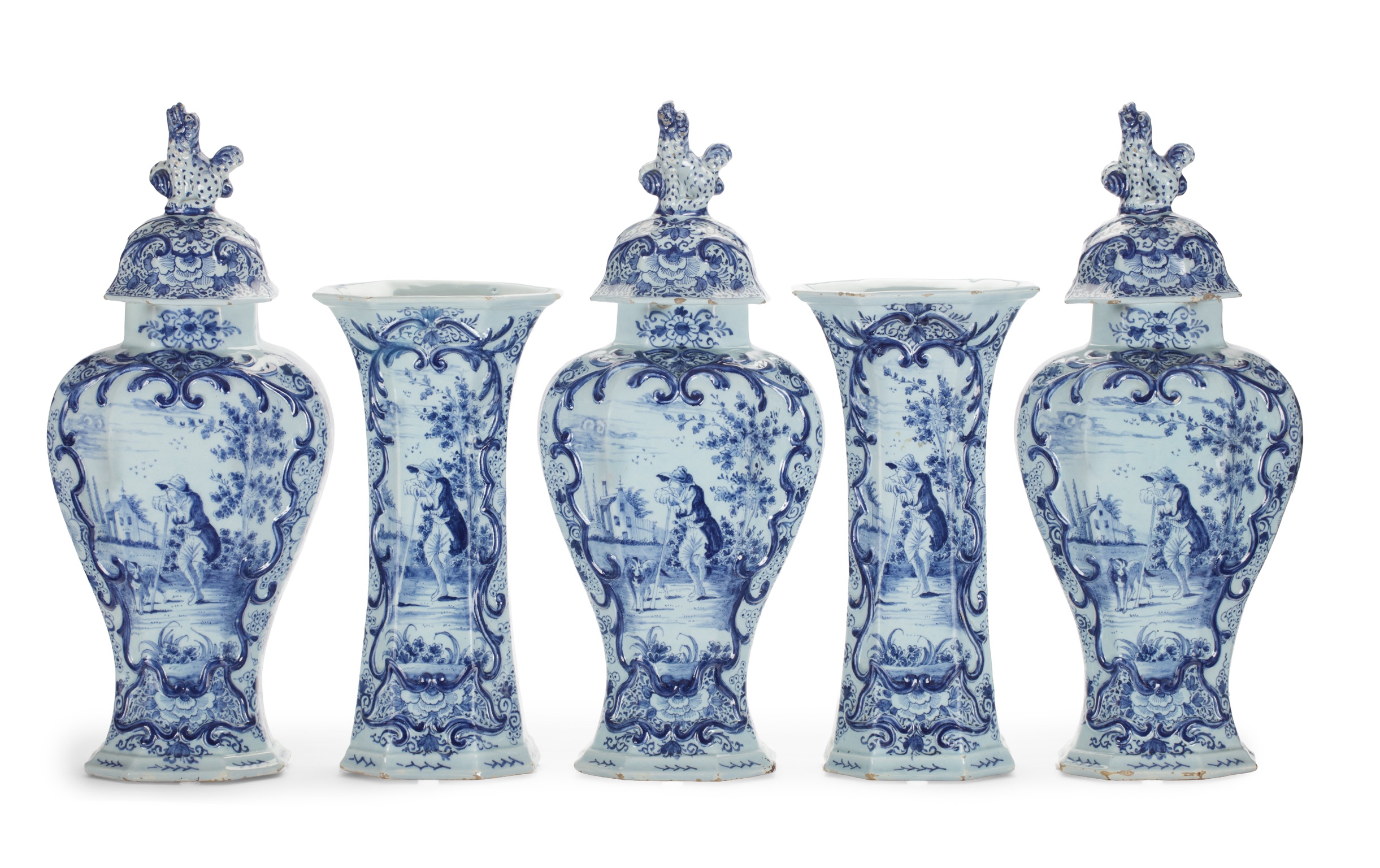
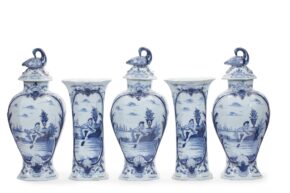
D2667. Garniture Set
Delft, circa 1770
Marked LPK in blue for De Porceleyne Lampetkan (The Porcelain Ewer) factory
DIMENSIONS
Heights: 35.5 and 49 cm. (14 and 19.3 in.)
PROVENANCE
Belgian Private Collection;
Aronson Antiquairs, Amsterdam
NOTE
The history of De Lampetkan factory, one of Delft’s most storied ceramic workshops, begins in 1609, when Abraham Davidsz. Oosterhouck acquired a property named De Burcht van Leyden, which he transformed into a pottery. Over the course of the seventeenth century, the factory passed through the hands of several prominent owners, including Cornelis Harmesz. Valckenhoff, Claas Jansz. van Straten, and members of the Hoppesteyn and Van der Voorn families. By 1723, the enterprise entered a prosperous new chapter under the Van der Ceel family, known for their refined production and enduring influence in the Delftware industry.
Among the factory’s most prized creations are its blue and white garniture sets, jardinières, figurines and ornamental vases. De Lampetkan’s artistic repertoire also embraced the chinoiserie style that swept through European decorative arts in the eighteenth century. Around 1760, the factory produced a series of elegant figures representing Asian women. These figures, with their stylized poses and musical instruments, were often inspired by Chinese export porcelain of the Qianlong period (1736–1795), though interpreted through a distinctly Dutch lens. Delft artisans frequently adapted the original Chinese forms, enhancing them with intricate, imaginative surface decoration unconstrained by the symbolic meanings of the originals. The current garniture set shows that also European topics were part of the assortment as well.
Under the stewardship of the Van der Ceel family, the factory flourished. By the 1770s and 1780s, the business had expanded its infrastructure, acquiring shares in De Paauw mill and a clay washery, an investment that allowed them greater control over their raw materials and reduced dependence on intermediaries. This strategic expansion contributed to the sustained quality and innovation seen in De Lampetkan’s later production.
The standing shepherd and dog are from an etching and engraving by Johannes [de] Visscher (1633-92+) entitled A Herd Leaning on his Staff. Detail of engraving by Johannes [de] Visscher and illustrated in F.W.H. Hollstein’s Dutch & Flemish Etchings, Engravings and Wood-cuts, Vol. XLI, 1992, p. 74, no. 106.
 CHINESE 阿伦森 WEBSITE