

Images on this website are licensed under a
Creative Commons Attribution-NoDerivs 3.0 Unported License.
OBJECT
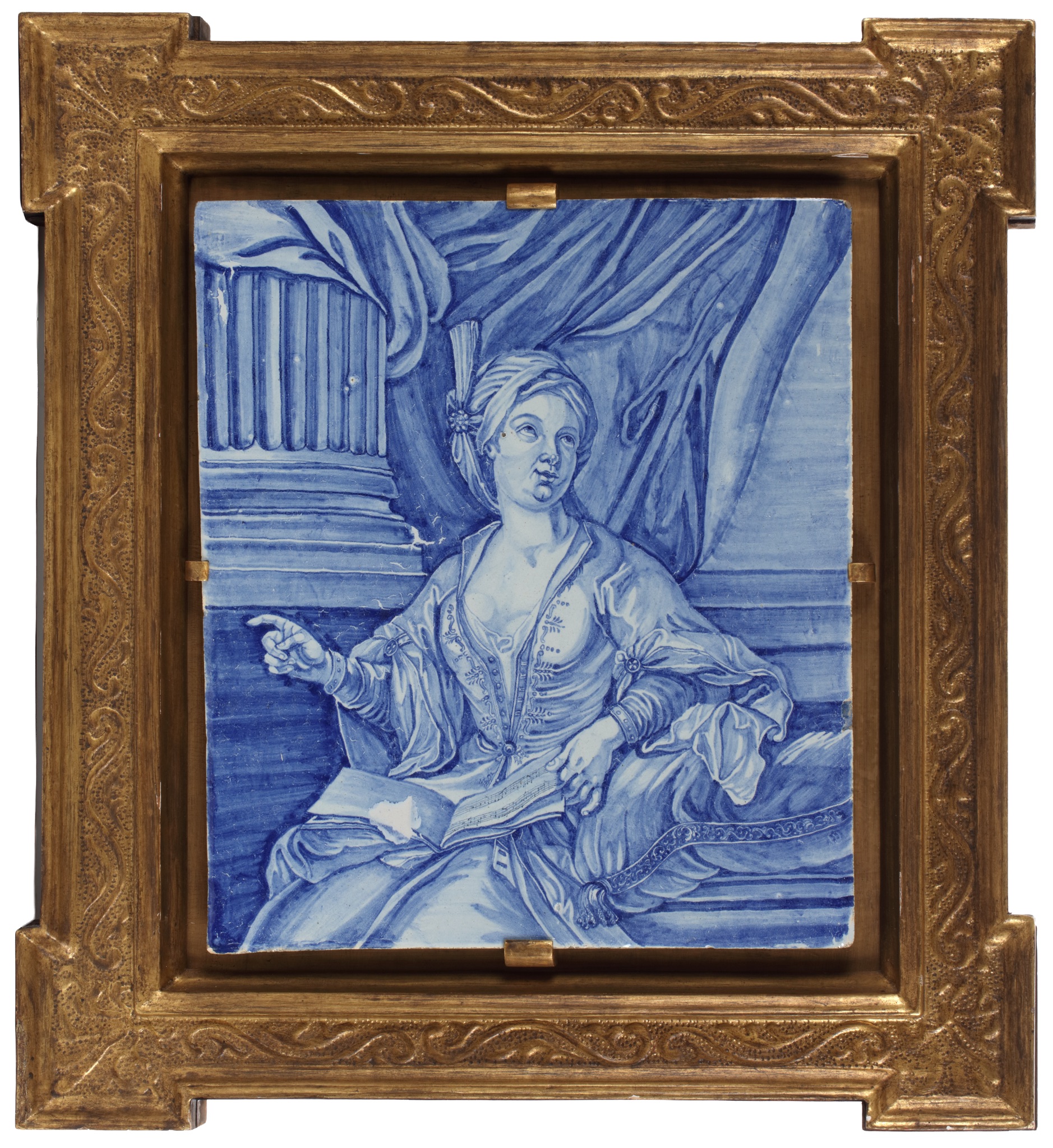
•D2665. Plaque with a Portrait of a Lady
Delft, circa 1770
DIMENSIONS
Height: 40.5 cm. (16 in.); Width: 34.9 cm. (13.8 in.)
PROVENANCE
American Private Collection;
Aronson Antiquairs, Amsterdam 2005;
Sotheby’s Amsterdam, 12 October 2004, lot 157
LITERATURE
Aronson 2019, pp. 114-115, no. 58
NOTE
The mirrored source for this plaque is La Musique Philis, an engraving by Nicolas Chateau (1680–1750), Paris, 1708, accompanied by a poem praising the enchanting power of music and love:
La Musique, Philis, est une enchanteresse,
Mais qui doit à l’Amour ce qu’elle fait de mieux.
Je juge avoir ce Dieu qui brille dans tes yeux,
Ce qu’il peut à ta voix ajouter de tendresse.
M.R.
Philis (Phyllis) is a figure from Greek mythology whose name signifies “foliage” or “leaves.” According to the legend, she married Demophoön, King of Athens and son of Theseus, during his return from Troy. When he failed to keep his vow to return to her, Phyllis took her own life and was transformed by the gods into an almond tree. Only upon opening a casket she had entrusted to him did Demophoön understand his neglect; embracing the barren tree, he brought it miraculously into bloom.
Phyllis’s story was well known in the seventeenth century and was referenced by the Dutch composer Jacob van Eyck (1590–1657) in several works, including Phyllis schooner Herderin and Philis quam Philander tegen. Such compositions may have contributed to the reception of Chateau’s La Musique Philis, which in turn served as the model for the present plaque.
 CHINESE 阿伦森 WEBSITE