

Images on this website are licensed under a
Creative Commons Attribution-NoDerivs 3.0 Unported License.
OBJECT
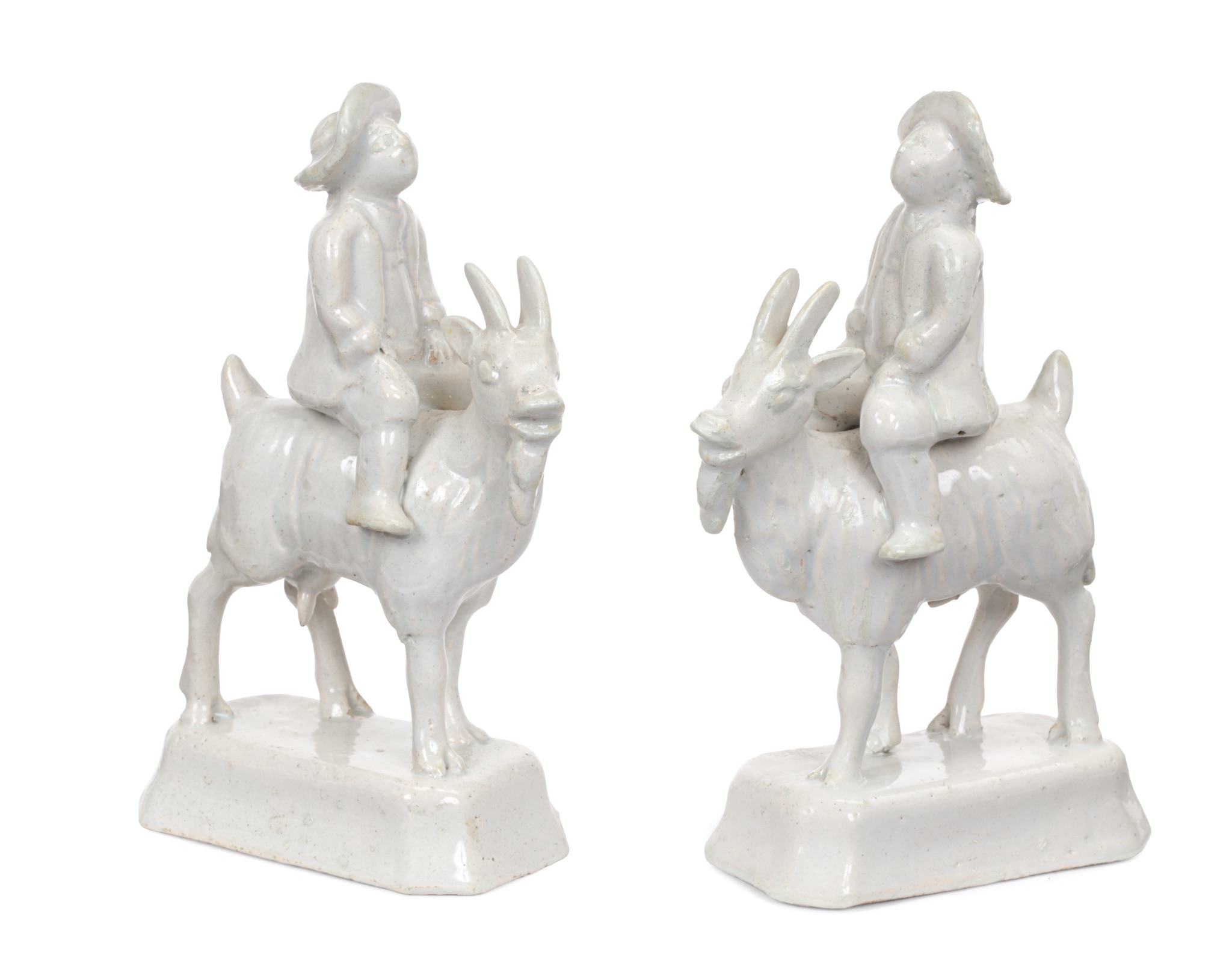
•D2660. Pair of Figures on Goats
Delft, circa 1760
DIMENSIONS
Heights: 13.6 cm. (5.4 in.)
PROVENANCE
Dutch Private Collection
NOTE
Dutch Delftware was produced in an extraordinary variety over the centuries, ranging from the purity of plain white glaze to the brilliance of richly polychrome decoration. For a long time, art historians regarded Delfts wit, white Delftware, as primarily functional, yet delicate figures such as this pair demonstrate that plain white faience could also serve a decorative purpose. Delft potters produced figures of both animals and people in the color of the white tin glaze alone, without further decoration, to be displayed as table ornaments or in a cabinet, sometimes alongside Chinese porcelain.
Faience with an undecorated white tin glaze was first made in Italy around 1550, known as bianchi di Faenza. Initially large dishes and vessels, these wares developed into more modest forms made in series for affordable everyday use. By around 1600, Dutch potteries began producing white faience, each with its own blend of raw materials that produced shades ranging from grey and blue to yellow, green, or even pink. Most white Delftware was made for the domestic market and is rarely marked or dated.
Research continues into whether some white-glazed and unpainted groups were cold-painted after production, perhaps by decorators outside the factory, with the unfired decoration later lost or intentionally removed. It is also possible that certain white-glazed figures were intended from the outset as less costly alternatives to painted wares. Although simpler to produce than blue or polychrome Delftware, white undecorated objects were initially affordable only to the upper class. By the end of the seventeenth century, white Delftware had become more common, with factories producing larger quantities of kitchenware for daily use alongside decorative objects of figures and animals for display on the mantelpiece.
 CHINESE 阿伦森 WEBSITE