
Images on this website are licensed under a
Creative Commons Attribution-NoDerivs 3.0 Unported License.
OBJECT
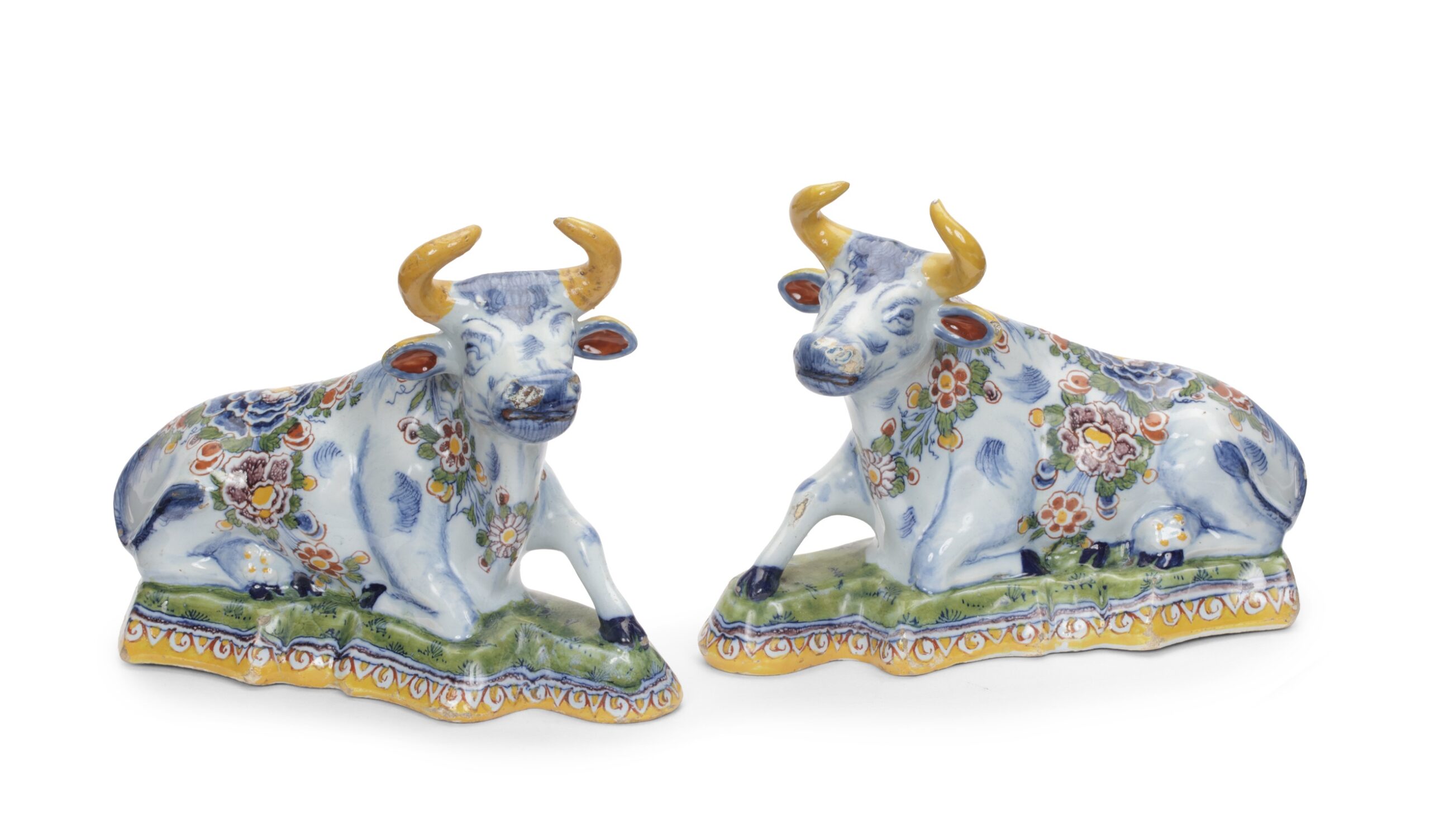
•D2657. Pair of Cows
Delft, circa 1760
Marked in blue with an unidentified X on the base.
DIMENSIONS
Height: 11 cm. (4.3 in.);
Length: 15 cm. (5.9 in.)
PROVENANCE
Dutch Private Collection, Maastricht;
Aronson Antiquairs, Amsterdam
NOTE
This pair of recumbent Delftware cows represents a distinct variant within the broader group of eighteenth-century Delft cow models. Unlike standing examples, which emphasize verticality and display, these figures are shown resting on the ground, their bodies compact and their poses more contained. The recumbent posture introduces a quieter, more introspective character, distinguishing the group from both ceremonial and active representations of cattle.
Despite this difference in pose, the recumbent cows share key features with standing Delftware examples. They are conceived as a mirrored pair, turned toward one another to create a balanced and self-contained composition. The floral garlands draped across their backs and necks remain an essential decorative element, visually linking them to other cow models produced in Delft during this period. Yellow horns further reinforce this continuity, marking the figures as decorative objects rather than naturalistic studies.
The modeling of the recumbent cows differs subtly but significantly. The lowered body and bent legs require a broader base, resulting in a more horizontal emphasis. This shift affects the visual rhythm of the figures, drawing attention to the contours of the animals’ backs and flanks rather than their stance. The pose also allows for a more expansive treatment of surface decoration, with floral motifs unfolding across the body in a continuous, flowing pattern.
Within the wider Delftware repertoire, recumbent cows appear less frequently than standing examples, suggesting a deliberate variation rather than a standard type. Their restrained posture and compact form introduce an alternative interpretation of the cow motif, one that complements but does not replicate other models. Together with standing cows and milking groups, the recumbent pair demonstrates the flexibility with which Delft potters explored a single subject, adapting pose and composition while maintaining a recognizable visual language.
 CHINESE 阿伦森 WEBSITE