
Images on this website are licensed under a
Creative Commons Attribution-NoDerivs 3.0 Unported License.
OBJECT
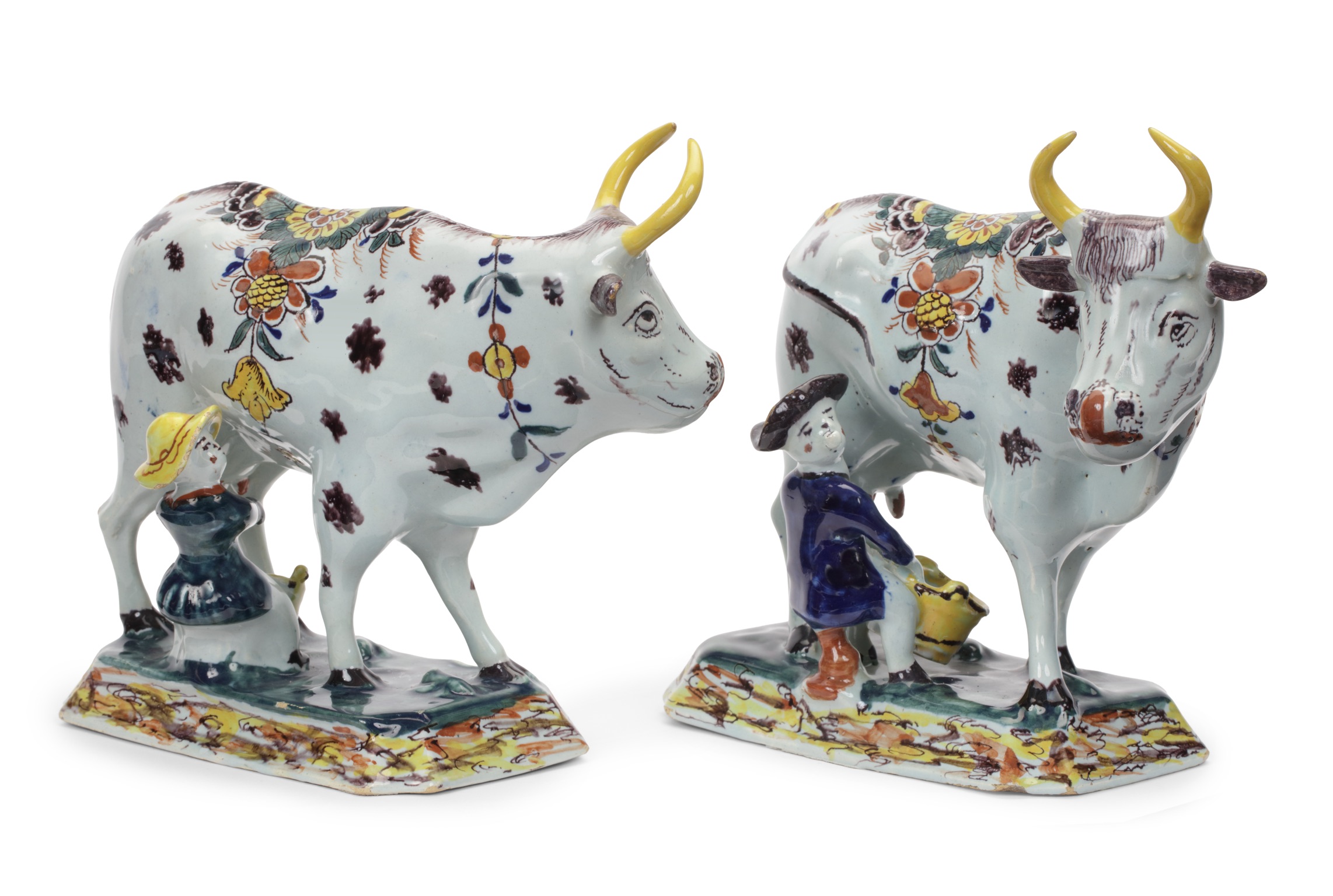
•D2656. Pair of Milking Groups
Delft, circa 1760
DIMENSIONS
Heights: 20 cm. (7.9 in.);
Lengths: 24.5 cm. (9.7 in.)
PROVENANCE
Belgian Private Collection;
Aronson Antiquairs, Amsterdam
NOTE
Animal figures constitute a distinctive and evocative category within the Delftware tradition, and cow groups in particular occupy a cherished place in Dutch material culture. Produced from the early eighteenth century onward, Delftware cows adorned mantelpieces, window sills, and cupboards in both urban and rural homes, reflecting the central role of dairy farming in the Netherlands. These groups were typically made in pairs, each cow gently turning its head inward and often accompanied by a milker or milkmaid to evoke scenes of everyday agricultural life.
In most Delft examples, the attendants are placed on opposite sides of the cows so that both figures remain visible when the pair is displayed together. The present pair, however, is unusual in that both milkers sit on the right side of their respective cows. This deliberate arrangement mirrors authentic Dutch dairy practice: cows are generally milked from the same side, most often the right, to maintain consistency, minimize stress, and ensure higher productivity. This adherence to real agricultural technique sets the pair apart as a particularly accurate and thoughtful representation of historical milking routines.
Delftware cow groups thus provide more than decorative appeal. They convey a nostalgic yet informed glimpse into the rhythms of rural Dutch life, capturing both the charm of pastoral imagery and the realities of farm labor. Their enduring popularity reflects not only their delightful modeling and polychrome decoration but also their role as material witnesses to the agricultural heritage that shaped the social and economic fabric of the early modern Netherlands.
 CHINESE 阿伦森 WEBSITE