
Images on this website are licensed under a
Creative Commons Attribution-NoDerivs 3.0 Unported License.
OBJECT
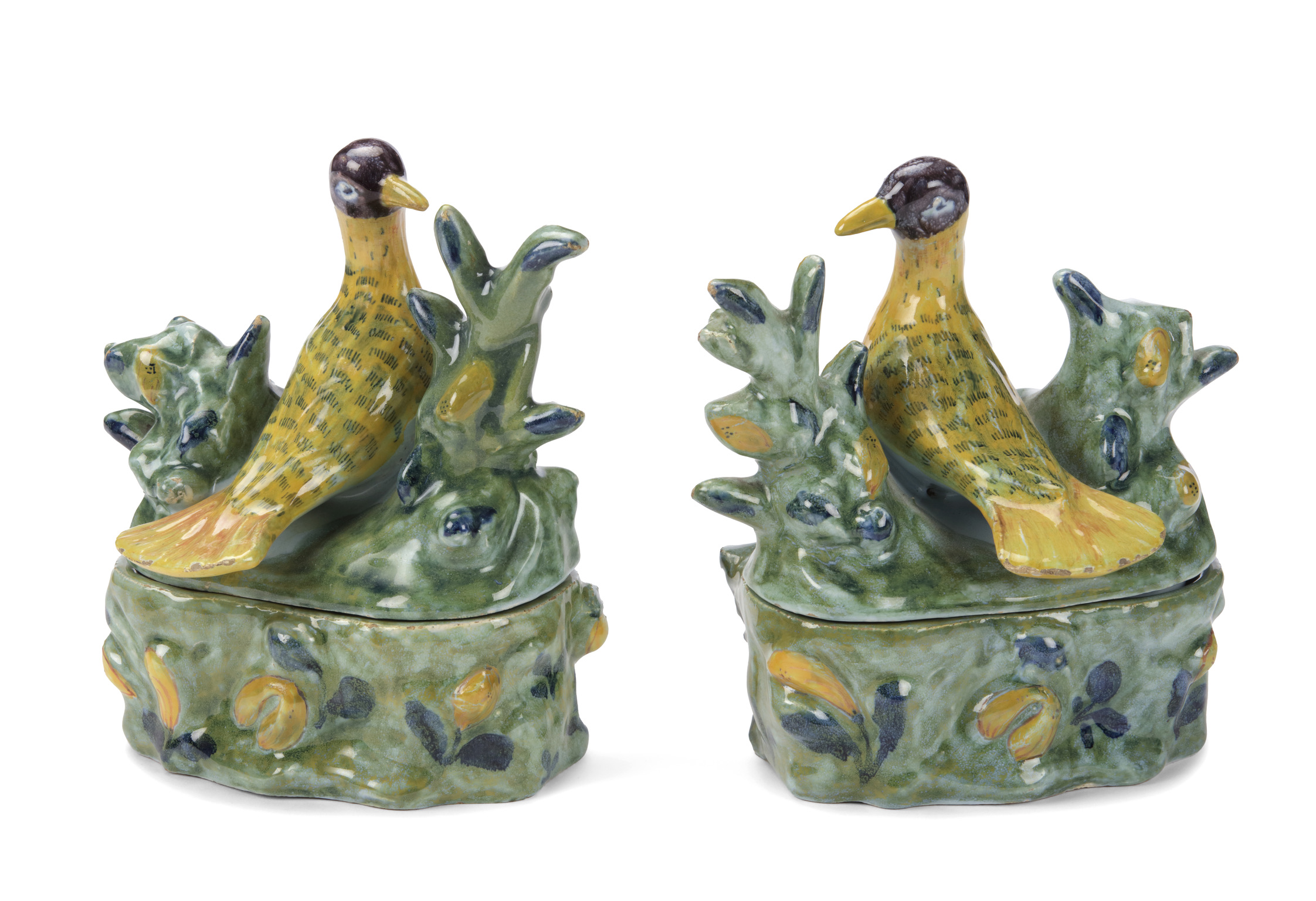
•D2655. Bird Tureens
Delft, circa 1770
DIMENSIONS
Heights: 14.2 cm. (5.5 in.
PROVENANCE
American Private Collection;
Aronson Antiquairs, Amsterdam, 2001;
The Van der Vorm Collection, The Netherlands;
Aronson Antiquairs, Amsterdam
LITERATURE
Aronson 2000/2001;
Abraham & Aronson
2010, pp. 32-33;
Aronson 2021, pp. 76-77, no. 52
NOTE
Birds have occupied a prominent place in Western visual culture for centuries, appearing variously as symbols, ornamental motifs, and objects of scientific inquiry. Their meanings have shifted across time and place: in seventeenth-century Dutch genre painting birds often carried sexual connotations, linked to the verb vogelen, while in medieval manuscripts they served primarily decorative functions within marginal borders. From the early sixteenth century onward, however, birds increasingly became the subject of empirical study, stimulated by voyages of discovery and the emergence of illustrated natural histories.
These bird-form tureens belong to a long tradition of zoomorphic tableware in Delftware, where potters translated both familiar and exotic avian forms into sculptural vessels. By the mid-eighteenth century, dining à la Française had become the dominant mode of elite table service across Europe. Under this system, entire courses were displayed symmetrically on the table, encouraging the use of visually striking serving vessels. Delft factories responded by producing an expanded range of decorative tablewares, including tureens modeled as animals, which functioned as both utilitarian objects and conversation pieces.
The origins of such forms lie in the late medieval and early modern tradition of savory pies, elaborate culinary showpieces often shaped from pastry and filled with meat or poultry. These pies were frequently presented with feathers, heads, and tails intact, emphasizing spectacle as much as sustenance. As ceramic tableware increasingly replaced edible display pieces in the eighteenth century, trompe l’œil tureens offered a refined substitute, evoking the visual drama of the earlier pies without the need to sacrifice an entire animal.
Delft bird tureens range from representations of common domestic fowl to imaginative renderings inspired by exotic species known through trade, prints, and natural history illustrations. Their appeal lay in the combination of naturalistic modeling, vibrant coloration, and the enduring fascination with birds as creatures poised between the terrestrial and the aerial.
 CHINESE 阿伦森 WEBSITE