
Images on this website are licensed under a
Creative Commons Attribution-NoDerivs 3.0 Unported License.
OBJECT
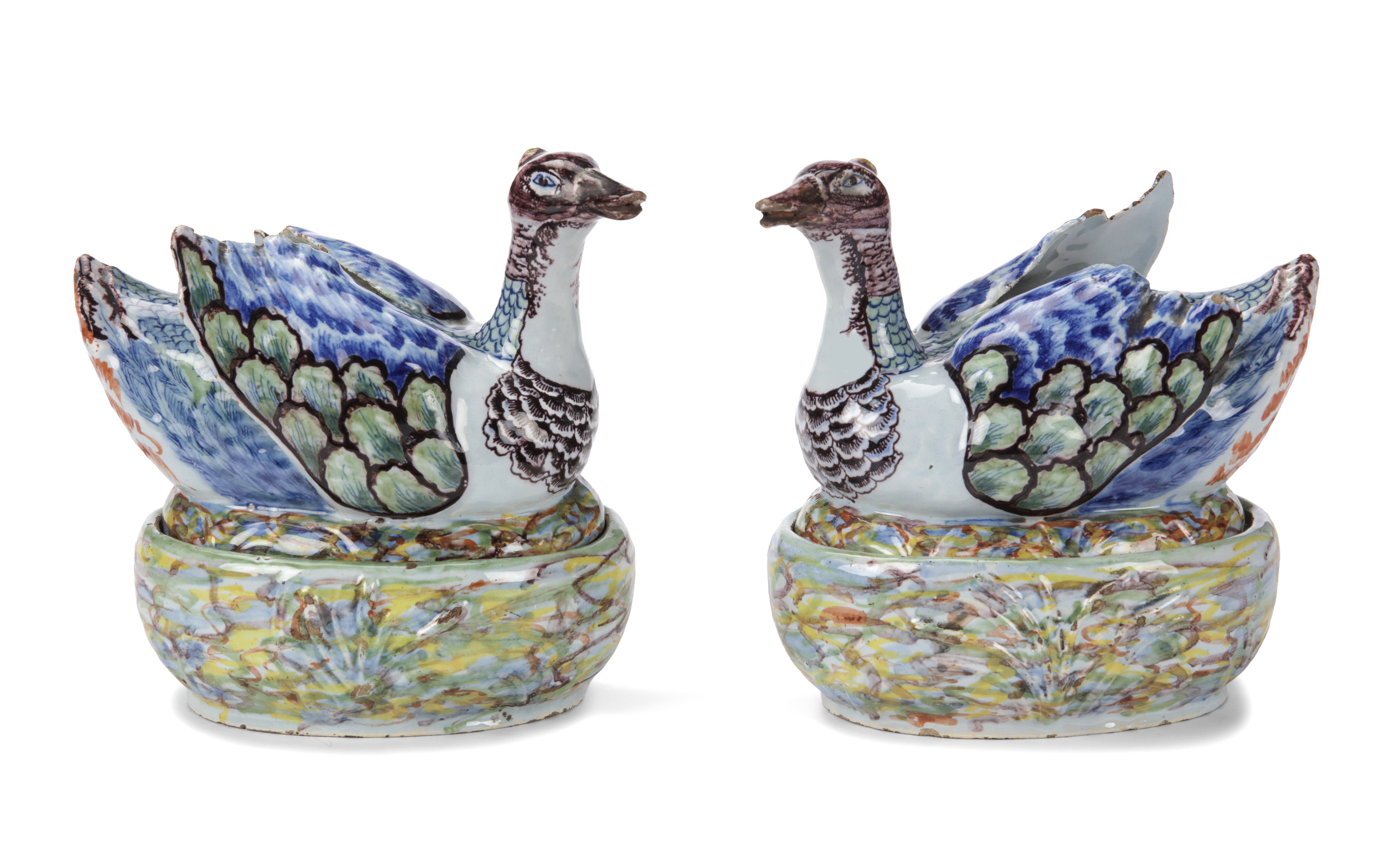
D2654. Duck Tureens
Delft, circa 1760
Each marked GVS in blue for Geertruij Verstelle, the owner of Het Oude Moriaanshooft (The Old Moor’s Head) factory from 1761 to 1769
DIMENSIONS
Heights: 13.5 cm. (5.3 in.)
PROVENANCE
Dutch Private Collection, Amsterdam
NOTE
This pair of duck-form tureens is marked for Geertruij Verstelle, proprietor of the Delft factory Het Oude Moriaanshooft (The Old Moor’s Head) between 1761 and 1769. Verstelle belongs to a small yet significant group of women who assumed ownership and managerial responsibility within the Delft pottery industry during the eighteenth century, often following the death of a spouse but operating with considerable independence and commercial acumen.
During Verstelle’s tenure, Het Oude Moriaanshooft produced a range of finely modeled and richly colored wares that demonstrate both technical competence and a clear sensitivity to contemporary fashion. The present duck tureens exemplify this production: their carefully articulated bodies, textured plumage, and alert heads reflect the Rococo taste for naturalism and visual play, while the oval bases evoke nest-like forms that enhance the illusionistic effect. The vibrant palette of blues, greens, yellows, and manganese outlines further underscores the painterly ambitions of the workshop.
The popularity of zoomorphic tureens in the mid-eighteenth century formed part of a broader European fascination with trompe l’œil ceramics, stimulated by innovations in Meissen porcelain and by the continued influx of Chinese export wares during the Qianlong period (1736–1795). Delft factories responded by translating these fashionable forms into Delftware, adapting international models to local materials and traditions. In comparison with their porcelain counterparts, Delft examples such as these are distinguished by their robust modeling, expressive surfaces, and distinctive polychrome decoration.
Seen within this context, the duck tureens stand as characteristic products of Het Oude Moriaanshooft under Verstelle’s direction. They testify not only to the vitality of the Delft ceramic industry in the 1760s, but also to the active role played by women in sustaining and shaping its output, contributing decisively to Delft’s participation in an increasingly interconnected European market for luxury tableware.
 CHINESE 阿伦森 WEBSITE