
Images on this website are licensed under a
Creative Commons Attribution-NoDerivs 3.0 Unported License.
OBJECT
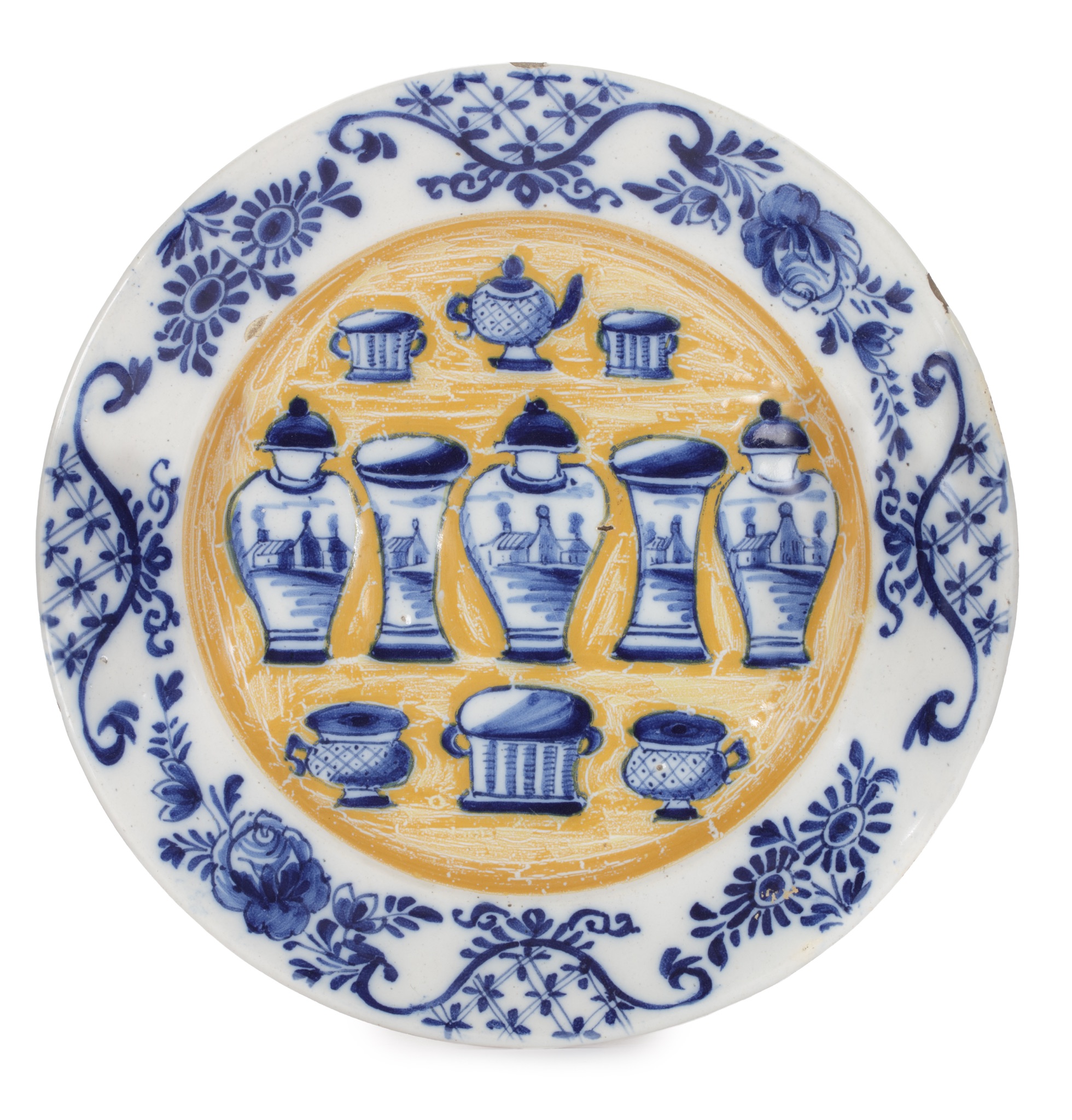
D2651. Yellow Ground Sample Plate
Delft, circa 1765
DIMENSIONS
Diameter: 23 cm. (9 in.)
PROVENANCE
Dutch Private Collection, Maastricht;
Aronson Antiquairs, Amsterdam
NOTE
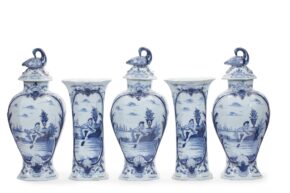
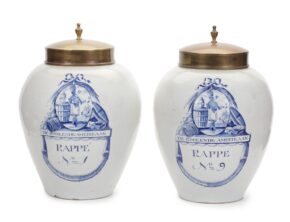
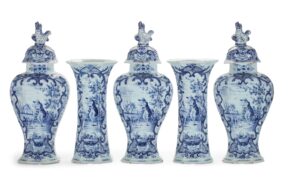
The precise function of Delftware plates and plaques painted with a yellow ground and decorated with garnitures, cuspidors, teapots, and other ceramic wares arranged in rows remains uncertain. Although documentary evidence is lacking, these rare objects have long been interpreted as sample plates, possibly used by Delftware factories to display their inventory and demonstrate the technical and artistic skill of their painters. Their concept may have been inspired by Chinese Kangxi-period porcelain decorated with assemblages of loose objects, motifs such as the “Hundred Antiquities” or “Eight Precious Objects.” Unlike the freely scattered compositions on Chinese porcelain, however, Delft painters arranged their objects in orderly rows and depicted them with a markedly higher degree of realism. These differences support the idea that the Delft examples served as structured catalogues of production rather than purely decorative motifs.
The bright yellow glaze used on these plates further underscores their prestige. As described by Gerrit Paape in De Plateelbakker of Delftsch Aardewerkmaaker (1794), Delft painters employed two recipes for yellow, both requiring antimony and gold litharge: materials that were costly and hazardous. The glaze was notoriously difficult to fire: it could burn easily, and pieces often required multiple firings. Paape notes that the pigment was applied in small bits on saucers dusted with ash to prevent sticking, then fired on the crown of the kiln.
Although these dishes are unmarked, stylistic parallels, including a marked plaque in the Kunstmuseum The Hague (inv. no. OC(D)245-1904), support an attribution to De Grieksche A (The Greek A) factory. Yet if the plates truly functioned as sample wares, their manufacture may not have been limited to a single workshop. This example continues the Delft tradition of “sample” designs, especially popular between 1750 and 1775, and reflects both technical ambition and the evolving visual language of Delft faience in the eighteenth century.
 CHINESE 阿伦森 WEBSITE