

Images on this website are licensed under a
Creative Commons Attribution-NoDerivs 3.0 Unported License.
OBJECT
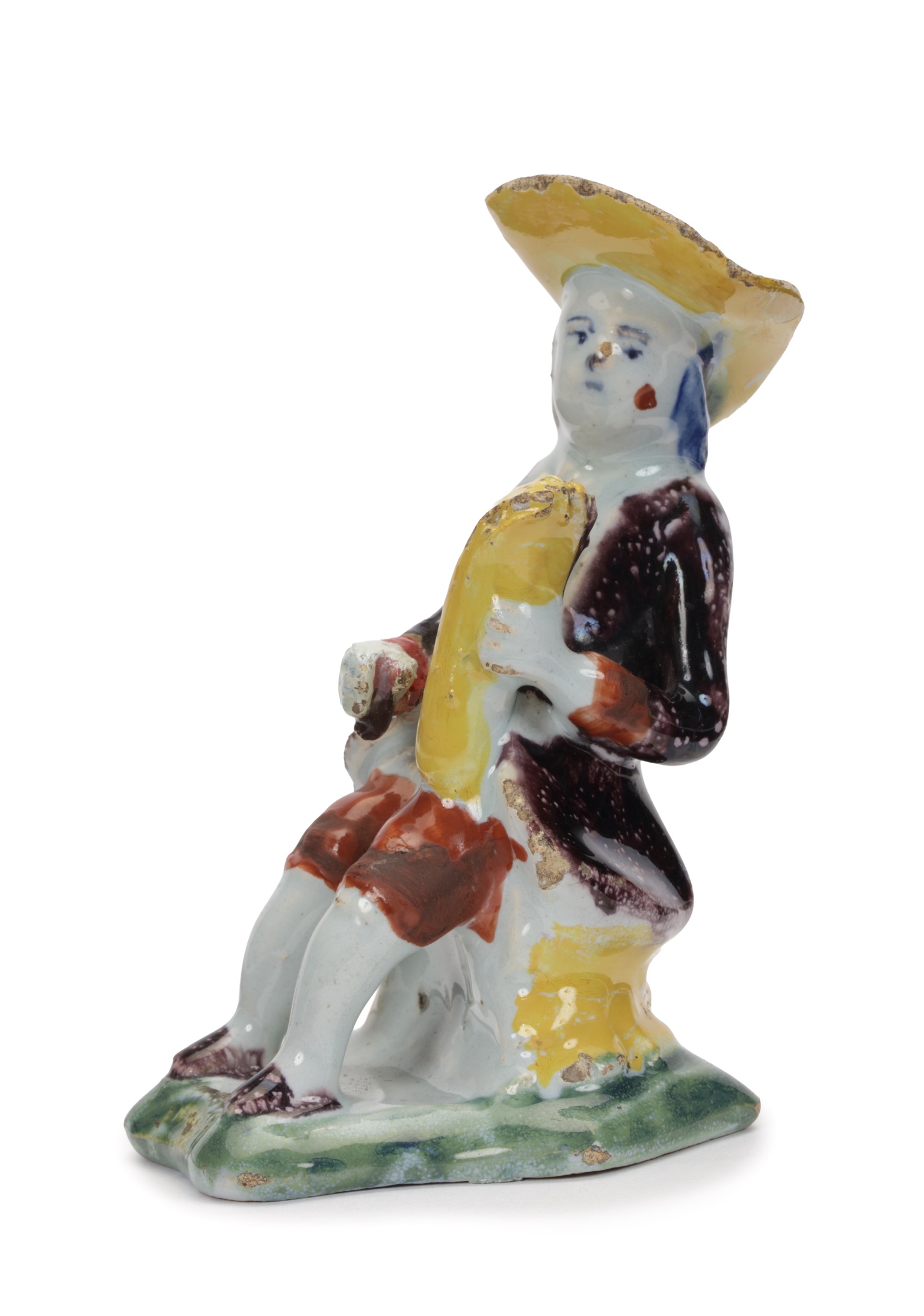
D2650. Figure of a Seated Man
Delft, circa 1760
DIMENSIONS
Height: 10.2 cm. (4 in.)
PROVENANCE
Dutch Private Collection;
Sold at Vendu Pulchri, Lot no. 561, November 1968
NOTE
This Delftware figure is part of a broader eighteenth-century interest in genre imagery, in which scenes drawn from everyday life were translated into decorative objects for the domestic interior. In the third quarter of the eighteenth century, Delft potters increasingly shifted away from Asian models and turned to European subjects, particularly those popularized by German porcelain manufactories such as Meissen. The present figure exemplifies this change in taste.
The sheaf of grain functions as a meaningful attribute, identifying the figure as a rural or agricultural type. In European visual culture, grain was associated with harvest, fertility, and abundance, and frequently appeared in representations of laborers and market figures. It could also allude more broadly to the allegory of Autumn, one of the Four Seasons, although in Delftware such references were typically suggestive rather than strictly codified.
Small genre figures of this kind were inspired by German porcelain models, themselves often based on printed sources. The influential Meissen Cris de Paris series, designed by Peter Reinicke in 1753 after drawings by Christoph Huet, provided important prototypes. Whereas porcelain figures tend to convey a refined elegance inherent to the medium, Delftware genre figures emphasize a more informal, folkloric character, marked by humor and immediacy.
The figure reflects the rococo aesthetic that spread across Europe during the reign of Louis XV. Although rococo was not a native Dutch style, its playful forms and decorative appeal were readily integrated into Dutch interiors. Displayed on mantelpieces, console tables, or in cabinets, figures such as this combined symbolic resonance with decorative charm, embodying a distinctly Dutch interpretation of contemporary European taste.
 CHINESE 阿伦森 WEBSITE