
Images on this website are licensed under a
Creative Commons Attribution-NoDerivs 3.0 Unported License.
OBJECT
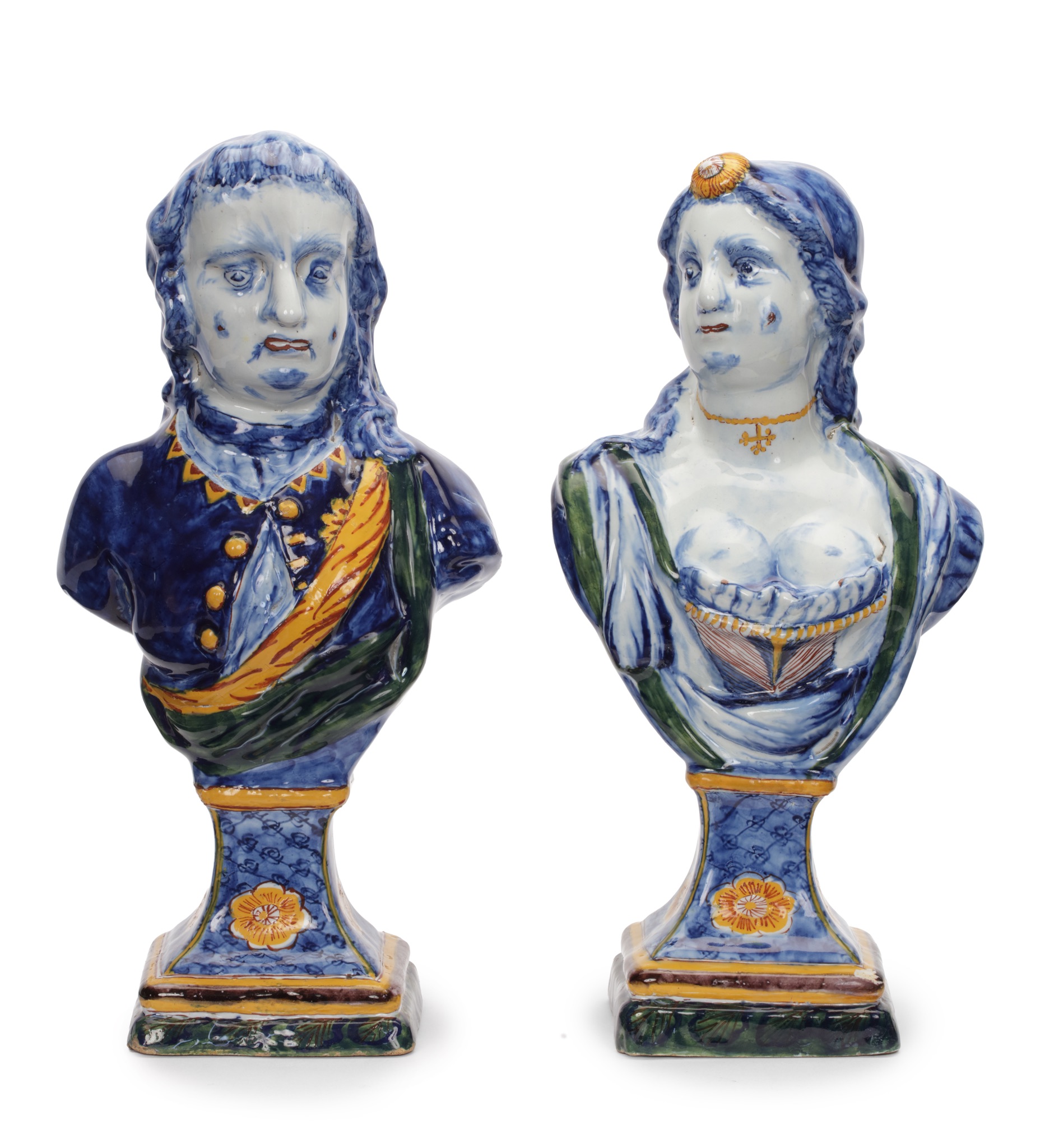
•D2645. Royal Busts
Delft, circa 1760
Each marked P:V:M / 6 in blue for Petrus van Marum, the owner of De Romeyn (The Roman) factory from 1754 to 1764
DIMENSIONS
Heights: 28.2 & 29 cm. (11.1 & 11.4 in.)
PROVENANCE
Private Collection region Antwerp, Belgium;
Mak van Waay, September 16, 1975, lot no. 167;
Collection Ween & Klepman, Amsterdam in 1929
LITERATURE
Catalogue of the ‘Vereeniging van Handelaren in de Oude Kunst (VHOK)’, Rijksmuseum, Amsterdam, 1929, p. 110 and depicted as no. 517.
NOTE
This pair of polychrome Delft busts represents Prince William IV of Orange-Nassau (1711–1751) and Princess Anna of Hanover (1709–1759), a prominent eighteenth-century ruling couple whose political and dynastic importance made them frequent subjects of portraiture. Delft busts of identifiable sitters are rare, underscoring the significance of this pair and the technical ambition of the potters who created them.
Prince William IV, born in Leeuwarden, became Stadtholder of Friesland, Groningen, and Drenthe at the age of three and, in 1747, was proclaimed hereditary Stadtholder of all seven provinces, uniting the Dutch Republic under a single hereditary leader for the first time. His efforts to centralize administration and reform governance met with resistance from entrenched provincial interests, yet his brief rule strengthened the long-term position of the House of Orange-Nassau.
William married Princess Anna of Hanover in 1734, daughter of King George II of Great Britain. Known in Dutch sources as Anna van Hannover, she brought strong dynastic ties and considerable intellectual influence. After William’s death in 1751, Anna served as regent for their son, the future William V, playing an active role in political decision-making, educational reform, and cultural patronage.
Depictions of the couple, including paintings, engravings, medallions, and rare Delftware busts such as the present examples, functioned as instruments of political representation. They emphasized William’s role as unifying stadtholder and Anna’s reputation as a capable and dignified regent. As such, this pair of busts offers both an expressive artistic portrayal and a material testament to their political and cultural significance in the eighteenth-century Dutch Republic.
 CHINESE 阿伦森 WEBSITE