

Images on this website are licensed under a
Creative Commons Attribution-NoDerivs 3.0 Unported License.
OBJECT
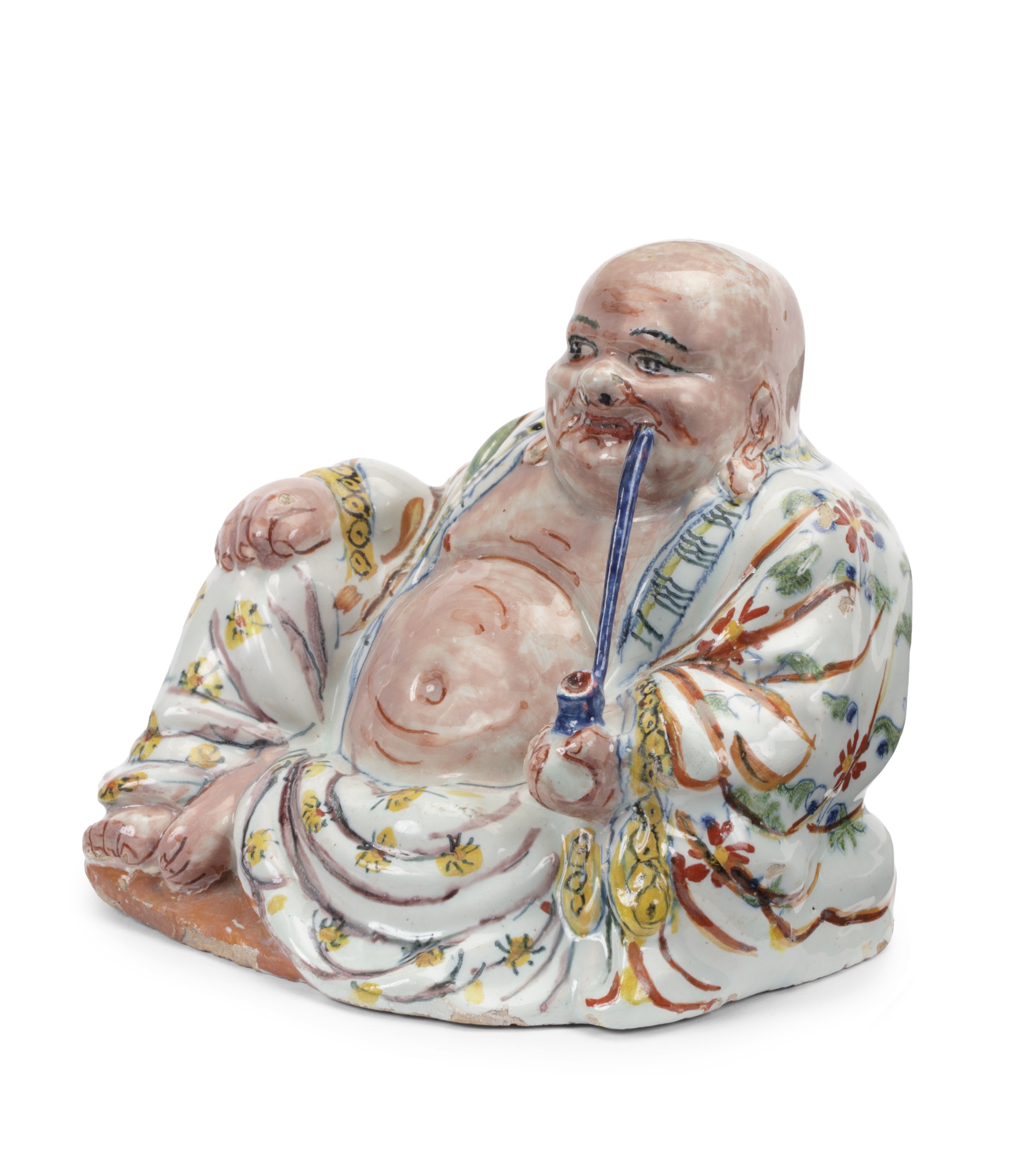
•D2636. Figure of a Budai Heshang
Delft, circa 1710
DIMENSIONS
Height: 14 cm. (5.1 in.)
PROVENANCE
Private Collection;
Aronson Antiquairs, Amsterdam;
Günther Grethe Collection, Hamburg
LITERATURE
Aronson 2004, p. 139, no. 161
NOTE
The Budai Heshang, often known in the West as the “Laughing Buddha,” is a well-loved figure in Chinese culture and Buddhism. Based on a semi-legendary monk of the late Tang or early Song dynasty, Budai’s name, meaning “cloth sack,” refers to the bag he carried, from which he distributed food and gifts to those in need. Regarded as a manifestation of Maitreya, the future Buddha, he embodies abundance, contentment, and generosity. His cheerful, corpulent form, with its prominently exposed belly, became a symbol of happiness and prosperity across East Asia, offering a relaxed, approachable counterpart to the more formal depictions of the Buddha.
From the late seventeenth century onward, European trade with China, particularly through the Dutch East India Company (VOC), brought Budai imagery into European decorative arts. Porcelain figures from Dehua, known as blanc de Chine, were shipped in large numbers to the Netherlands and England, where they inspired local ceramic production. Delft potters adapted the form, translating the serene white porcelain into their own tin-glazed earthenware, often enlivened with polychrome decoration. While retaining the essential elements of Budai’s Chinese iconography, seated posture, smiling face, ample belly, Delft versions incorporated Dutch decorative sensibilities, making the figure resonate with European collectors fascinated by “exotic” subjects.
The model for this Delft figure likely derives from a Dehua blanc de Chine seated Budai made between 1640 and 1680, a type that continued to be exported into the early eighteenth century. Less likely is influence from early Meissen porcelain Budai figures of circa 1712–1720, themselves based on the Chinese prototypes.
 CHINESE 阿伦森 WEBSITE