
Images on this website are licensed under a
Creative Commons Attribution-NoDerivs 3.0 Unported License.
OBJECT
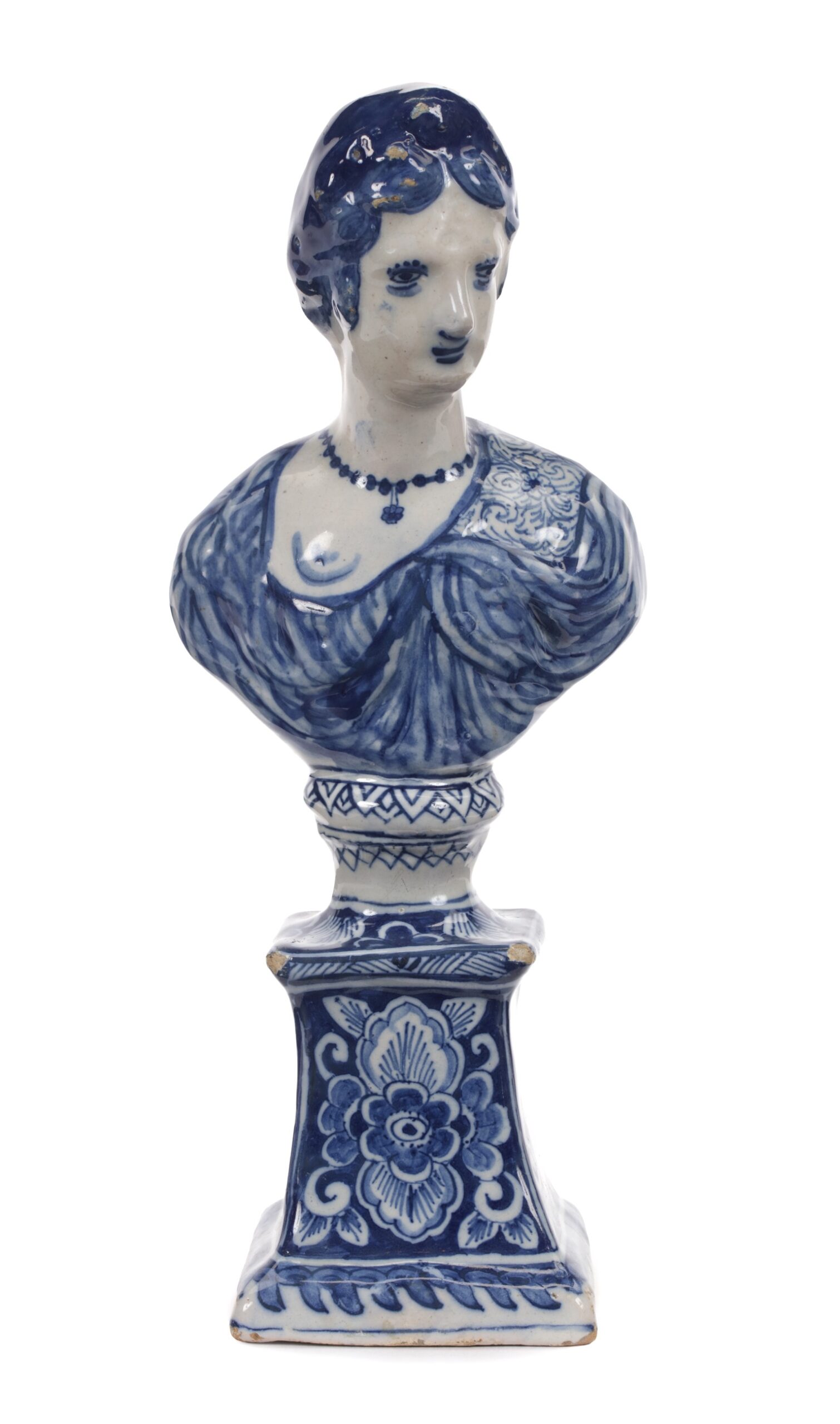
D2635. Bust of a Lady
Delft, circa 1710
Attributed to Lambertus van Eenhoorn, the owner of De Metaale Pot (The Metal Pot) factory from 1691 to 1721
DIMENSIONS
Height: 22 cm. (8.7 in.)
NOTE
This bust of a lady belongs to a small but significant group of figural Delftware sculptures that translate sculptural portrait traditions into tin-glazed earthenware. Modeled as a half-length female figure mounted on an integral pedestal, the bust reflects the growing ambition of Delft potters in the early eighteenth century to move beyond purely functional wares and into the realm of decorative sculpture.
The woman is depicted with softly modeled facial features, her head turned slightly to one side, and her hair arranged in loose curls gathered at the back, a coiffure consistent with contemporary European fashions around 1700. She wears a draped garment loosely crossing the chest, leaving the neckline exposed, and is adorned with a necklace and pendant, details that emphasize femininity, refinement, and social status rather than individual likeness.
While the bust has sometimes been interpreted as a portrait, it is more convincingly understood as an idealized or allegorical female figure rather than a depiction of a specific historical individual. Delft potters frequently drew inspiration from contemporary prints, sculptural models, and allegorical imagery circulating in Europe, particularly representations of classical goddesses, muses, or personifications of abstract virtues such as Beauty, Abundance, or Harmony. The generalized features and lack of identifying attributes argue against a precise portrait identification.
Busts like the present likely functioned as decorative objects intended for display on mantelpieces or cabinets, aligning with the period’s taste for sculptural accents within domestic interiors. Their form echoes contemporary stone or bronze busts, scaled down and adapted to ceramic production. In the broader context of Delftware, figural busts such as this one illustrate the intersection of ceramic art with sculpture, print culture, and interior decoration. They testify to the versatility of Delft workshops around 1710 and their engagement with international artistic trends, translating elite sculptural formats into a medium accessible to a wider, though still affluent, audience. Whether understood as an allegorical figure, or a generalized “lady of fashion,” this object exemplifies Delft’s capacity to merge painterly surface decoration with three-dimensional form in a manner both inventive and refined.
 CHINESE 阿伦森 WEBSITE