
Images on this website are licensed under a
Creative Commons Attribution-NoDerivs 3.0 Unported License.
OBJECT
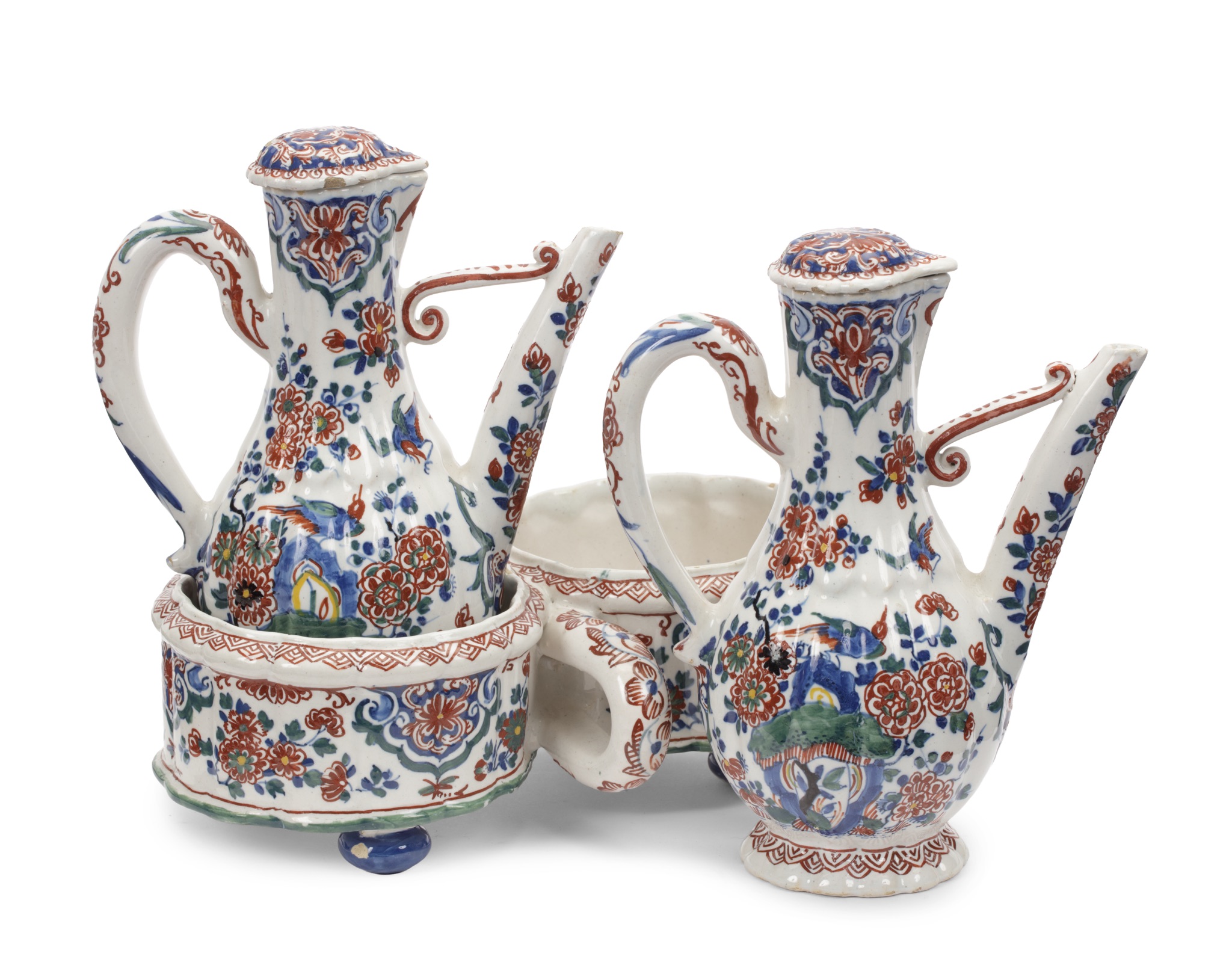
D2632. Cashmere Palette Cruet Set
Delft, circa 1710
DIMENSIONS
Overall height: 20.5 cm. (8.1 in.)
PROVENANCE
Dutch Private Collection, Maastricht;
Aronson Antiquairs, Amsterdam, 2022;
Private Collection;
Aronson Antiquairs, Amsterdam, 2000
LITERATURE
Aronson 2000, ill. 24; Aronson 2022, pp.44-45, no. 14
NOTE
This cruet set belongs to a category of refined dining wares that developed alongside the changing culture of the European table in the late seventeenth and early eighteenth centuries. By this time, formal dining had become an important social performance among the Dutch elite, and table furnishings were chosen to signal both wealth and cultivated taste. The term cruet is thought to derive either from the Old French crue (“earthen pot”) or from the Dutch kruicke, often spelled crewet. Sets containing oil (olie) and vinegar (azijn), as indicated by the letters on the ewer necks, allowed diners to season their food individually, reflecting a shift toward lighter, more nuanced flavors and contemporary ideas about the digestibility of vegetables.
The design of this set was likely inspired by contemporary silver models, a frequent source for high-quality Delftware. The paired ewers with narrow necks, loop handles, and curved spouts rest in a fitted stand with peg feet, echoing the elegance of precious metalwork. Its decoration is executed in the cashmere palette, with intricate iron-red, blue, green, and yellow enamels. The ewers are adorned with floral sprays, stylized rocks, and birds among foliage, while the stand and covers feature complementary lappets and scrolling motifs. The dense yet balanced ornament unifies the ensemble, making it as visually compelling as it is functional.
In its original setting, this cruet set would have been prominently displayed on the dining table, serving both practical and ceremonial roles. Its vivid polychromy, sophisticated composition, and allusions to abundance and refinement align with the broader use of Delftware as an artistic medium that paralleled, and at times rivaled, luxury imports and contemporary silverwork.
 CHINESE 阿伦森 WEBSITE